chapt 1.11 in clp_2 for UBC math 101 for MATH 101 A
This skill appears on:
Why Numerical Integration?
Some integrals can't be evaluated exactly — there's no antiderivative in terms of elementary functions. For example:
$$\int_0^1 e^{-x^2} \, dx$$
Even when we can find the antiderivative, numerical methods are often faster for getting a decimal answer. The three main methods we'll cover are:
- Midpoint Rule — rectangles using midpoints
- Trapezoidal Rule — trapezoids
- Simpson's Rule — parabolic arcs
All three methods work by dividing $[a, b]$ into $n$ equal subintervals of width:
$$\Delta x = \frac{b - a}{n}$$
![Subdivision diagram showing interval $[a,b]$ divided into $n$ subintervals with points $a = x_0, x_1, x_2, \ldots, x_{n-1}, x_n = b$](https://vapor-us-east-1-assets-1739470042.s3.amazonaws.com/uploads/ex170_figure_20251211221114.webp)
Subdivision diagram showing interval $[a,b]$ divided into $n$ subintervals with points $a = x_0, x_1, x_2, \ldots, x_{n-1}, x_n = b$
The Midpoint Rule
Use rectangles whose heights are the function values at the midpoint of each subinterval.
$$M_n = \Delta x \left[f(\bar{x}_1) + f(\bar{x}_2) + \cdots + f(\bar{x}_n)\right]$$
where $\bar{x}_i = \frac{x_{i-1} + x_i}{2}$ is the midpoint of the $i$-th subinterval.
In practice: The midpoints are at $a + \frac{\Delta x}{2}, a + \frac{3\Delta x}{2}, a + \frac{5\Delta x}{2}, \ldots$

Midpoint rectangle showing a single subinterval $[x_{j-1}, x_j]$ with rectangle height $f(\bar{x}_j) = f\left(\frac{x_{j-1}+x_j}{2}\right)$ at the midpoint
Problem: Use the Midpoint Rule with $n = 4$ to approximate $\displaystyle\int_0^2 x^2 \, dx$.
$$\Delta x = \frac{2 - 0}{4} = 0.5$$
The subintervals are $[0, 0.5], [0.5, 1], [1, 1.5], [1.5, 2]$.
Midpoints: $\bar{x}_1 = 0.25, \bar{x}_2 = 0.75, \bar{x}_3 = 1.25, \bar{x}_4 = 1.75$
$$M_4 = 0.5\left[f(0.25) + f(0.75) + f(1.25) + f(1.75)\right]$$
$$= 0.5\left[0.0625 + 0.5625 + 1.5625 + 3.0625\right]$$
$$= 0.5 \times 5.25 = 2.625$$
$$\boxed{M_4 = 2.625}$$
The Trapezoidal Rule
Use trapezoids instead of rectangles. Each trapezoid has parallel sides of heights $f(x_{i-1})$ and $f(x_i)$.
$$T_n = \frac{\Delta x}{2}\left[f(x_0) + 2f(x_1) + 2f(x_2) + \cdots + 2f(x_{n-1}) + f(x_n)\right]$$
Notice the pattern: First and last terms have coefficient 1, all middle terms have coefficient 2.
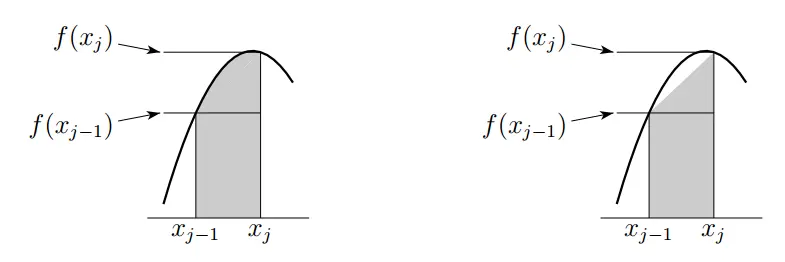
Trapezoid showing a single subinterval $[x_{j-1}, x_j]$ with heights $f(x_{j-1})$ and $f(x_j)$ at the endpoints
Problem: Use the Trapezoidal Rule with $n = 4$ to approximate $\displaystyle\int_0^2 x^2 \, dx$.
$$\Delta x = \frac{2 - 0}{4} = 0.5$$
The points are: $x_0 = 0, x_1 = 0.5, x_2 = 1, x_3 = 1.5, x_4 = 2$
$$T_4 = \frac{0.5}{2}\left[f(0) + 2f(0.5) + 2f(1) + 2f(1.5) + f(2)\right]$$
$$= 0.25\left[0 + 2(0.25) + 2(1) + 2(2.25) + 4\right]$$
$$= 0.25\left[0 + 0.5 + 2 + 4.5 + 4\right]$$
$$= 0.25 \times 11 = 2.75$$
$$\boxed{T_4 = 2.75}$$
Simpson's Rule
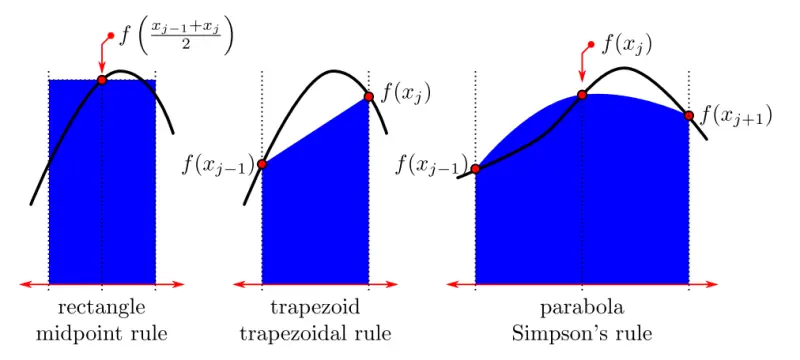
Simpson's Rule uses parabolic arcs instead of straight lines. It's generally the most accurate method.
$$S_n = \frac{\Delta x}{3}\left[f(x_0) + 4f(x_1) + 2f(x_2) + 4f(x_3) + 2f(x_4) + \cdots + 4f(x_{n-1}) + f(x_n)\right]$$
The pattern: Coefficients alternate 1, 4, 2, 4, 2, 4, ..., 4, 1
Important: Simpson's Rule requires $n$ to be even.

Problem: Use Simpson's Rule with $n = 4$ to approximate $\displaystyle\int_0^2 x^2 \, dx$.
$$\Delta x = \frac{2 - 0}{4} = 0.5$$
The points are: $x_0 = 0, x_1 = 0.5, x_2 = 1, x_3 = 1.5, x_4 = 2$
$$S_4 = \frac{0.5}{3}\left[f(0) + 4f(0.5) + 2f(1) + 4f(1.5) + f(2)\right]$$
$$= \frac{0.5}{3}\left[0 + 4(0.25) + 2(1) + 4(2.25) + 4\right]$$
$$= \frac{0.5}{3}\left[0 + 1 + 2 + 9 + 4\right]$$
$$= \frac{0.5}{3} \times 16 = \frac{8}{3} \approx 2.6667$$
$$\boxed{S_4 = \frac{8}{3} \approx 2.6667}$$
Comparing Results and Computing Error
The exact value is $\displaystyle\int_0^2 x^2 \, dx = \frac{x^3}{3}\Big|_0^2 = \frac{8}{3} \approx 2.6667$.
| Method | Approximation | Absolute Error |
|---|---|---|
| Midpoint | 2.625 | 0.0417 |
| Trapezoidal | 2.75 | 0.0833 |
| Simpson's | 2.6667 | 0 (exact!) |
Surprise: For polynomials of degree ≤ 3, Simpson's Rule gives the exact answer!
Types of Error
When $\alpha$ is an approximation to the true value $A$:
Absolute Error: $$|A - \alpha|$$
Relative Error: $$\frac{|A - \alpha|}{|A|}$$
Percentage Error: $$100 \times \frac{|A - \alpha|}{|A|}\%$$
Problem: The Trapezoidal Rule with $n = 4$ gives $T_4 = 2.75$ for $\displaystyle\int_0^2 x^2 \, dx$. The exact value is $\frac{8}{3}$. Find the absolute, relative, and percentage errors.
True value: $A = \frac{8}{3} \approx 2.6667$
Approximation: $\alpha = 2.75$
Absolute Error: $$|A - \alpha| = \left|\frac{8}{3} - 2.75\right| = \left|\frac{8}{3} - \frac{11}{4}\right| = \left|\frac{32 - 33}{12}\right| = \frac{1}{12} \approx 0.0833$$
Relative Error: $$\frac{|A - \alpha|}{|A|} = \frac{1/12}{8/3} = \frac{1}{12} \times \frac{3}{8} = \frac{3}{96} = \frac{1}{32} = 0.03125$$
Percentage Error: $$100 \times 0.03125 = 3.125\%$$
$$\boxed{\text{Absolute: } \frac{1}{12}, \quad \text{Relative: } \frac{1}{32}, \quad \text{Percentage: } 3.125\%}$$
Problem: Use Simpson's Rule with $n = 4$ to approximate $\displaystyle\int_0^1 e^{-x^2} \, dx$.
$$\Delta x = \frac{1 - 0}{4} = 0.25$$
Points: $x_0 = 0, x_1 = 0.25, x_2 = 0.5, x_3 = 0.75, x_4 = 1$
Compute function values:
- $f(0) = e^0 = 1$
- $f(0.25) = e^{-0.0625} \approx 0.9394$
- $f(0.5) = e^{-0.25} \approx 0.7788$
- $f(0.75) = e^{-0.5625} \approx 0.5698$
- $f(1) = e^{-1} \approx 0.3679$
$$S_4 = \frac{0.25}{3}\left[1 + 4(0.9394) + 2(0.7788) + 4(0.5698) + 0.3679\right]$$
$$= \frac{0.25}{3}\left[1 + 3.7576 + 1.5576 + 2.2792 + 0.3679\right]$$
$$= \frac{0.25}{3} \times 8.9623 \approx 0.7469$$
$$\boxed{S_4 \approx 0.7469}$$
(The actual value is approximately 0.7468, so Simpson's is very accurate even with just $n = 4$!)
Problem: Use the Trapezoidal Rule to estimate $\displaystyle\int_0^{1.2} f(x) \, dx$ using:
| $x$ | 0 | 0.3 | 0.6 | 0.9 | 1.2 |
|---|---|---|---|---|---|
| $f(x)$ | 2.0 | 2.4 | 2.9 | 3.1 | 3.0 |
$$\Delta x = 0.3, \quad n = 4$$
$$T_4 = \frac{0.3}{2}\left[2.0 + 2(2.4) + 2(2.9) + 2(3.1) + 3.0\right]$$
$$= 0.15\left[2.0 + 4.8 + 5.8 + 6.2 + 3.0\right]$$
$$= 0.15 \times 21.8 = 3.27$$
$$\boxed{T_4 = 3.27}$$
Quick Reference: Coefficient Patterns
| Method | Formula Prefix | Coefficient Pattern |
|---|---|---|
| Midpoint | $\Delta x$ | All 1's (at midpoints) |
| Trapezoidal | $\frac{\Delta x}{2}$ | 1, 2, 2, 2, ..., 2, 1 |
| Simpson's | $\frac{\Delta x}{3}$ | 1, 4, 2, 4, 2, ..., 4, 1 |
Common Mistakes and Misunderstandings
❌ Mistake: Using endpoints for Midpoint Rule
Wrong: Evaluating $f(x_0), f(x_1), \ldots, f(x_n)$ for the Midpoint Rule.
Why it's wrong: The Midpoint Rule uses the midpoints of each subinterval, not the endpoints.
Correct: Midpoints are at $\bar{x}_i = \frac{x_{i-1} + x_i}{2}$, or equivalently at $a + \frac{\Delta x}{2}, a + \frac{3\Delta x}{2}, \ldots$
❌ Mistake: Wrong coefficients in Trapezoidal Rule
Wrong: $T_n = \Delta x[f(x_0) + f(x_1) + \cdots + f(x_n)]$
Why it's wrong: This counts interior points twice (once for each adjacent trapezoid), so you must average by using $\frac{\Delta x}{2}$ and doubling interior terms.
Correct: $T_n = \frac{\Delta x}{2}[f(x_0) + 2f(x_1) + \cdots + 2f(x_{n-1}) + f(x_n)]$
❌ Mistake: Using odd $n$ for Simpson's Rule
Wrong: Applying Simpson's Rule with $n = 5$ subintervals.
Why it's wrong: Simpson's Rule fits parabolas through consecutive triples of points, which requires pairs of subintervals. So $n$ must be even.
Correct: Use $n = 4, 6, 8, \ldots$ for Simpson's Rule.
❌ Mistake: Confusing relative and percentage error
Wrong: Saying "the relative error is 3.125%"
Why it's wrong: Relative error is a decimal (like 0.03125). Percentage error is relative error × 100.
Correct: Relative error = 0.03125, Percentage error = 3.125%
Midpoint Rule
Approximates the integral using rectangles with heights at the midpoint of each subinterval.
Variables:
- $M_n$:
- midpoint approximation with n subintervals
- $Δx$:
- (b - a)/n, the width of each subinterval
- $x̄_i$:
- midpoint of the i-th subinterval
Trapezoidal Rule
Approximates the integral using trapezoids. Coefficients are 1, 2, 2, ..., 2, 1.
Variables:
- $T_n$:
- trapezoidal approximation with n subintervals
- $Δx$:
- (b - a)/n, the width of each subinterval
- $x_i$:
- the i-th endpoint, x_i = a + iΔx
Simpson's Rule
Approximates the integral using parabolic arcs. Requires n to be even. Coefficients alternate 1, 4, 2, 4, 2, ..., 4, 1.
Variables:
- $S_n$:
- Simpson's approximation with n subintervals
- $Δx$:
- (b - a)/n, the width of each subinterval
- $n$:
- must be even
Absolute Error
The absolute difference between the true value A and the approximation α.
Variables:
- $A$:
- true (exact) value
- $α$:
- approximation
Relative Error
The absolute error divided by the true value. Expresses error as a fraction of the true value.
Variables:
- $A$:
- true (exact) value
- $α$:
- approximation
Percentage Error
The relative error expressed as a percentage.
Variables:
- $A$:
- true (exact) value
- $α$:
- approximation
This skill is taught in the following courses. Create an account to access practice exercises and full course materials.