Newton’s Method for MATH 140
Exam Relevance for MATH 140
Newton's Method appears occasionally on MATH 140 finals. Know the iteration formula x_{n+1} = x_n - f(x_n)/f'(x_n).
What is Newton's Method?
Newton's Method (also called Newton-Raphson) is a technique for finding roots of equations — that is, finding where $f(x) = 0$.
Isaac Newton developed this iterative approach: start with a guess, then repeatedly improve it using calculus until you're close enough to the actual root.
The Big Idea: Use the tangent line at your current guess to find a better guess. Repeat until you converge to the root.
Why Do We Need This?
Some equations can't be solved algebraically. For example:
- $x^5 - x - 1 = 0$ — no formula exists for 5th-degree polynomials!
- $\cos(x) = x$ — mixing trig and polynomials
- $e^x = 3x$ — mixing exponentials and polynomials
Newton's Method gives us a way to find approximate solutions to any precision we want.
The Formula
Starting from an initial guess $x_0$, each new approximation is:
$$x_{n+1} = x_n - \frac{f(x_n)}{f'(x_n)}$$
What This Means
- Evaluate $f(x_n)$ — how far is your current guess from being a root?
- Evaluate $f'(x_n)$ — what's the slope of the tangent line there?
- Compute the ratio and subtract — this gives you the next (better) guess
Key Variables
- $x_n$ — your current approximation (the $n$-th guess)
- $x_{n+1}$ — your next approximation (hopefully closer to the root)
- $f(x_n)$ — the function value at your current guess
- $f'(x_n)$ — the derivative (slope) at your current guess
The Geometric Intuition
Here's what's actually happening:
- You're at a point $(x_n, f(x_n))$ on the curve
- Draw the tangent line at that point
- Find where the tangent line crosses the x-axis
- That x-intercept becomes your new guess $x_{n+1}$
The tangent line is a good local approximation of the curve, so its root is close to the curve's root!
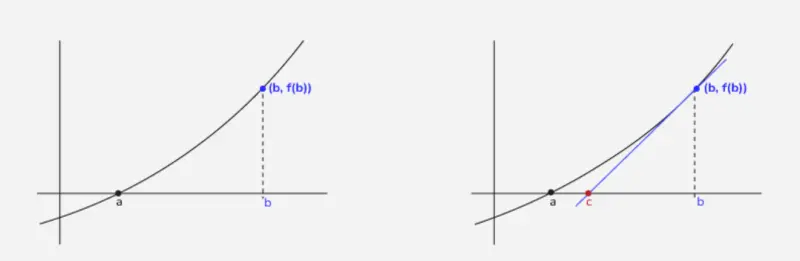
Starting from $x_0 = b$, watch how each tangent line leads us closer to the root $a$.
Use Newton's Method to approximate $\sqrt{2}$, starting with $x_0 = 1$.
Step 1: Set up the equation
We want $x = \sqrt{2}$, which means $x^2 = 2$, so $x^2 - 2 = 0$.
Let $f(x) = x^2 - 2$, so $f'(x) = 2x$.
Step 2: Write the iteration formula
$$x_{n+1} = x_n - \frac{x_n^2 - 2}{2x_n}$$
Step 3: Iterate!
$x_0 = 1$
$x_1 = 1 - \frac{1^2 - 2}{2(1)} = 1 - \frac{-1}{2} = 1.5$
$x_2 = 1.5 - \frac{1.5^2 - 2}{2(1.5)} = 1.5 - \frac{0.25}{3} = 1.5 - 0.0833... = 1.4167$
$x_3 = 1.4167 - \frac{1.4167^2 - 2}{2(1.4167)} \approx 1.4142$
After just 3 iterations, we have $\sqrt{2} \approx 1.4142$ (actual: $1.41421356...$)
$$\boxed{x_3 \approx 1.4142}$$
Find a solution to $\cos(x) = x$ using Newton's Method with $x_0 = 0.5$.
Step 1: Rewrite as $f(x) = 0$
$\cos(x) = x \implies \cos(x) - x = 0$
Let $f(x) = \cos(x) - x$, so $f'(x) = -\sin(x) - 1$.
Step 2: Write the iteration formula
$$x_{n+1} = x_n - \frac{\cos(x_n) - x_n}{-\sin(x_n) - 1}$$
Step 3: Iterate!
$x_0 = 0.5$
$f(0.5) = \cos(0.5) - 0.5 \approx 0.8776 - 0.5 = 0.3776$
$f'(0.5) = -\sin(0.5) - 1 \approx -0.4794 - 1 = -1.4794$
$x_1 = 0.5 - \frac{0.3776}{-1.4794} = 0.5 + 0.2552 = 0.7552$
$x_2 \approx 0.7391$
$x_3 \approx 0.7391$ (converged!)
$$\boxed{x \approx 0.7391}$$
This is the Dottie number — a fun mathematical constant!
Use Newton's Method to find a root of $f(x) = x^3 - 2x - 5$, starting with $x_0 = 2$.
Step 1: Find the derivative
$f(x) = x^3 - 2x - 5$
$f'(x) = 3x^2 - 2$
Step 2: Write the iteration formula
$$x_{n+1} = x_n - \frac{x_n^3 - 2x_n - 5}{3x_n^2 - 2}$$
Step 3: Iterate!
$x_0 = 2$
$f(2) = 8 - 4 - 5 = -1$
$f'(2) = 12 - 2 = 10$
$x_1 = 2 - \frac{-1}{10} = 2 + 0.1 = 2.1$
$x_2 = 2.1 - \frac{2.1^3 - 2(2.1) - 5}{3(2.1)^2 - 2} = 2.1 - \frac{0.061}{11.23} \approx 2.0946$
$x_3 \approx 2.0946$ (converged!)
$$\boxed{x \approx 2.0946}$$
Given $f(x) = e^x - 4x$ and $x_0 = 2$, find $x_1$ using Newton's Method.
Step 1: Find $f(x_0)$ and $f'(x_0)$
$f(x) = e^x - 4x \implies f'(x) = e^x - 4$
$f(2) = e^2 - 8 \approx 7.389 - 8 = -0.611$
$f'(2) = e^2 - 4 \approx 7.389 - 4 = 3.389$
Step 2: Apply the formula
$$x_1 = x_0 - \frac{f(x_0)}{f'(x_0)} = 2 - \frac{-0.611}{3.389} = 2 + 0.180 = 2.180$$
$$\boxed{x_1 \approx 2.180}$$
When Newton's Method Fails
Newton's Method doesn't always work! Watch out for:
-
Bad starting point — if $x_0$ is too far from the root, you might converge to a different root or not converge at all
-
Derivative is zero — if $f'(x_n) = 0$, you're dividing by zero!
-
Oscillation — sometimes the method bounces back and forth without converging
-
Divergence — the approximations can get further from the root instead of closer
Pro tip: Choose $x_0$ by sketching the graph or using a calculator to find roughly where the function crosses zero.
Tips for Newton's Method Problems
- Always find $f'(x)$ first — you'll need it for every iteration
- Set up the iteration formula before plugging in numbers
- Keep track of your iterations — organize as $x_0, x_1, x_2, ...$
- Watch for convergence — when successive values agree to the required decimal places, you're done
- Use a calculator — the arithmetic can get messy, and that's okay!
Common Mistakes and Misunderstandings
❌ Mistake: Forgetting the minus sign
Wrong: $x_{n+1} = x_n + \frac{f(x_n)}{f'(x_n)}$
Why it's wrong: The formula has a subtraction, not addition.
Correct: $x_{n+1} = x_n - \frac{f(x_n)}{f'(x_n)}$
❌ Mistake: Not rewriting the equation as $f(x) = 0$
Wrong: Using $f(x) = \cos(x)$ when solving $\cos(x) = x$.
Why it's wrong: Newton's Method finds roots (where $f(x) = 0$). You need $f(x) = \cos(x) - x$.
Correct: Rearrange to $\cos(x) - x = 0$, then use $f(x) = \cos(x) - x$.
❌ Mistake: Using the wrong derivative
Wrong: Forgetting chain rule or making arithmetic errors with $f'(x)$.
Why it's wrong: An incorrect derivative will give you wrong iterations.
Correct: Double-check your derivative before starting iterations.
Newton's Method Iteration
Starting from an initial guess x₀, each iteration uses the tangent line to find a better approximation of the root. Repeat until successive values agree to the desired precision.
Variables:
- $x_n$:
- Your current approximation (the n-th guess)
- $x_{n+1}$:
- Your next approximation (hopefully closer to the root)
- $f(x_n)$:
- The function value at your current guess
- $f'(x_n)$:
- The derivative (slope) at your current guess
This skill is taught in the following courses. Create an account to access practice exercises and full course materials.