Intermediate Value Theorem for MATH 140
Exam Relevance for MATH 140
IVT appears occasionally in MATH 140. Used to prove existence of roots—know the hypotheses (continuous on [a,b]).
This skill appears on:
What is the Intermediate Value Theorem?
The Intermediate Value Theorem (IVT) says that if a continuous function starts at one value and ends at another, it must hit every value in between at some point.
Intuitive idea: If you're at ground level and later you're on the 10th floor, you must have passed through floors 1, 2, 3, ... 9 at some point. You can't teleport!
The Formal Statement
Intermediate Value Theorem: If $f$ is continuous on $[a, b]$ and $N$ is any number between $f(a)$ and $f(b)$, then there exists at least one $c$ in $(a, b)$ such that $f(c) = N$.
In plain English:
- You have a continuous function on an interval $[a, b]$
- Pick any $y$-value $N$ between $f(a)$ and $f(b)$
- The theorem guarantees there's some $x = c$ where $f(c) = N$
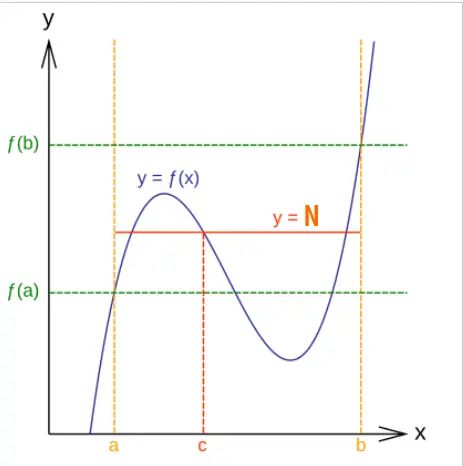
In this graph, notice how the continuous curve must cross the horizontal line $y = N$ at least once. The $x$-coordinate where this crossing happens is the value $c$ that the theorem guarantees exists.
Key Requirements
The IVT only works when both conditions are met:
| Condition | Why it matters |
|---|---|
| $f$ is continuous on $[a, b]$ | No jumps or holes—the function can be drawn without lifting your pen |
| $N$ is between $f(a)$ and $f(b)$ | The target value must be in the range the function covers |
⚠️ Critical: If the function has a discontinuity (jump, hole, or asymptote) in the interval, the IVT does not apply!
The Most Common Application: Proving a Root Exists
The IVT is most often used to prove that an equation $f(x) = 0$ has a solution in some interval.
Strategy:
- Find an interval $[a, b]$ where $f(a)$ and $f(b)$ have opposite signs
- Since $0$ is between a positive and negative number, IVT guarantees a root exists
Problem: Show that $f(x) = x^3 - x - 1$ has a root in the interval $[1, 2]$.
Step 1: Verify $f$ is continuous on $[1, 2]$.
$f(x) = x^3 - x - 1$ is a polynomial, so it's continuous everywhere. ✓
Step 2: Calculate $f(a)$ and $f(b)$.
$$f(1) = 1^3 - 1 - 1 = -1 \quad \text{(negative)}$$ $$f(2) = 2^3 - 2 - 1 = 5 \quad \text{(positive)}$$
Step 3: Apply IVT.
Since $f(1) = -1 < 0 < 5 = f(2)$, and $f$ is continuous on $[1, 2]$, the IVT guarantees there exists some $c \in (1, 2)$ such that $f(c) = 0$.
$$\boxed{\text{By IVT, } f(x) = x^3 - x - 1 \text{ has at least one root in } (1, 2)}$$
Problem: Show that $e^x = 3 - x$ has a solution.
Step 1: Rewrite as $f(x) = 0$.
Let $f(x) = e^x - (3 - x) = e^x + x - 3$
We need to find where $f(x) = 0$.
Step 2: Find values where $f$ changes sign.
Try $x = 0$: $$f(0) = e^0 + 0 - 3 = 1 - 3 = -2 \quad \text{(negative)}$$
Try $x = 1$: $$f(1) = e^1 + 1 - 3 = e - 2 \approx 2.718 - 2 = 0.718 \quad \text{(positive)}$$
Step 3: Apply IVT.
Since $f$ is continuous (it's $e^x$ plus a polynomial), and $f(0) < 0 < f(1)$, by IVT there exists $c \in (0, 1)$ such that $f(c) = 0$.
$$\boxed{\text{By IVT, } e^x = 3 - x \text{ has a solution in } (0, 1)}$$
Problem: Show that $f(x) = x^2$ takes the value $3$ somewhere in $[1, 2]$.
Step 1: Check continuity.
$f(x) = x^2$ is a polynomial, so it's continuous. ✓
Step 2: Calculate $f(1)$ and $f(2)$.
$$f(1) = 1 \quad \text{and} \quad f(2) = 4$$
Step 3: Is $N = 3$ between these values?
Yes! $1 < 3 < 4$ ✓
Step 4: Apply IVT.
By IVT, there exists $c \in (1, 2)$ such that $f(c) = 3$.
$$\boxed{\text{By IVT, } x^2 = 3 \text{ has a solution in } (1, 2)}$$
(We know this solution is $c = \sqrt{3} \approx 1.732$)
Problem: Does $f(x) = \frac{1}{x}$ have a value of $0$ in $[-1, 1]$?
Step 1: Check the conditions.
$f(-1) = -1$ and $f(1) = 1$
These have opposite signs, and $0$ is between them...
Step 2: BUT is $f$ continuous on $[-1, 1]$?
No! $f(x) = \frac{1}{x}$ has a vertical asymptote at $x = 0$. The function is discontinuous in this interval.
Conclusion: IVT does not apply. And indeed, $\frac{1}{x} = 0$ has no solution anywhere!
$$\boxed{\text{IVT cannot be applied—} f \text{ is not continuous on } [-1, 1]}$$
Common Mistakes and Misunderstandings
❌ Mistake: Applying IVT to discontinuous functions
Wrong: "Since $f(-1) = -1$ and $f(1) = 1$ for $f(x) = \frac{1}{x}$, there must be a root in $[-1, 1]$."
Why it's wrong: The IVT requires continuity on the entire interval. The discontinuity at $x = 0$ breaks the theorem's conditions.
Correct: First verify continuity, then apply IVT. If there's any discontinuity in $[a, b]$, IVT cannot be used.
❌ Mistake: Thinking IVT tells you exactly where the root is
Wrong: "By IVT, the root is at $c = 1.5$."
Why it's wrong: IVT is an existence theorem—it only tells you a root exists, not its exact value. To find the actual root, you need other methods (bisection, Newton's method, etc.).
Correct: "By IVT, a root exists in $(1, 2)$." (Don't claim to know the exact value unless you calculate it separately.)
❌ Mistake: Forgetting to check that $N$ is between $f(a)$ and $f(b)$
Wrong: Using IVT to claim $f(x) = x^2$ equals $10$ on $[0, 2]$.
Why it's wrong: $f(0) = 0$ and $f(2) = 4$, so the range is $[0, 4]$. The value $10$ is not between $0$ and $4$.
Correct: IVT only guarantees values between $f(a)$ and $f(b)$. Here, IVT can prove $f(x) = 3$ has a solution (since $0 < 3 < 4$), but not $f(x) = 10$.
Writing IVT Proofs on Exams
When asked to "use IVT to show..." follow this template:
- State that $f$ is continuous on $[a, b]$ (and why—polynomial, exponential, etc.)
- Calculate $f(a)$ and $f(b)$
- Note that $N$ (often $0$) is between them
- Conclude "By IVT, there exists $c \in (a, b)$ such that $f(c) = N$"
This structure earns full marks on most exams.
Intermediate Value Theorem
The IVT guarantees that a continuous function hits every y-value between f(a) and f(b) at least once. Most commonly used to prove roots exist.
Variables:
- $f$:
- a continuous function on [a, b]
- $a, b$:
- endpoints of the interval
- $N$:
- target y-value between f(a) and f(b)
- $c$:
- the x-value where f(c) = N (guaranteed to exist)
IVT for Root Existence
Special case: if f(a) and f(b) have opposite signs and f is continuous, there must be a root between them. This is the most common application of IVT.
Variables:
- $f(a)$:
- function value at left endpoint (negative)
- $f(b)$:
- function value at right endpoint (positive)
- $c$:
- location of the root
This skill is taught in the following courses. Create an account to access practice exercises and full course materials.