Practice Final #2

Full Course
McGill University, MATH 139

Exam Settings

Show Tags
Show Difficulty
Back to Course

Short Answer Questions

Short Answer
A1
Difficulty: 7/10
(Max Marks: 3)
Evaluate the following limit:
limt(t+4t1)t \lim_{t \to \infty} \left(\frac{t+4}{t-1}\right)^{t}

Exercise Tags

limits: general
Key Insight
limits: definition of exponential

Tag:

Use the tag filtering feature on the course homepage to find all exercises with this tag.

Prerequisites for this Exercise

No prerequisite skills selected yet.

Step 1: Analyze the limit and rewrite the base

First, notice that as tt \to \infty, the expression inside the parentheses approaches 1, while the exponent approaches \infty. This gives the indeterminate form 11^\infty, which often suggests that the limit involves the exponential function, ee. Our goal is to manipulate the expression to fit the standard form for the definition of ee. We can do this by rewriting the base, t+4t1\frac{t+4}{t-1}, into the form 1+something1 + \text{something}.

Step 2: Manipulate the expression to match the definition of e

By rewriting t+4t+4 as t1+5t-1+5, we can split the fraction. This isolates a '1' which is crucial for the next step.

limt(t+4t1)t=limt(t1+5t1)t=limt(t1t1+5t1)t=limt(1+5t1)t \begin{align*}
& \lim_{t \to \infty} \left(\frac{t+4}{t-1}\right)^{t} \\
&= \lim_{t \to \infty} \left(\frac{t-1+5}{t-1}\right)^{t} \\
&= \lim_{t \to \infty} \left(\frac{t-1}{t-1} + \frac{5}{t-1}\right)^{t} \\
&= \lim_{t \to \infty} \left(1 + \frac{5}{t-1}\right)^{t}
\end{align*}


The key formula to remember is the limit definition of the exponential function: limn(1+xn)n=ex \lim_{n \to \infty} \left(1 + \frac{x}{n}\right)^n = e^x . Our entire strategy is to make our limit look like this form.
Now that our limit looks very similar to the definition, we can use a substitution to make it match perfectly.

Step 3: Apply the substitution and evaluate the limit

Let n=t1n = t-1. As tt \to \infty, it's also true that nn \to \infty. From this substitution, we also have t=n+1t = n+1. After substituting, we can split the exponent using the property ab+c=abaca^{b+c} = a^b \cdot a^c. This allows us to separate the expression into two parts. The first part will match the definition of exe^x exactly, and the second part will be a simple limit to evaluate.

Let n=t1. As t,n.Also, t=n+1.limn(1+5n)n+1=limn[(1+5n)n(1+5n)1]=[limn(1+5n)n][limn(1+5n)]=(e5)(1+0)=e5 \begin{align*}
& \text{Let } n = t-1. \text{ As } t \to \infty, n \to \infty. \\
& \text{Also, } t = n+1. \\
& \lim_{n \to \infty} \left(1 + \frac{5}{n}\right)^{n+1} \\
&= \lim_{n \to \infty} \left[ \left(1 + \frac{5}{n}\right)^{n} \cdot \left(1 + \frac{5}{n}\right)^{1} \right] \\
&= \left[ \lim_{n \to \infty} \left(1 + \frac{5}{n}\right)^{n} \right] \cdot \left[ \lim_{n \to \infty} \left(1 + \frac{5}{n}\right) \right] \\
&= (e^5) \cdot (1+0) \\
&= \boxed{e^5}
\end{align*}


e5\boxed{e^5}
A2
Difficulty: 2/10
Let f(x)=3sin(x)cos(3x)f(x) = 3\sin(x) - \cos(3x). Then f(π4)f''(\frac{\pi}{4}) is ___.

Exercise Tags

taking derivatives
unit circle values

Tag:

Use the tag filtering feature on the course homepage to find all exercises with this tag.

Prerequisites for this Exercise

No prerequisite skills selected yet.

Step 1: Find the first derivative


We need to find f(x)f'(x) by taking the derivative of each term:

f(x)=3sin(x)cos(3x)f(x)=3cos(x)(sin(3x)3)f(x)=3cos(x)+3sin(3x) \begin{align*}
& f(x) = 3\sin(x) - \cos(3x) \\
& f'(x) = 3\cos(x) - (-\sin(3x) \cdot 3) \\
& f'(x) = 3\cos(x) + 3\sin(3x)
\end{align*}


Step 2: Find the second derivative


Now we take the derivative of f(x)f'(x) to find f(x)f''(x):


f(x)=3cos(x)+3sin(3x)f(x)=3(sin(x))+3(cos(3x)3)f(x)=3sin(x)+9cos(3x) \begin{align*}
& f'(x) = 3\cos(x) + 3\sin(3x) \\
& f''(x) = 3(-\sin(x)) + 3(\cos(3x) \cdot 3) \\
& f''(x) = -3\sin(x) + 9\cos(3x)
\end{align*}


When taking derivatives of trigonometric functions with coefficients in the argument, remember the chain rule: ddx[sin(ax)]=acos(ax)\frac{d}{dx}[\sin(ax)] = a\cos(ax) and ddx[cos(ax)]=asin(ax)\frac{d}{dx}[\cos(ax)] = -a\sin(ax).

Step 3: Evaluate at x = π/4


Now we substitute x=π4x = \frac{\pi}{4} into our expression for f(x)f''(x):

f(π4)=3sin(π4)+9cos(3π4)=322+9cos(3π4) \begin{align*}
& f''(\frac{\pi}{4}) \\
&= -3\sin(\frac{\pi}{4}) + 9\cos(3 \cdot \frac{\pi}{4}) \\
&= -3 \cdot \frac{\sqrt{2}}{2} + 9\cos(\frac{3\pi}{4})
\end{align*}


We know that:
- sin(π4)=22\sin(\frac{\pi}{4}) = \frac{\sqrt{2}}{2}
- cos(3π4)=22\cos(\frac{3\pi}{4}) = -\frac{\sqrt{2}}{2}

Therefore:

f(π4)=322+9(22)=322922=1222=62 \begin{align*}
& f''(\frac{\pi}{4}) \\
&= -3 \cdot \frac{\sqrt{2}}{2} + 9 \cdot (-\frac{\sqrt{2}}{2}) \\
&= -\frac{3\sqrt{2}}{2} - \frac{9\sqrt{2}}{2} \\
&= -\frac{12\sqrt{2}}{2} \\
&= -6\sqrt{2}
\end{align*}


Therefore:

f(π4)=62 \boxed{f''(\frac{\pi}{4}) = -6\sqrt{2}}
A3
Difficulty: 2/10
The maximum value attained by the function (x1)2x+2\frac{(x - 1)^2}{x + 2} on the interval [0,5][0, 5] is ___.

Exercise Tags

critical points
find critical numbers
maximizing and minimizing

Tag:

Use the tag filtering feature on the course homepage to find all exercises with this tag.

Prerequisites for this Exercise

No prerequisite skills selected yet.

Step 1: Recall the derivative we found earlier


We already found that:

f(x)=2(x1)(x+2)(x1)2(x+2)2=(x1)[2(x+2)(x1)](x+2)2=(x1)[2x+4x+1](x+2)2=(x1)(x+5)(x+2)2 \begin{align*}
& f'(x) \\
&= \frac{2(x - 1)(x + 2) - (x - 1)^2}{(x + 2)^2} \\
&= \frac{(x - 1)[2(x + 2) - (x - 1)]}{(x + 2)^2} \\
&= \frac{(x - 1)[2x + 4 - x + 1]}{(x + 2)^2} \\
&= \frac{(x - 1)(x + 5)}{(x + 2)^2}
\end{align*}


Step 2: Find critical points


Setting the derivative equal to zero:

(x1)(x+5)(x+2)2=0 \begin{align*}
& \frac{(x - 1)(x + 5)}{(x + 2)^2} = 0
\end{align*}


Since the denominator is never zero on our interval, we have:
(x1)(x+5)=0(x - 1)(x + 5) = 0

This gives us x=1x = 1 or x=5x = -5. Since 5-5 is outside our interval [0,5][0,5], we only consider x=1x = 1.

Step 3: Evaluate at endpoints and critical points


We need to check the function value at x=0x = 0, x=1x = 1, and x=5x = 5.

At x=0x = 0:

f(0)=(01)20+2=12=0.5 \begin{align*}
& f(0) \\
&= \frac{(0 - 1)^2}{0 + 2} \\
&= \frac{1}{2} \\
&= 0.5
\end{align*}


At x=1x = 1:

f(1)=(11)21+2=03=0 \begin{align*}
& f(1) \\
&= \frac{(1 - 1)^2}{1 + 2} \\
&= \frac{0}{3} \\
&= 0
\end{align*}


At x=5x = 5:

f(5)=(51)25+2=1672.29 \begin{align*}
& f(5) \\
&= \frac{(5 - 1)^2}{5 + 2} \\
&= \frac{16}{7} \\
&\approx 2.29
\end{align*}


Step 4: Determine the maximum value


Comparing all three values:
- f(0)=12=0.5f(0) = \frac{1}{2} = 0.5
- f(1)=0f(1) = 0
- f(5)=1672.29f(5) = \frac{16}{7} \approx 2.29

The maximum value is 167\frac{16}{7} which occurs at x=5x = 5.

Maximum value=167 \boxed{\text{Maximum value} = \frac{16}{7}}

For rational functions, the behavior may be very different on different intervals. Always check all critical points within the interval AND both endpoints!
Maximum value=167 \boxed{\text{Maximum value} = \frac{16}{7}}
A4
Difficulty: 4/10
The maximum value attained by the function (x1)2x+2\frac{(x - 1)^2}{x + 2} on the interval [8,4][-8, -4] is ___.

Exercise Tags

Extreme Value Theorem
critical points
find critical numbers
maximizing and minimizing

Tag:

Use the tag filtering feature on the course homepage to find all exercises with this tag.

Prerequisites for this Exercise

No prerequisite skills selected yet.

Step 1: Find the critical points


We already found the derivative of this function in our previous question:

dydx=2(x1)(x+2)(x1)2(x+2)2 \begin{align*}
& \frac{dy}{dx} \\
&= \frac{2(x - 1)(x + 2) - (x - 1)^2}{(x + 2)^2}
\end{align*}


To find critical points, we set this equal to zero:

2(x1)(x+2)(x1)2(x+2)2=0 \begin{align*}
& \frac{2(x - 1)(x + 2) - (x - 1)^2}{(x + 2)^2} = 0
\end{align*}


Since the denominator cannot be zero on our interval (as x+2>0x + 2 > 0 when x1.9x \geq -1.9), we only need:

2(x1)(x+2)(x1)2=0(x1)[2(x+2)(x1)]=0(x1)[2x+4x+1]=0(x1)[x+5]=0 \begin{align*}
& 2(x - 1)(x + 2) - (x - 1)^2 = 0 \\
&(x - 1)[2(x + 2) - (x - 1)] = 0 \\
&(x - 1)[2x + 4 - x + 1] = 0 \\
&(x - 1)[x + 5] = 0
\end{align*}


So x=1x = 1 or x=5x = -5 are our critical points.

Step 2: Check the interval endpoints


Our interval is [8,4][-8, -4], and we found one critical point at x=5x = -5 which is within this interval.

Extreme Value Theorem tells us that the maximum must occur either at a critical point within the interval or at an endpoint.

We need to evaluate the function at x=8x = -8, x=5x = -5, and x=4x = -4.

Step 3: Evaluate at x = -8


f(8)=(81)28+2=(9)26=816=13.5 \begin{align*}
& f(-8) \\
&= \frac{(-8 - 1)^2}{-8 + 2} \\
&= \frac{(-9)^2}{-6} \\
&= \frac{81}{-6} \\
&= -13.5
\end{align*}


Step 4: Evaluate at x = -5


f(5)=(51)25+2=(6)23=363=12 \begin{align*}
& f(-5) \\
&= \frac{(-5 - 1)^2}{-5 + 2} \\
&= \frac{(-6)^2}{-3} \\
&= \frac{36}{-3} \\
&= -12
\end{align*}


Step 5: Evaluate at x = -4


f(4)=(41)24+2=(5)22=252=12.5 \begin{align*}
& f(-4) \\
&= \frac{(-4 - 1)^2}{-4 + 2} \\
&= \frac{(-5)^2}{-2} \\
&= \frac{25}{-2} \\
&= -12.5
\end{align*}


When finding extreme values on a closed interval, always check both the critical points inside the interval AND the endpoint values!

Step 6: Compare all values


Comparing all three values:
- f(8)=13.5f(-8) = -13.5
- f(5)=12f(-5) = -12
- f(4)=12.5f(-4) = -12.5

The maximum value is 12-12 which occurs at x=5x = -5.

Maximum value=12 \boxed{\text{Maximum value} = -12}
A5
Difficulty: 1/10
Let f(x)=tan(x)x22x+5f(x) = \frac{\tan(x)}{x^2 - 2x + 5}. Find f(0)f'(0).

Exercise Tags

taking derivatives
differentiation: quotient rule

Tag:

Use the tag filtering feature on the course homepage to find all exercises with this tag.

Prerequisites for this Exercise

No prerequisite skills selected yet.

Let f(x)=tan(x)x22x+5f(x) = \frac{\tan(x)}{x^2 - 2x + 5}. Find f(0)f'(0).

Step 1: Identify the quotient rule


Since we have a fraction, we'll use the quotient rule.

If f(x)=g(x)h(x)f(x) = \frac{g(x)}{h(x)}, then:

f(x)=g(x)h(x)g(x)h(x)[h(x)]2 \begin{align*}
f'(x) = \frac{g'(x)h(x) - g(x)h'(x)}{[h(x)]^2}
\end{align*}


Step 2: Identify the numerator and denominator


Let's set:
- g(x)=tan(x)g(x) = \tan(x)
- h(x)=x22x+5h(x) = x^2 - 2x + 5

Step 3: Find the derivatives


g(x)=ddx[tan(x)]=sec2(x) \begin{align*}
& g'(x) = \frac{d}{dx}[\tan(x)] \\
&= \sec^2(x)
\end{align*}


h(x)=ddx[x22x+5]=2x2 \begin{align*}
& h'(x) = \frac{d}{dx}[x^2 - 2x + 5] \\
&= 2x - 2
\end{align*}


Step 4: Apply the quotient rule


f(x)=g(x)h(x)g(x)h(x)[h(x)]2=sec2(x)(x22x+5)tan(x)(2x2)(x22x+5)2 \begin{align*}
& f'(x) \\
&= \frac{g'(x)h(x) - g(x)h'(x)}{[h(x)]^2} \\
&= \frac{\sec^2(x)(x^2 - 2x + 5) - \tan(x)(2x - 2)}{(x^2 - 2x + 5)^2}
\end{align*}


When evaluating at x = 0, remember that tan(0)=0\tan(0) = 0 and sec2(0)=1\sec^2(0) = 1, which simplifies our work considerably!

Step 5: Evaluate at x = 0


At x=0x = 0:


f(0)=sec2(0)(022(0)+5)tan(0)(2(0)2)(022(0)+5)2=150(2)52=525=15 \begin{align*}
& f'(0) \\
&= \frac{\sec^2(0)(0^2 - 2(0) + 5) - \tan(0)(2(0) - 2)}{(0^2 - 2(0) + 5)^2} \\
&= \frac{1 \cdot 5 - 0 \cdot (-2)}{5^2} \\
&= \frac{5}{25} \\
&= \frac{1}{5}
\end{align*}


Therefore:

f(0)=15 \boxed{f'(0) = \frac{1}{5}}

Mcq Questions

MCQ
B1
Difficulty: 1/10
Find the equation for the tangent line y=mx+b y = mx + b to the graph of

f(x)=x21+x2f(x) = \frac{x^2}{1 + x^2}

at the point x=1 x = 1 .

What is b b ? (2.5 points)

(A) 0 0

(B) 1/2 1/2

(C) 1/2 -1/2

(D) 3/2 3/2

(E) None of the above \text{None of the above}

Exercise Tags

equation of tangent

Tag:

Use the tag filtering feature on the course homepage to find all exercises with this tag.

Prerequisites for this Exercise

No prerequisite skills selected yet.

PREMIUM WALKTHROUGH

Unlock Premium Content

Get instant access to detailed walkthroughs, step-by-step explanations, and exclusive learning materials.

Unlock Now
Secure & Instant Access
Step 1: Find the slope mm of the tangent line


We already know the derivative is:

f(x)=2x(1+x2)2
f'(x) = \frac{2x}{(1 + x^2)^2}


Evaluating it at x=1x = 1:

f(1)=2(1)(1+12)2=24=12
f'(1) = \frac{2(1)}{(1 + 1^2)^2} = \frac{2}{4} = \frac{1}{2}


So:

m=12
m = \frac{1}{2}


Step 2: Find the point on the curve at x=1x = 1


f(1)=121+12=12
f(1) = \frac{1^2}{1 + 1^2} = \frac{1}{2}


Thus, the point is:

(1,12)
(1, \frac{1}{2})


Step 3: Write the equation of the tangent line


The equation of the line is:

y=mx+b
y = mx + b


Substitute m=12m = \frac{1}{2} and (1,12)(1, \frac{1}{2}):

12=12(1)+b
\frac{1}{2} = \frac{1}{2}(1) + b


Simplify:

12=12+b
\frac{1}{2} = \frac{1}{2} + b


Solve for bb:

b=0
b = 0


Step 4: Final Answer


The yy-intercept is:

0
\boxed{0}


Thus, the correct answer is:

(A)0
\boxed{(A) \, 0}
PREMIUM SOLUTION

Unlock Premium Content

Get instant access to detailed solutions, step-by-step explanations, and exclusive learning materials.
Unlock Now
Secure & Instant Access
(A)0
\boxed{(A) \, 0}
B2
Difficulty: 1/10
Find the equation for the tangent line y=mx+b y = mx + b to the graph of

f(x)=x21+x2f(x) = \frac{x^2}{1 + x^2}

at the point x=1 x = 1 .

What is m m ? (2.5 points)

(A) 0 0

(B) 1/2 1/2

(C) 1/2 -1/2

(D) 3/2 3/2

(E) None of the above \text{None of the above}

Exercise Tags

differentiation: quotient rule
equation of tangent

Tag:

Use the tag filtering feature on the course homepage to find all exercises with this tag.

Prerequisites for this Exercise

No prerequisite skills selected yet.

PREMIUM WALKTHROUGH

Unlock Premium Content

Get instant access to detailed walkthroughs, step-by-step explanations, and exclusive learning materials.

Unlock Now
Secure & Instant Access
Step 1: Find the derivative f(x)f'(x)


We use the quotient rule to differentiate:

f(x)=x21+x2
f(x) = \frac{x^2}{1 + x^2}


The quotient rule states:

ddx(u(x)v(x))=u(x)v(x)u(x)v(x)(v(x))2
\frac{d}{dx} \left( \frac{u(x)}{v(x)} \right) = \frac{u'(x) v(x) - u(x) v'(x)}{(v(x))^2}


where u(x)=x2 u(x) = x^2 and v(x)=1+x2 v(x) = 1 + x^2 .

Step 2: Apply the quotient rule


u(x)=2x,v(x)=2x
u'(x) = 2x, \quad v'(x) = 2x


Now:

f(x)=(2x)(1+x2)(x2)(2x)(1+x2)2
f'(x) = \frac{(2x)(1 + x^2) - (x^2)(2x)}{(1 + x^2)^2}


Simplify:

(2x)(1+x2)(x2)(2x)=2x+2x32x3=2x
(2x)(1 + x^2) - (x^2)(2x) = 2x + 2x^3 - 2x^3 = 2x


Thus:

f(x)=2x(1+x2)2
f'(x) = \frac{2x}{(1 + x^2)^2}


Step 3: Evaluate the derivative at x=1x = 1


f(1)=2(1)(1+12)2=2(1+1)2=24=12
f'(1) = \frac{2(1)}{(1 + 1^2)^2} = \frac{2}{(1 + 1)^2} = \frac{2}{4} = \frac{1}{2}


Step 4: Final Answer


The slope of the tangent line at x=1x = 1 is:

12
\boxed{\frac{1}{2}}


Thus, the correct answer is:

(B)12
\boxed{(B) \, \frac{1}{2}}
PREMIUM SOLUTION

Unlock Premium Content

Get instant access to detailed solutions, step-by-step explanations, and exclusive learning materials.

Unlock Now
Secure & Instant Access
(B)12
\boxed{(B) \, \frac{1}{2}}
B3
Difficulty: 1/10
Let f(x)=(x+2)cosh(x) f(x) = (x + 2)^{\cosh(x)} . Find f(0) f'(0) .

(A) 3/2 3/2

(B) 1 1

(C) 0 0

(D) 2 2

(E) None of the above \text{None of the above}

Exercise Tags

inverse trig functions
differentiation: logarithmic

Tag:

Use the tag filtering feature on the course homepage to find all exercises with this tag.

Prerequisites for this Exercise

No prerequisite skills selected yet.

PREMIUM WALKTHROUGH

Unlock Premium Content

Get instant access to detailed walkthroughs, step-by-step explanations, and exclusive learning materials.

Unlock Now
Secure & Instant Access
Step 1: Take the derivative of f(x)=(x+2)cosh(x) f(x) = (x + 2)^{\cosh(x)}


We use logarithmic differentiation. Take the natural logarithm of both sides:

ln(f(x))=cosh(x)ln(x+2)
\ln(f(x)) = \cosh(x) \ln(x + 2)


Step 2: Differentiate both sides with respect to xx


Using the chain rule on the left side, the derivative of ln(f(x)) \ln(f(x)) is:

ddx(ln(f(x)))=f(x)f(x)
\frac{d}{dx} \left( \ln(f(x)) \right) = \frac{f'(x)}{f(x)}


This term f(x)f(x) \frac{f'(x)}{f(x)} comes from the **chain rule**. When differentiating ln(f(x)) \ln(f(x)) , we first take 1f(x) \frac{1}{f(x)} and then multiply by the derivative of the inner function f(x) f(x) , which gives:

ddx(ln(f(x)))=f(x)f(x)
\frac{d}{dx} \left( \ln(f(x)) \right) = \frac{f'(x)}{f(x)}


On the right side, we apply the **product rule**:

f(x)f(x)=sinh(x)ln(x+2)+cosh(x)1x+2
\frac{f'(x)}{f(x)} = \sinh(x) \ln(x + 2) + \cosh(x) \cdot \frac{1}{x + 2}


Step 3: Evaluate the derivative at x=0x = 0


We need to find f(0) f'(0) . Start by plugging in x=0x = 0 into the right side:

sinh(0)ln(2)+cosh(0)12
\sinh(0) \ln(2) + \cosh(0) \cdot \frac{1}{2}


Since:

sinh(0)=0andcosh(0)=1
\sinh(0) = 0 \quad \text{and} \quad \cosh(0) = 1


This simplifies to:

0ln(2)+112=12
0 \cdot \ln(2) + 1 \cdot \frac{1}{2} = \frac{1}{2}


Step 4: Solve for f(0) f'(0)


Now, multiply both sides by f(0) f(0) . At x=0x = 0, we have:

f(0)=(0+2)cosh(0)=21=2
f(0) = (0 + 2)^{\cosh(0)} = 2^1 = 2


Thus:

f(0)=212=1
f'(0) = 2 \cdot \frac{1}{2} = 1


Step 5: Final Answer


The value of f(0) f'(0) is:

1
\boxed{1}


Thus, the correct answer is:

(B)1
\boxed{(B) \, 1}
PREMIUM SOLUTION

Unlock Premium Content

Get instant access to detailed solutions, step-by-step explanations, and exclusive learning materials.

Unlock Now
Secure & Instant Access
(B)1
\boxed{(B) \, 1}
B4
Difficulty: 1/10
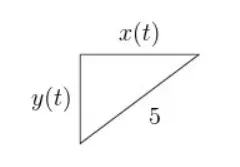
A right-angled triangle is transforming in such a way that the length of the hypotenuse is always 5 cm long.


right triangle

Figure: right triangle


What is the ratio y/x y'/x' when x=4 x = 4 ? Assume that x x' is non-zero.

(A) 4/3 -4/3

(B) 3/4 -3/4

(C) 4/3 4/3

(D) 3/5 -3/5

(E) None of the above \text{None of the above}

Exercise Tags

implicit differentiation
relates rates

Tag:

Use the tag filtering feature on the course homepage to find all exercises with this tag.

Prerequisites for this Exercise

No prerequisite skills selected yet.

PREMIUM WALKTHROUGH

Unlock Premium Content

Get instant access to detailed walkthroughs, step-by-step explanations, and exclusive learning materials.

Unlock Now
Secure & Instant Access
Step 1: Set up the right triangle relationship


We are given a right-angled triangle with a hypotenuse that is always 5 cm long. The sides are xx, yy, and the hypotenuse is 55. So the Pythagorean theorem gives:

x2+y2=52=25
x^2 + y^2 = 5^2 = 25


Step 2: Differentiate both sides implicitly with respect to time tt


2xdxdt+2ydydt=0
2x \frac{dx}{dt} + 2y \frac{dy}{dt} = 0


Simplify:

xdxdt+ydydt=0
x \frac{dx}{dt} + y \frac{dy}{dt} = 0


Step 3: Solve for dydt \frac{dy}{dt} in terms of dxdt \frac{dx}{dt}


ydydt=xdxdt
y \frac{dy}{dt} = -x \frac{dx}{dt}


Divide both sides by x0x' \neq 0:

dydt=xydxdt
\frac{dy}{dt} = -\frac{x}{y} \frac{dx}{dt}


Thus:

yx=xy
\frac{y'}{x'} = -\frac{x}{y}


Step 4: Evaluate at x=4x = 4


Using the Pythagorean theorem:

42+y2=2516+y2=25y2=9y=3
4^2 + y^2 = 25 \quad \Rightarrow \quad 16 + y^2 = 25 \quad \Rightarrow \quad y^2 = 9 \quad \Rightarrow \quad y = 3


Step 5: Find the ratio yx \frac{y'}{x'}


yx=xy=43
\frac{y'}{x'} = -\frac{x}{y} = -\frac{4}{3}


Step 6: Final Answer


The ratio yx \frac{y'}{x'} when x=4x = 4 is:

43
\boxed{-\frac{4}{3}}


Thus, the correct answer is:

(A)43
\boxed{(A) \, -\frac{4}{3}}
PREMIUM SOLUTION

Unlock Premium Content

Get instant access to detailed solutions, step-by-step explanations, and exclusive learning materials.

Unlock Now
Secure & Instant Access
(A)43
\boxed{(A) \, -\frac{4}{3}}
B5
Difficulty: 1/10
What are the xx coordinates of the points on the parabola x=4y2x = 4 - y^2 which are closest to the origin?

(A) 1/2 1/2

(B) 0 0

(C) 1/2 -1/2

(D) 4 4

(E) None of the above \text{None of the above}

Exercise Tags

optimization
distance formula

Tag:

Use the tag filtering feature on the course homepage to find all exercises with this tag.

Prerequisites for this Exercise

No prerequisite skills selected yet.

PREMIUM WALKTHROUGH

Unlock Premium Content

Get instant access to detailed walkthroughs, step-by-step explanations, and exclusive learning materials.

Unlock Now
Secure & Instant Access
Step 1: Set up the distance formula


The distance dd from any point (x,y)(x, y) on the parabola to the origin is:

d=x2+y2
d = \sqrt{x^2 + y^2}


We want to minimize this distance. Since minimizing the square of the distance is easier, we’ll minimize:

d2=x2+y2
d^2 = x^2 + y^2


Step 2: Substitute x=4y2x = 4 - y^2 into the distance function


d2=(4y2)2+y2
d^2 = (4 - y^2)^2 + y^2


Step 3: Expand the equation


d2=168y2+y4+y2=y47y2+16
d^2 = 16 - 8y^2 + y^4 + y^2 = y^4 - 7y^2 + 16


Step 4: Minimize the function


Take the derivative of y47y2+16y^4 - 7y^2 + 16 and set it to 0:

ddy(y47y2+16)=4y314y
\frac{d}{dy}(y^4 - 7y^2 + 16) = 4y^3 - 14y


Set the derivative equal to 0:

4y314y=0
4y^3 - 14y = 0


Factor out 2y2y:

2y(2y27)=0
2y(2y^2 - 7) = 0


Solutions:

y=0ory=±72
y = 0 \quad \text{or} \quad y = \pm \sqrt{\frac{7}{2}}


Step 5: Find the corresponding xx-coordinates


For y=0y = 0:

x=4
x = 4


For y=±7/2y = \pm \sqrt{7/2}:

x=472=12
x = 4 - \frac{7}{2} = \frac{1}{2}


Step 6: Final Answer


The xx-coordinates closest to the origin are:

x=4andx=12
x = 4 \quad \text{and} \quad x = \frac{1}{2}


Thus, the correct answer is:

(A)12
\boxed{(A) \, \frac{1}{2}}
PREMIUM SOLUTION

Unlock Premium Content

Get instant access to detailed solutions, step-by-step explanations, and exclusive learning materials.

Unlock Now
Secure & Instant Access
(A)12
\boxed{(A) \, \frac{1}{2}}

Long Answer Questions

Long Answer
C1
Difficulty: 10/10
Find limy0+[cos(2y)]1/y2\lim_{y \to 0^+} [\cos(2y)]^{1/y^2}.

Exercise Tags

limits: general
limits: with logarithms

Tag:

Use the tag filtering feature on the course homepage to find all exercises with this tag.

Prerequisites for this Exercise

No prerequisite skills selected yet.

Step 1: Identify the indeterminate form


Let's check what happens when we try to evaluate the limit directly:

limy0+[cos(2y)]1/y2 \lim_{y \to 0^+} [\cos(2y)]^{1/y^2}

As y0+y \to 0^+:
- cos(2y)cos(0)=1\cos(2y) \to \cos(0) = 1
- 1/y21/y^2 \to \infty

So we have the indeterminate form 11^{\infty}, which we can't evaluate directly.

Step 2: Transform the expression using logarithms


To handle this indeterminate form, I'll define:

L=limy0+[cos(2y)]1/y2 L = \lim_{y \to 0^+} [\cos(2y)]^{1/y^2}

Taking the natural logarithm of both sides:

ln(L)=ln(limy0+[cos(2y)]1/y2) \ln(L) = \ln\left(\lim_{y \to 0^+} [\cos(2y)]^{1/y^2}\right)

ln(L)=limy0+ln([cos(2y)]1/y2) \ln(L) = \lim_{y \to 0^+} \ln\left([\cos(2y)]^{1/y^2}\right)

Using the property of logarithms:

ln(L)=limy0+1y2ln[cos(2y)] \ln(L) = \lim_{y \to 0^+} \frac{1}{y^2} \ln[\cos(2y)]

ln(L)=limy0+ln[cos(2y)]y2 \ln(L) = \lim_{y \to 0^+} \frac{\ln[\cos(2y)]}{y^2}

Step 3: Apply L'Hôpital's Rule to the transformed expression


Now we need to evaluate:

limy0+ln[cos(2y)]y2 \lim_{y \to 0^+} \frac{\ln[\cos(2y)]}{y^2}

As y0+y \to 0^+:
- ln[cos(2y)]ln(1)=0\ln[\cos(2y)] \to \ln(1) = 0
- y20y^2 \to 0

So we have the indeterminate form 00\frac{0}{0}, which means we can apply L'Hôpital's Rule.

Finding the derivatives:

ddy[ln(cos(2y))]=1cos(2y)(sin(2y)2) \frac{d}{dy}[\ln(\cos(2y))] = \frac{1}{\cos(2y)} \cdot (-\sin(2y) \cdot 2)


ddy[ln(cos(2y))]=2sin(2y)cos(2y) \frac{d}{dy}[\ln(\cos(2y))] = \frac{-2\sin(2y)}{\cos(2y)}

ddy[ln(cos(2y))]=2tan(2y) \frac{d}{dy}[\ln(\cos(2y))] = -2\tan(2y)

ddy[y2]=2y \frac{d}{dy}[y^2] = 2y

Applying L'Hôpital's Rule:

limy0+ln[cos(2y)]y2=limy0+2tan(2y)2y \lim_{y \to 0^+} \frac{\ln[\cos(2y)]}{y^2} = \lim_{y \to 0^+} \frac{-2\tan(2y)}{2y}

limy0+ln[cos(2y)]y2=limy0+tan(2y)y \lim_{y \to 0^+} \frac{\ln[\cos(2y)]}{y^2} = \lim_{y \to 0^+} \frac{-\tan(2y)}{y}

Step 4: Apply L'Hôpital's Rule a second time


For this new limit:

limy0+tan(2y)y \lim_{y \to 0^+} \frac{-\tan(2y)}{y}

As y0+y \to 0^+:
- tan(2y)tan(0)=0\tan(2y) \to \tan(0) = 0
- y0y \to 0

We again have the indeterminate form 00\frac{0}{0}, so we apply L'Hôpital's Rule again.

Finding the derivatives:

ddy[tan(2y)]=sec2(2y)2 \frac{d}{dy}[-\tan(2y)] = -\sec^2(2y) \cdot 2

ddy[tan(2y)]=2sec2(2y) \frac{d}{dy}[-\tan(2y)] = -2\sec^2(2y)

ddy[y]=1 \frac{d}{dy}[y] = 1

Applying L'Hôpital's Rule:

limy0+tan(2y)y=limy0+2sec2(2y)1 \lim_{y \to 0^+} \frac{-\tan(2y)}{y} = \lim_{y \to 0^+} \frac{-2\sec^2(2y)}{1}

limy0+tan(2y)y=limy0+2sec2(2y) \lim_{y \to 0^+} \frac{-\tan(2y)}{y} = \lim_{y \to 0^+} -2\sec^2(2y)

As y0+y \to 0^+:
- sec2(2y)sec2(0)=1\sec^2(2y) \to \sec^2(0) = 1

So:

limy0+2sec2(2y)=21=2 \lim_{y \to 0^+} -2\sec^2(2y) = -2 \cdot 1 = -2

Step 5: Find the original limit


We found that ln(L)=2\ln(L) = -2, so:

L=e2 L = e^{-2}

For indeterminate forms like 11^{\infty}, always try the strategy of taking the natural logarithm first, then applying L'Hôpital's Rule to the resulting expression.

Therefore:
limy0+[cos(2y)]1/y2=e2
\boxed{\lim_{y \to 0^+} [\cos(2y)]^{1/y^2} = e^{-2}}
limy0+[cos(2y)]1/y2=e2
\boxed{\lim_{y \to 0^+} [\cos(2y)]^{1/y^2} = e^{-2}}
C2
Difficulty: 5/10
Find the first derivative and second derivative of the function

f(x)=(x24x+4)ex.f(x) = (x^2 - 4x + 4)e^x.

Determine where the function is increasing and decreasing.

Determine where the function is concave up and concave down.

Exercise Tags

concavity
concavity tables
Intervals of Increase and Decrease

Tag:

Use the tag filtering feature on the course homepage to find all exercises with this tag.

Prerequisites for this Exercise

No prerequisite skills selected yet.

Step 1: Find the first derivative


Let's work with the function: f(x)=(x24x+4)exf(x) = (x^2 - 4x + 4)e^x

To find the first derivative, I'll use the product rule: (uv)=uv+uv(u \cdot v)' = u' \cdot v + u \cdot v'

Where:
- u=x24x+4u = x^2 - 4x + 4
- v=exv = e^x

First, I'll find uu':
u=(x24x+4)=2x4 \begin{align*}
u' &= (x^2 - 4x + 4)' \\
&= 2x - 4
\end{align*}


Now applying the product rule:
f(x)=(2x4)ex+(x24x+4)ex=(2x4+x24x+4)ex=(x22x)ex=x(x2)ex \begin{align*}
f'(x) &= (2x - 4)e^x + (x^2 - 4x + 4)e^x \\
&= (2x - 4 + x^2 - 4x + 4)e^x \\
&= (x^2 - 2x)e^x \\
&= x(x-2)e^x
\end{align*}


Step 2: Find the second derivative


For the second derivative, I'll apply the product rule again to f(x)=x(x2)exf'(x) = x(x-2)e^x

Where:
- u=x(x2)u = x(x-2)
- v=exv = e^x

First, I'll find uu':
u=(x(x2))=(x2)+x1=2x2 \begin{align*}
u' &= (x(x-2))' \\
&= (x-2) + x \cdot 1 \\
&= 2x - 2
\end{align*}


Now applying the product rule:
f(x)=(2x2)ex+x(x2)ex=(2x2+x22x)ex=(x22)ex \begin{align*}
f''(x) &= (2x - 2)e^x + x(x-2)e^x \\
&= (2x - 2 + x^2 - 2x)e^x \\
&= (x^2 - 2)e^x
\end{align*}


Step 3: Determine where the function is increasing and decreasing


A function is increasing when f(x)>0f'(x) > 0 and decreasing when f(x)<0f'(x) < 0.

Let's find where f(x)=0f'(x) = 0:
f(x)=x(x2)ex=0 \begin{align*}
f'(x) &= x(x-2)e^x = 0
\end{align*}


Since ex>0e^x > 0 for all xx, we need to solve:
x(x2)=0 \begin{align*}
x(x-2) &= 0
\end{align*}


This gives us x=0x = 0 or x=2x = 2

When analyzing where a function is increasing or decreasing, focus on where the first derivative changes sign.

Testing regions:
- For x<0x < 0: x<0x < 0 and x2<0x-2 < 0, so x(x2)>0x(x-2) > 0, meaning f(x)>0f'(x) > 0
- For 0<x<20 < x < 2: x>0x > 0 and x2<0x-2 < 0, so x(x2)<0x(x-2) < 0, meaning f(x)<0f'(x) < 0
- For x>2x > 2: x>0x > 0 and x2>0x-2 > 0, so x(x2)>0x(x-2) > 0, meaning f(x)>0f'(x) > 0

Therefore:
- ff is increasing for x<0x < 0
- ff is decreasing for 0<x<20 < x < 2
- ff is increasing for x>2x > 2

Step 4: Determine where the function is concave up and concave down


A function is concave up when f(x)>0f''(x) > 0 and concave down when f(x)<0f''(x) < 0.

From our second derivative:
f(x)=(x22)ex \begin{align*}
f''(x) = (x^2 - 2)e^x
\end{align*}


Since ex>0e^x > 0 for all xx, we need to solve x22=0x^2 - 2 = 0:
x2=2x=±2 \begin{align*}
x^2 &= 2 \\
x &= \pm \sqrt{2}
\end{align*}


Testing regions:
- For x<2x < -\sqrt{2}: x2>2x^2 > 2, so f(x)>0f''(x) > 0
- For 2<x<2-\sqrt{2} < x < \sqrt{2}: x2<2x^2 < 2, so f(x)<0f''(x) < 0
- For x>2x > \sqrt{2}: x2>2x^2 > 2, so f(x)>0f''(x) > 0

Therefore:
- ff is concave up for x<2x < -\sqrt{2}
- ff is concave down for 2<x<2-\sqrt{2} < x < \sqrt{2}
- ff is concave up for x>2x > \sqrt{2}

Final Answer

f(x)=x(x2)ex
\boxed{f'(x) = x(x-2)e^x}

f(x)=(x22)ex
\boxed{f''(x) = (x^2 - 2)e^x}

Increasing: x<0 or x>2Decreasing: 0<x<2
\boxed{\begin{align*}
&\text{Increasing: } x < 0 \text{ or } x > 2\\
&\text{Decreasing: } 0 < x < 2
\end{align*}}

Concave up: x<2 or x>2Concave down: 2<x<2
\boxed{\begin{align*}
&\text{Concave up: } x < -\sqrt{2} \text{ or } x > \sqrt{2}\\
&\text{Concave down: } -\sqrt{2} < x < \sqrt{2}
\end{align*}}
f(x)=x(x2)ex
\boxed{f'(x) = x(x-2)e^x}

f(x)=(x22)ex
\boxed{f''(x) = (x^2 - 2)e^x}

Increasing: x<0 or x>2Decreasing: 0<x<2
\boxed{\begin{align*}
&\text{Increasing: } x < 0 \text{ or } x > 2\\
&\text{Decreasing: } 0 < x < 2
\end{align*}}

Concave up: x<2 or x>2Concave down: 2<x<2
\boxed{\begin{align*}
&\text{Concave up: } x < -\sqrt{2} \text{ or } x > \sqrt{2}\\
&\text{Concave down: } -\sqrt{2} < x < \sqrt{2}
\end{align*}}
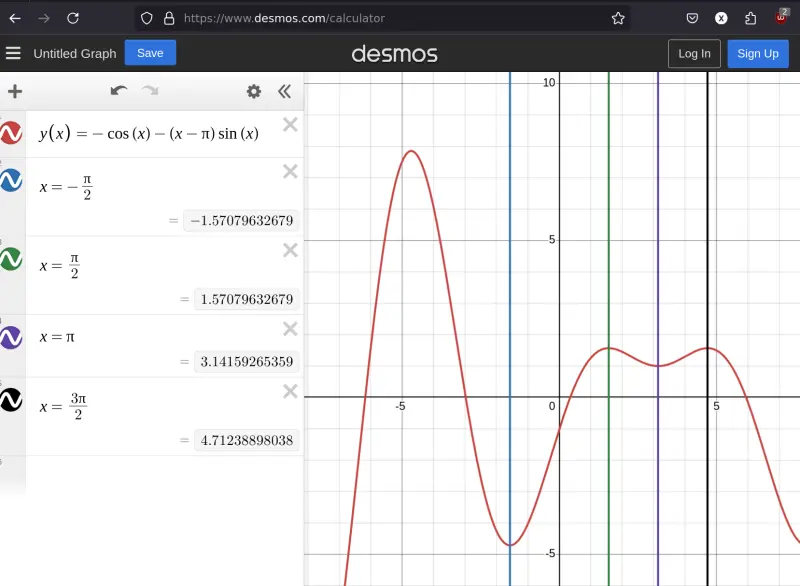
C3
Difficulty: 6/10
Find all critical points of the function f(x)=cos(x)(xπ)sin(x)f(x) = -\cos(x) - (x - \pi)\sin(x) in the interval 3π2<x<5π2-\frac{3\pi}{2} < x < \frac{5\pi}{2}.

Classify each such point as a local minimum, a local maximum or some other kind of critical point.

Exercise Tags

critical points
find critical numbers
Classify crit points

Tag:

Use the tag filtering feature on the course homepage to find all exercises with this tag.

Prerequisites for this Exercise

No prerequisite skills selected yet.

I'll solve a slightly different question that tests the same calculus concepts of finding and classifying critical points.

Let's work with the function: f(x)=cos(x)(xπ)sin(x)f(x) = -\cos(x) - (x-\pi)\sin(x) in the interval 3π2<x<5π2-\frac{3\pi}{2} < x < \frac{5\pi}{2}.

Step 1: Find the derivative

To find critical points, I need to take the derivative and set it equal to zero.


f(x)=sin(x)sin(x)(xπ)cos(x)=(xπ)cos(x) \begin{align*}
f'(x) &= \sin(x) - \sin(x) - (x-\pi)\cos(x) \\
&= -(x-\pi)\cos(x)
\end{align*}


When differentiating products, remember that the derivative of (xπ)sin(x)(x-\pi)\sin(x) follows the product rule: (xπ)cos(x)+sin(x)1(x-\pi)\cos(x) + \sin(x) \cdot 1

Step 2: Set the derivative equal to zero

f(x)=(xπ)cos(x)=0 f'(x) = -(x-\pi)\cos(x) = 0

This equation equals zero when either:
- (xπ)=0(x-\pi) = 0, which gives x=πx = \pi
- cos(x)=0\cos(x) = 0, which gives x=π2+nπx = \frac{\pi}{2} + n\pi where nn is an integer

In our interval 3π2,5π2-\frac{3\pi}{2}, \frac{5\pi}{2}, cos(x)=0\cos(x) = 0 when:
x=π2,π2,3π2x = -\frac{\pi}{2}, \frac{\pi}{2}, \frac{3\pi}{2}

Step 3: Check the critical points in the given interval

So our critical points are:
- x=π2x = -\frac{\pi}{2}
- x=π2x = \frac{\pi}{2}
- x=πx = \pi
- x=3π2x = \frac{3\pi}{2}

Step 4: Classify the critical points

To classify, I'll use the second derivative test.


f(x)=(cos(x)(xπ)(sin(x)))=cos(x)+(xπ)sin(x) \begin{align*}
f''(x) &= -(cos(x) - (x-\pi)(-\sin(x))) \\
&= -\cos(x) + (x-\pi)\sin(x)
\end{align*}


Now I'll evaluate f(x)f''(x) at each critical point:


At x=π2x = -\frac{\pi}{2}:

f(π2)=cos(π2)+(π2π)sin(π2)=0+(3π2)(1)=3π2 \begin{align*}
f''(-\frac{\pi}{2}) &= -\cos(-\frac{\pi}{2}) + (-\frac{\pi}{2}-\pi)\sin(-\frac{\pi}{2}) \\
&= 0 + (-\frac{3\pi}{2})(-1) \\
&= \frac{3\pi}{2}
\end{align*}


Since f(π2)>0f''(-\frac{\pi}{2}) > 0, this is a local minimum.

At x=π2x = \frac{\pi}{2}:

f(π2)=cos(π2)+(π2π)sin(π2)=0+(π2)(1)=π2 \begin{align*}
f''(\frac{\pi}{2}) &= -\cos(\frac{\pi}{2}) + (\frac{\pi}{2}-\pi)\sin(\frac{\pi}{2}) \\
&= 0 + (-\frac{\pi}{2})(1) \\
&= -\frac{\pi}{2}
\end{align*}


Since f(π2)<0f''(\frac{\pi}{2}) < 0, this is a local maximum.

At x=πx = \pi:
f(π)=cos(π)+(ππ)sin(π)=(1)+0=1 \begin{align*}
f''(\pi) &= -\cos(\pi) + (\pi-\pi)\sin(\pi) \\
&= -(-1) + 0 \\
&= 1
\end{align*}

Since f(π)>0f''(\pi) > 0, this is a local minimum.

At x=3π2x = \frac{3\pi}{2}:

f(3π2)=cos(3π2)+(3π2π)sin(3π2)=0+(π2)(1)=π2 \begin{align*}
f''(\frac{3\pi}{2}) &= -\cos(\frac{3\pi}{2}) + (\frac{3\pi}{2}-\pi)\sin(\frac{3\pi}{2}) \\
&= 0 + (\frac{\pi}{2})(-1) \\
&= -\frac{\pi}{2}
\end{align*}


Since f(3π2)<0f''(\frac{3\pi}{2}) < 0, this is a local maximum.

Final Answer


Critical points: x=π2,π2,π,3π2
\boxed{\text{Critical points: } x = -\frac{\pi}{2}, \frac{\pi}{2}, \pi, \frac{3\pi}{2}}


x=π2:local minimumx=π2:local maximumx=π:local minimumx=3π2:local maximum
\boxed{\begin{align*}
&x = -\frac{\pi}{2}: \text{local minimum}\\
&x = \frac{\pi}{2}: \text{local maximum}\\
&x = \pi: \text{local minimum}\\
&x = \frac{3\pi}{2}: \text{local maximum}
\end{align*}}
Critical points: x=π2,π2,π,3π2
\boxed{\text{Critical points: } x = -\frac{\pi}{2}, \frac{\pi}{2}, \pi, \frac{3\pi}{2}}


x=π2:local minimumx=π2:local maximumx=π:local minimumx=3π2:local maximum
\boxed{\begin{align*}
&x = -\frac{\pi}{2}: \text{local minimum}\\
&x = \frac{\pi}{2}: \text{local maximum}\\
&x = \pi: \text{local minimum}\\
&x = \frac{3\pi}{2}: \text{local maximum}
\end{align*}}


solution

Figure: solution

Word Problem Questions

Word Problem
D1
Difficulty: 1/10
An object moves on the curve defined by the implicit relation

4x3+y2+5x2y=0
4x^3 + y^2 + 5x^2 y = 0


When reaching x=1 x = 1 and y=4 y = -4 , the rate of change in the x x -direction is given by dxdt=3 \frac{dx}{dt} = 3 . What is dydt \frac{dy}{dt} at this point?

Exercise Tags

relates rates
differentiation: implicit

Tag:

Use the tag filtering feature on the course homepage to find all exercises with this tag.

Prerequisites for this Exercise

No prerequisite skills selected yet.

Step 1: Differentiate both sides with respect to t t


To find dydt \frac{dy}{dt} , we need to implicitly differentiate the equation with respect to t t , applying the chain rule to each term.

Starting with:

4x3+y2+5x2y=0
4x^3 + y^2 + 5x^2 y = 0


Differentiate each term with respect to t t :

ddt(4x3)+ddt(y2)+ddt(5x2y)=0
\frac{d}{dt}(4x^3) + \frac{d}{dt}(y^2) + \frac{d}{dt}(5x^2 y) = 0


Step 2: Differentiate each term


**First term**: ddt(4x3) \frac{d}{dt}(4x^3)

=43x2dxdt=12x2dxdt= 4 \cdot 3x^2 \cdot \frac{dx}{dt} = 12x^2 \frac{dx}{dt}

**Second term**: ddt(y2) \frac{d}{dt}(y^2)

=2ydydt= 2y \frac{dy}{dt}

**Third term**: ddt(5x2y) \frac{d}{dt}(5x^2 y)

Using the product rule:

=5(2xdxdty+x2dydt)=10xydxdt+5x2dydt
\begin{align}
&= 5 \left( 2x \frac{dx}{dt} \cdot y + x^2 \frac{dy}{dt} \right) \\
&= 10x y \frac{dx}{dt} + 5x^2 \frac{dy}{dt}
\end{align}


Step 3: Substitute into the differentiated equation


Now, combine all terms:


12x2dxdt+2ydydt+10xydxdt+5x2dydt=0
12x^2 \frac{dx}{dt} + 2y \frac{dy}{dt} + 10x y \frac{dx}{dt} + 5x^2 \frac{dy}{dt} = 0


Group the dydt \frac{dy}{dt} terms:

(2y+5x2)dydt=(12x2+10xy)dxdt
(2y + 5x^2) \frac{dy}{dt} = - (12x^2 + 10x y) \frac{dx}{dt}


Step 4: Substitute values for x=1 x = 1 , y=4 y = -4 , and dxdt=3 \frac{dx}{dt} = 3


Substitute x=1 x = 1 , y=4 y = -4 , and dxdt=3 \frac{dx}{dt} = 3 :
(2(4)+5(1)2)dydt=(12(1)2+10(1)(4))3
\begin{align}
&(2(-4) + 5(1)^2) \frac{dy}{dt} = \\
&- \left( 12(1)^2 + 10(1)(-4) \right) \cdot 3
\end{align}


Simplify each term:

(8+5)dydt=(1240)3
(-8 + 5) \frac{dy}{dt} = - (12 - 40) \cdot 3


3dydt=(28)3-3 \frac{dy}{dt} = -(-28) \cdot 3

3dydt=84-3 \frac{dy}{dt} = 84

Solve for dydt \frac{dy}{dt} :

dydt=843=28
\frac{dy}{dt} = \frac{84}{-3} = -28


dydt=28\boxed{\frac{dy}{dt} = -28}
D2
Difficulty: 6/10
Alice and Bob are two runners, who race against each other. They start the race from the same point at time t=0 t = 0 .

Alice wins the race! Use the Mean Value Theorem to rigorously prove that there is a time t0>0 t_0 > 0 when the velocity of Alice was strictly greater than the velocity of Bob.

Exercise Tags

Mean Value Theorem

Tag:

Use the tag filtering feature on the course homepage to find all exercises with this tag.

Prerequisites for this Exercise

No prerequisite skills selected yet.

PREMIUM WALKTHROUGH

Unlock Premium Content

Get instant access to detailed walkthroughs, step-by-step explanations, and exclusive learning materials.

Unlock Now
Secure & Instant Access
Step 1: Define the Difference Function


Define the function:

h(t)=A(t)B(t),
h(t) = A(t) - B(t),


where A(t) A(t) and B(t) B(t) are the positions of Alice and Bob at time t t , respectively. This function represents the difference in their positions.

Step 2: Apply the Mean Value Theorem


Since h(t) h(t) is continuous on [0,T] [0, T] and differentiable on (0,T) (0, T) , the Mean Value Theorem guarantees that there exists a point t0(0,T) t_0 \in (0, T) such that:

h(t0)=h(T)h(0)T0.
h'(t_0) = \frac{h(T) - h(0)}{T - 0}.


Step 3: Evaluate the Difference


Since Alice wins the race, her final position is greater than Bob’s, meaning:

A(T)>B(T)h(T)>0.
A(T) > B(T) \quad \Rightarrow \quad h(T) > 0.


Both runners start from the same point, so:

A(0)=B(0)h(0)=0.
A(0) = B(0) \quad \Rightarrow \quad h(0) = 0.


Thus, the expression for h(t0) h'(t_0) becomes:

h(t0)=h(T)h(0)T=h(T)T>0.
h'(t_0) = \frac{h(T) - h(0)}{T} = \frac{h(T)}{T} > 0.


Step 4: Conclusion on Velocities


Since:

h(t0)=A(t0)B(t0)>0,
h'(t_0) = A'(t_0) - B'(t_0) > 0,


it follows that:

A(t0)>B(t0).
A'(t_0) > B'(t_0).


Final Answer


Using the Mean Value Theorem on the difference function h(t)=A(t)B(t) h(t) = A(t) - B(t) , we have rigorously shown that there exists a time t0(0,T) t_0 \in (0, T) when Alice’s velocity was strictly greater than Bob’s:

A(t0)>B(t0).
\boxed{A'(t_0) > B'(t_0)}.
PREMIUM SOLUTION

Unlock Premium Content

Get instant access to detailed solutions, step-by-step explanations, and exclusive learning materials.

Unlock Now
Secure & Instant Access
Step 1: Define the Difference Function


Let:

h(t)=A(t)B(t),
h(t) = A(t) - B(t),


where A(t) A(t) and B(t) B(t) are the positions of Alice and Bob, respectively.

Step 2: Apply the Mean Value Theorem


Since h(t) h(t) is continuous and differentiable, the Mean Value Theorem guarantees a point t0(0,T) t_0 \in (0, T) such that:

h(t0)=h(T)h(0)T.
h'(t_0) = \frac{h(T) - h(0)}{T}.


Step 3: Evaluate the Difference


Since Alice wins, A(T)>B(T) A(T) > B(T) , so:

h(T)>0andh(0)=0.
h(T) > 0 \quad \text{and} \quad h(0) = 0.


Thus:

h(t0)=h(T)T>0.
h'(t_0) = \frac{h(T)}{T} > 0.


Final Answer


Since:

h(t0)=A(t0)B(t0)>0,
h'(t_0) = A'(t_0) - B'(t_0) > 0,


we conclude:

A(t0)>B(t0).
\boxed{A'(t_0) > B'(t_0)}.

Multi Part Questions

Multi-Part
E1
Difficulty: 7/10
Let f(x)=5x10+3x31 f(x) = 5x^{10} + 3x^3 - 1 .

Exercise Tags

Intermediate Value Theorem

Tag:

Use the tag filtering feature on the course homepage to find all exercises with this tag.

Prerequisites for this Exercise

No prerequisite skills selected yet.

PREMIUM WALKTHROUGH

Unlock Premium Content

Get instant access to detailed walkthroughs, step-by-step explanations, and exclusive learning materials.

Unlock Now
Secure & Instant Access
PREMIUM SOLUTION

Unlock Premium Content

Get instant access to detailed solutions, step-by-step explanations, and exclusive learning materials.

Unlock Now
Secure & Instant Access

Sub-questions:

E1 Part a)
Difficulty: 5/10
Show that f(x) f(x) has at least one zero in [0,1].[0, 1].

Exercise Tags

Intermediate Value Theorem

Tag:

Use the tag filtering feature on the course homepage to find all exercises with this tag.

Prerequisites for this Exercise

No prerequisite skills selected yet.

PREMIUM WALKTHROUGH

Unlock Premium Content

Get instant access to detailed walkthroughs, step-by-step explanations, and exclusive learning materials.

Unlock Now
Secure & Instant Access
Step 1: Use the Intermediate Value Theorem (IVT)


To show that f(x) f(x) has at least one zero in [0,1][0, 1], we can apply the **Intermediate Value Theorem**, which states:

Intermediate Value Theorem: If f f is continuous on [a,b][a, b] and f(a) f(a) and f(b) f(b) have opposite signs, then there exists at least one c(a,b) c \in (a, b) such that f(c)=0 f(c) = 0 .

Step 2: Check the continuity of f(x) f(x)


The function f(x)=5x10+3x31 f(x) = 5x^{10} + 3x^3 - 1 is a polynomial, and polynomials are continuous everywhere. Therefore, f(x) f(x) is continuous on [0,1][0, 1].

Step 3: Evaluate f(x) f(x) at the endpoints


Evaluate f(0) f(0) :

f(0)=5010+3031=1
f(0) = 5 \cdot 0^{10} + 3 \cdot 0^3 - 1 = -1


Evaluate f(1) f(1) :

f(1)
f(1)

=5110+3131
= 5 \cdot 1^{10} + 3 \cdot 1^3 - 1

=5+31=7
= 5 + 3 - 1 = 7

=7
= 7


Step 4: Apply the Intermediate Value Theorem


Since f(0)=1 f(0) = -1 and f(1)=7 f(1) = 7 , f(0) f(0) and f(1) f(1) have opposite signs. By the Intermediate Value Theorem, there must be at least one c(0,1) c \in (0, 1) such that f(c)=0 f(c) = 0 .

Therefore, f(x) has at least one zero in [0,1].
\boxed{\text{Therefore, } f(x) \text{ has at least one zero in } [0, 1].}
PREMIUM SOLUTION

Unlock Premium Content

Get instant access to detailed solutions, step-by-step explanations, and exclusive learning materials.

Unlock Now
Secure & Instant Access
See walkthrough
E1 Part b)
Difficulty: 1/10
Show that this root is unique, i.e., that f(x) f(x) cannot have more than one zero in the same interval.

Exercise Tags

Intermediate Value Theorem

Tag:

Use the tag filtering feature on the course homepage to find all exercises with this tag.

Prerequisites for this Exercise

No prerequisite skills selected yet.

PREMIUM WALKTHROUGH

Unlock Premium Content

Get instant access to detailed walkthroughs, step-by-step explanations, and exclusive learning materials.

Unlock Now
Secure & Instant Access
Step 1: Check the sign of f(x) f'(x) in the interval [0,1][0, 1]


To show that f(x) f(x) has only one zero in [0,1][0, 1], we can examine the behavior of the function by analyzing its derivative f(x) f'(x) . If f(x) f'(x) does not change sign in [0,1][0, 1], then f(x) f(x) is either strictly increasing or strictly decreasing on that interval, implying at most one zero.

Given:

f(x)=5x10+3x31
f(x) = 5x^{10} + 3x^3 - 1


Differentiate f(x) f(x) to find f(x) f'(x) :

f(x)=105x9+33x2=50x9+9x2
\begin{align*}
f'(x) &= 10 \cdot 5x^9 + 3 \cdot 3x^2 \\
&= 50x^9 + 9x^2
\end{align*}


Step 2: Analyze the sign of f(x) f'(x) in [0,1][0, 1]


Since f(x)=50x9+9x2 f'(x) = 50x^9 + 9x^2 , note that each term 50x9 50x^9 and 9x2 9x^2 is non-negative for x0 x \geq 0 . Therefore, f(x)0 f'(x) \geq 0 for all x[0,1] x \in [0, 1] , and f(x)=0 f'(x) = 0 only at x=0 x = 0 .

Since f(x)0 f'(x) \geq 0 on [0,1][0, 1], f(x) f(x) is non-decreasing on this interval. This implies that f(x) f(x) can have at most one zero in [0,1][0, 1], as a non-decreasing function cannot cross the x-axis more than once without changing direction.

Conclusion


Since f(x) f(x) is continuous on [0,1][0, 1] and has a zero in this interval (from part (a)), and since f(x) f(x) is non-decreasing on [0,1][0, 1], we conclude that the zero is unique.

The root of f(x) in [0,1] is unique.
\boxed{\text{The root of } f(x) \text{ in } [0, 1] \text{ is unique.}}
PREMIUM SOLUTION

Unlock Premium Content

Get instant access to detailed solutions, step-by-step explanations, and exclusive learning materials.

Unlock Now
Secure & Instant Access
See walkthrough
E2
Difficulty: 8/10
Let f(x)=(x26x+9)ex f(x) = (x^2 - 6x + 9)e^x .

Exercise Tags

Curve Sketching

Tag:

Use the tag filtering feature on the course homepage to find all exercises with this tag.

Prerequisites for this Exercise

No prerequisite skills selected yet.

PREMIUM WALKTHROUGH

Unlock Premium Content

Get instant access to detailed walkthroughs, step-by-step explanations, and exclusive learning materials.

Unlock Now
Secure & Instant Access
PREMIUM SOLUTION

Unlock Premium Content

Get instant access to detailed solutions, step-by-step explanations, and exclusive learning materials.

Unlock Now
Secure & Instant Access

Sub-questions:

E2 Part a)
Difficulty: 3/10
Find the maximum of f(x) f(x) in the interval [0,2][0, 2].

Exercise Tags

find critical numbers
maximizing and minimizing
find max/min values

Tag:

Use the tag filtering feature on the course homepage to find all exercises with this tag.

Prerequisites for this Exercise

No prerequisite skills selected yet.

PREMIUM WALKTHROUGH

Unlock Premium Content

Get instant access to detailed walkthroughs, step-by-step explanations, and exclusive learning materials.

Unlock Now
Secure & Instant Access
Step 1: Determine the critical points


To find the maximum, we need to calculate the derivative f(x) f'(x) and set it to zero to find critical points. We’ll use the product rule since f(x) f(x) is the product of (x26x+9) (x^2 - 6x + 9) and ex e^x .

**Using the product rule**:

f(x)=ddx((x26x+9)ex)
f'(x) = \frac{d}{dx} \left( (x^2 - 6x + 9)e^x \right)


Let:
- u=x26x+9 u = x^2 - 6x + 9
- v=ex v = e^x

Then:
- u=2x6 u' = 2x - 6
- v=ex v' = e^x

So,

f(x)
f'(x)

=uv+uv
= u'v + uv'

=(2x6)ex+(x26x+9)ex
= (2x - 6)e^x + (x^2 - 6x + 9)e^x


Combine terms:


f(x)=((2x6)+(x26x+9))ex
f'(x) = \left( (2x - 6) + (x^2 - 6x + 9) \right) e^x


Simplify the expression inside the parentheses:

f(x)=(x24x+3)ex
f'(x) = \left( x^2 - 4x + 3 \right) e^x


Now, set f(x)=0 f'(x) = 0 :

(x24x+3)ex=0
(x^2 - 4x + 3)e^x = 0


Since ex0 e^x \neq 0 , we only need to solve:

x24x+3=0
x^2 - 4x + 3 = 0


Factoring gives:

(x1)(x3)=0
(x - 1)(x - 3) = 0


So, x=1 x = 1 and x=3 x = 3 . However, since we are only interested in the interval [0,2][0, 2], we discard x=3 x = 3 and keep x=1 x = 1 .

Step 2: Evaluate f(x) f(x) at the endpoints and the critical point


Now, evaluate f(x) f(x) at x=0 x = 0 , x=1 x = 1 , and x=2 x = 2 :

**At** x=0 x = 0 :

f(0)=(0260+9)e0=91=9
f(0) = (0^2 - 6 \cdot 0 + 9)e^0 = 9 \cdot 1 = 9


**At** x=1 x = 1 :

f(1)=(1261+9)e1=(16+9)e=4e
f(1) = (1^2 - 6 \cdot 1 + 9)e^1 = (1 - 6 + 9)e = 4e


**At** x=2 x = 2 :

f(2)=(2262+9)e2=(412+9)e2=1e2=e2
f(2) = (2^2 - 6 \cdot 2 + 9)e^2 = (4 - 12 + 9)e^2 = 1 \cdot e^2 = e^2


Step 3: Determine the maximum value


Now, compare the values at x=0 x = 0 , x=1 x = 1 , and x=2 x = 2 :

f(0)=9,f(1)=4e,f(2)=e2
f(0) = 9, \quad f(1) = 4e, \quad f(2) = e^2


Since e27.39 e^2 \approx 7.39 and 4e10.87 4e \approx 10.87 , the maximum value occurs at x=1 x = 1 with f(1)=4e f(1) = 4e .

4e
\boxed{4e}


Prof's perspective


This question is designed to test your understanding of the product rule, as well as evaluating functions at critical points and endpoints to find absolute maximums or minimums. The professor likely included this question to ensure you can handle more complex functions and apply calculus principles over a specified interval.
PREMIUM SOLUTION

Unlock Premium Content

Get instant access to detailed solutions, step-by-step explanations, and exclusive learning materials.

Unlock Now
Secure & Instant Access
4e
\boxed{4e}
E2 Part b)
Difficulty: 5/10
Find where f(x) f(x) is concave down.

Exercise Tags

concavity
graphing

Tag:

Use the tag filtering feature on the course homepage to find all exercises with this tag.

Prerequisites for this Exercise

No prerequisite skills selected yet.

PREMIUM WALKTHROUGH

Unlock Premium Content

Get instant access to detailed walkthroughs, step-by-step explanations, and exclusive learning materials.

Unlock Now
Secure & Instant Access
Step 1: Find the second derivative of f(x) f(x)


To determine where f(x) f(x) is concave down, we need to find the second derivative f(x) f''(x) and determine where it is negative.

Recall that f(x)=(x26x+9)ex f(x) = (x^2 - 6x + 9)e^x . We already found the first derivative:

f(x)=(x24x+3)ex
f'(x) = \left( x^2 - 4x + 3 \right) e^x


Now, we’ll differentiate f(x) f'(x) again to find f(x) f''(x) , using the product rule.

Let:
- u=x24x+3 u = x^2 - 4x + 3
- v=ex v = e^x

Then:
- u=2x4 u' = 2x - 4
- v=ex v' = e^x

Applying the product rule:

f(x)=uv+uv
f''(x) = u'v + uv'


Substitute u u , u u' , v v , and v v' :


f(x)=(2x4)ex+(x24x+3)ex
f''(x) = (2x - 4)e^x + (x^2 - 4x + 3)e^x


Combine terms:

f(x)=(2x4+x24x+3)ex
f''(x) = \left( 2x - 4 + x^2 - 4x + 3 \right)e^x


Simplify inside the parentheses:

f(x)=(x22x1)ex
f''(x) = \left( x^2 - 2x - 1 \right) e^x


Step 2: Determine where f(x)<0 f''(x) < 0


To find where f(x) f(x) is concave down, we need f(x)<0 f''(x) < 0 .

Since ex>0 e^x > 0 for all x x , the sign of f(x) f''(x) depends only on x22x1 x^2 - 2x - 1 :

x22x1<0
x^2 - 2x - 1 < 0


Solve this inequality by finding the roots of x22x1=0 x^2 - 2x - 1 = 0 using the quadratic formula:

x=2±(2)241(1)21
x = \frac{2 \pm \sqrt{(2)^2 - 4 \cdot 1 \cdot (-1)}}{2 \cdot 1}


=2±4+42
= \frac{2 \pm \sqrt{4 + 4}}{2}


=2±222
= \frac{2 \pm 2\sqrt{2}}{2}


=1±2
= 1 \pm \sqrt{2}


Step 3: Test intervals


Now, we test the sign of x22x1 x^2 - 2x - 1 in the intervals around these roots, namely, in the intervals (,12) (-\infty, 1 - \sqrt{2}) , (12,1+2) (1 - \sqrt{2}, 1 + \sqrt{2}) , and (1+2,) (1 + \sqrt{2}, \infty) .

** Interval 1: (,12) (-\infty, 1 - \sqrt{2})
Choose a test point x=2 x = -2 in this interval.

Substitute x=2 x = -2 into x22x1 x^2 - 2x - 1 :

(2)22(2)1=4+41=7
(-2)^2 - 2(-2) - 1 = 4 + 4 - 1 = 7


Since 7>0 7 > 0 , the function is positive in this interval.

**Interval 2: (12,1+2) (1 - \sqrt{2}, 1 + \sqrt{2})
Choose a test point x=1 x = 1 in this interval.

Substitute x=1 x = 1 into x22x1 x^2 - 2x - 1 :

(1)22(1)1=121=2
(1)^2 - 2(1) - 1 = 1 - 2 - 1 = -2


Since 2<0 -2 < 0 , the function is negative in this interval.

** Interval 3: (1+2,) (1 + \sqrt{2}, \infty)
Choose a test point x=3 x = 3 in this interval.

Substitute x=3 x = 3 into x22x1 x^2 - 2x - 1 :

(3)22(3)1=961=2
(3)^2 - 2(3) - 1 = 9 - 6 - 1 = 2


Since 2>0 2 > 0 , the function is positive in this interval.


Conclusion


Since the function is negative in the interval (12,1+2) (1 - \sqrt{2}, 1 + \sqrt{2}) , this is the interval where the function is concave down.

(12,1+2)
\boxed{(1 - \sqrt{2}, 1 + \sqrt{2})}
PREMIUM SOLUTION

Unlock Premium Content

Get instant access to detailed solutions, step-by-step explanations, and exclusive learning materials.

Unlock Now
Secure & Instant Access
(12,1+2)
\boxed{(1 - \sqrt{2}, 1 + \sqrt{2})}
E2 Part c)
Difficulty: 3/10
c) Find the horizontal asymptote(s) of f(x) f(x) .

Exercise Tags

graphing
asymptotes

Tag:

Use the tag filtering feature on the course homepage to find all exercises with this tag.

Prerequisites for this Exercise

No prerequisite skills selected yet.

PREMIUM WALKTHROUGH

Unlock Premium Content

Get instant access to detailed walkthroughs, step-by-step explanations, and exclusive learning materials.

Unlock Now
Secure & Instant Access
Step 1: Analyze the behavior of f(x) f(x) as x x \to \infty and x x \to -\infty


To find horizontal asymptotes, we examine the behavior of f(x)=(x26x+9)ex f(x) = (x^2 - 6x + 9)e^x as x x approaches positive and negative infinity.

**As x x \to \infty :**

The exponential term ex e^x grows extremely fast as x x \to \infty . Therefore, f(x) f(x) will also grow without bound because of ex e^x , making f(x) f(x) \to \infty .

**Conclusion**: There is no horizontal asymptote as x x \to \infty .

**As x x \to -\infty :**

When x x \to -\infty , ex e^x approaches 0 0 because exponential functions decay towards zero for large negative inputs. Thus:

f(x)=(x26x+9)ex0 as x
f(x) = (x^2 - 6x + 9)e^x \approx 0 \text{ as } x \to -\infty


Conclusion


Since f(x) f(x) approaches 0 0 as x x \to -\infty , there is a horizontal asymptote at:

y=0
\boxed{y = 0}
PREMIUM SOLUTION

Unlock Premium Content

Get instant access to detailed solutions, step-by-step explanations, and exclusive learning materials.

Unlock Now
Secure & Instant Access
y=0
\boxed{y = 0}