Practice Final #1

Full Course
McGill University, MATH 139

Exam Settings

Show Tags
Show Difficulty
Back to Course

Short Answer Questions

Short Answer
A1
Difficulty: 6/10
Let f(x)=2x4 f(x) = |2x - 4| . Use linear approximation at a=5 a = 5 to estimate f(4.9) f(4.9) . Show all steps.

Exercise Tags

Absolute Value
linear approximation

Tag:

Use the tag filtering feature on the course homepage to find all exercises with this tag.

Prerequisites for this Exercise

No prerequisite skills selected yet.

Step 1: Rewrite the absolute value function


To differentiate an absolute value function, first determine which "piece" you're on. The expression 2x4 |2x - 4| changes at 2x4=0 2x - 4 = 0 , which is x=2 x = 2 .

For x>2 x > 2 : the inside (2x4) (2x - 4) is positive, so 2x4=2x4 |2x - 4| = 2x - 4

For x<2 x < 2 : the inside (2x4) (2x - 4) is negative, so 2x4=(2x4)=2x+4 |2x - 4| = -(2x - 4) = -2x + 4

Since our anchor point a=5 a = 5 and our target x=4.9 x = 4.9 are both greater than 2, we use:

f(x)=2x4 f(x) = 2x - 4

Step 2: Calculate f(a) f(a)


f(5)=2(5)4=104=6 f(5) = 2(5) - 4 = 10 - 4 = 6

Step 3: Find the derivative


Since f(x)=2x4 f(x) = 2x - 4 for x>2 x > 2 :

f(x)=2 f'(x) = 2

So f(5)=2 f'(5) = 2 .

Step 4: Apply the linear approximation formula


Using L(x)=f(a)+f(a)(xa) L(x) = f(a) + f'(a)(x - a) :

L(4.9)=f(5)+f(5)(4.95)=6+2(0.1)=60.2=5.8 \begin{align*}
& L(4.9) = f(5) + f'(5)(4.9 - 5) \\
&= 6 + 2(-0.1) \\
&= 6 - 0.2 \\
&= 5.8
\end{align*}


f(4.9)5.8 \boxed{f(4.9) \approx 5.8}
A2
Difficulty: 3/10

Find the absolute extreme values (maximum and minimum) of the function f(x)=x2lnx f(x) = x^{-2} \ln x on the given interval [12,4] \left[\frac{1}{2}, 4\right] .

Exercise Tags

critical points
find critical numbers

Tag:

Use the tag filtering feature on the course homepage to find all exercises with this tag.

Prerequisites for this Exercise

No prerequisite skills selected yet.


Step 1: Find the Derivative f(x)f'(x)


We use the Product Rule, (uv)=uv+uv(uv)' = u'v + uv', where u=x2u = x^{-2} and v=lnxv = \ln x.
f(x)=(2x3)(lnx)+(x2)(1x)=2x3lnx+x3=x3(12lnx)
\begin{aligned}
& \quad f'(x) \\
&= (-2x^{-3})(\ln x) + (x^{-2})\left(\frac{1}{x}\right) \\
&= -2x^{-3} \ln x + x^{-3} \\
&= x^{-3}(1 - 2 \ln x)
\end{aligned}


Step 2: Find the Critical Numbers


We set f(x)=0f'(x) = 0. Since x3=1x3x^{-3} = \frac{1}{x^3} is never zero for x>0x > 0, we solve the other factor:
12lnx=02lnx=1lnx=12x=e1/2x=e
\begin{aligned}
1 - 2 \ln x &= 0 \\
2 \ln x &= 1 \\
\ln x &= \frac{1}{2} \\
x &= e^{1/2} \\
x &= \sqrt{e}
\end{aligned}


Since e1.65 \sqrt{e} \approx 1.65 , this critical number is within the interval [12,4] \left[\frac{1}{2}, 4\right] .

Step 3: Evaluate f(x)f(x) at the Endpoints and Critical Number


We use the function f(x)=lnxx2 f(x) = \frac{\ln x}{x^2} to evaluate the required points.

At the Left Endpoint x=12x=\frac{1}{2}

f(12)=ln(1/2)(1/2)2=ln(1)ln(2)1/4=4(0ln2)=4ln2(2.77)
\begin{aligned}
& \quad f\left(\frac{1}{2}\right) \\
&= \frac{\ln(1/2)}{(1/2)^2} \\
&= \frac{\ln(1) - \ln(2)}{1/4} \\
&= 4(0 - \ln 2) \\
&= -4 \ln 2 \quad (\approx -2.77)
\end{aligned}


At the Right Endpoint x=4x=4

f(4)=ln442=ln416(0.087)
\begin{aligned}
& \quad f(4) \\
&= \frac{\ln 4}{4^2} \\
&= \frac{\ln 4}{16} \quad (\approx 0.087)
\end{aligned}


At the Critical Number x=ex=\sqrt{e}

f(e)=ln(e1/2)(e)2=1/2e=12e(0.184)
\begin{aligned}
& \quad f(\sqrt{e}) \\
&= \frac{\ln(e^{1/2})}{(\sqrt{e})^2} \\
&= \frac{1/2}{e} \\
&= \frac{1}{2e} \quad (\approx 0.184)
\end{aligned}


Step 4: Conclude the Absolute Extreme Values


Comparing the values 4ln2-4 \ln 2, ln416\frac{\ln 4}{16}, and 12e\frac{1}{2e}:
- The largest value is 12e\frac{1}{2e}.
- The smallest value is 4ln2-4 \ln 2.

Final Answer

Absolute Maximum Value: 12e \boxed{\frac{1}{2e}}
Absolute Minimum Value: 4ln2 \boxed{-4 \ln 2}
A3
Difficulty: 3/10
Evaluate limn(n2+5nn) \lim_{n\to\infty} (\sqrt{n^2 + 5n} - n) .

Exercise Tags

limits: general
conjugate

Tag:

Use the tag filtering feature on the course homepage to find all exercises with this tag.

Prerequisites for this Exercise

No prerequisite skills selected yet.

We multiply and divide the expression by its conjugate, (n2+3n+n) (\sqrt{n^2 + 3n} + n) .
limn(n2+3nn)=limn(n2+3nn)(n2+3n+nn2+3n+n)=limn(n2+3n)n2n2+3n+n=limn3nn2+3n+n
\begin{aligned}
& \quad \lim_{n\to\infty} (\sqrt{n^2 + 3n} - n) \\
&= \lim_{n\to\infty} (\sqrt{n^2 + 3n} - n) \left(\frac{\sqrt{n^2 + 3n} + n}{\sqrt{n^2 + 3n} + n}\right) \\
&= \lim_{n\to\infty} \frac{(n^2 + 3n) - n^2}{\sqrt{n^2 + 3n} + n} \\
&= \lim_{n\to\infty} \frac{3n}{\sqrt{n^2 + 3n} + n}
\end{aligned}


Since n>0n > 0, we can simplify n2=n\sqrt{n^2} = n. We factor n2n^2 out from under the radical in the denominator.
=limn3nn2(1+3n)+n=limn3nn1+3n+n=limn3nn(1+3n+1)=limn31+3n+1
\begin{aligned}
&= \lim_{n\to\infty} \frac{3n}{\sqrt{n^2\left(1 + \frac{3}{n}\right)} + n} \\
&= \lim_{n\to\infty} \frac{3 \cdot n}{n\sqrt{1 + \frac{3}{n}} + n} \\
&= \lim_{n\to\infty} \frac{3 \cdot n}{n\left(\sqrt{1 + \frac{3}{n}} + 1\right)} \\
&= \lim_{n\to\infty} \frac{3}{\sqrt{1 + \frac{3}{n}} + 1}
\end{aligned}

As nn \to \infty, the term 3n\frac{3}{n} goes to 0.
=31+0+1=31+1=32
\begin{aligned}
&= \frac{3}{\sqrt{1 + 0} + 1} \\
&= \frac{3}{1 + 1} \\
&= \boxed{\frac{3}{2}}
\end{aligned}
32
\boxed{\frac{3}{2}}

A4
Difficulty: 3/10
(Max Marks: 2)
Given limx0f(x)=6\lim_{x \to 0} f(x) = 6, limx0g(x)=4\lim_{x \to 0} g(x) = -4, and limx0h(x)=1\lim_{x \to 0} h(x) = -1.

Compute

limx0f(x)g(x)\lim_{x \to 0} \frac{f(x)}{\sqrt{g(x)}}

If it is not possible to compute the limit, clearly explain why not.

Exercise Tags

limits: general

Tag:

Use the tag filtering feature on the course homepage to find all exercises with this tag.

Prerequisites for this Exercise

No prerequisite skills selected yet.

Step 1: Analyze the Limit Expression


The limit we need to compute is a quotient of two functions, f(x)f(x) and g(x)\sqrt{g(x)}. We try to apply the Quotient Limit Property:

limx0f(x)g(x)\lim_{x \to 0} \frac{f(x)}{\sqrt{g(x)}}

The property requires that the limit of the denominator, limx0g(x)\lim_{x \to 0} \sqrt{g(x)}, exists and is not zero.

Step 2: Evaluate the Denominator Limit


We use the Root Limit Property on the denominator:
limxcF(x)n=limxcF(x)n\lim_{x \to c} \sqrt[n]{F(x)} = \sqrt[n]{\lim_{x \to c} F(x)}


The key conceptual trick is the Root Limit Property constraint: when nn is an even integer (like the square root where n=2n=2), the limit of the function inside the root must be non-negative (limxcF(x)0\lim_{x \to c} F(x) \geq 0).


We evaluate the limit of the function inside the square root, g(x)g(x):
limx0g(x)=4\lim_{x \to 0} g(x) = -4

Since the limit value, 4-4, is **negative** and we are taking an **even root** (square root), the Root Limit Property cannot be applied in the real number system.

Step 3: Conclusion


Since limx0g(x)=4\lim_{x \to 0} g(x) = -4, this means that the function g(x)g(x) must be negative for values of xx sufficiently close to 00.

Because g(x)<0g(x) < 0 near x=0x=0, the function g(x)\sqrt{g(x)} is **undefined** in the real numbers near x=0x=0. Therefore, the overall function f(x)g(x)\frac{f(x)}{\sqrt{g(x)}} is not defined on any open interval around x=0x=0, and the limit **does not exist**.
Limit does not exist
A5
Difficulty: 2/10
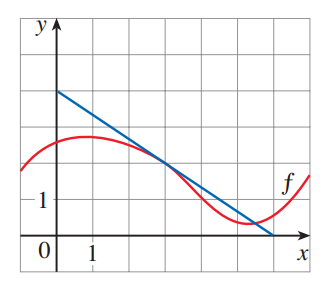
If g(x)=f(x) g(x) = \sqrt{f(x)} , where the graph of f f is shown, evaluate g(3) g'(3) .
Current Exercise Image

Exercise Tags

Review Lesson
Video Lesson
Chain Rule

Tag:

Use the tag filtering feature on the course homepage to find all exercises with this tag.

Prerequisites for this Exercise

No prerequisite skills selected yet.

Step 1: Use the Chain Rule


To evaluate g(3) g'(3) , we first need to find the derivative of g(x)=f(x) g(x) = \sqrt{f(x)} . We can rewrite this as g(x)=(f(x))1/2 g(x) = (f(x))^{1/2} . We must use the chain rule to find the derivative.
g(x)=12(f(x))1/2f(x)=f(x)2f(x)
\begin{aligned}
& \quad g'(x) \\
&= \frac{1}{2}(f(x))^{-1/2} \cdot f'(x) \\
&= \frac{f'(x)}{2\sqrt{f(x)}}
\end{aligned}


Step 2: Find Values from the Graph at x=3x=3


Next, we need to find two values from the provided graph: the value of the function f(3)f(3) and the slope of the tangent line f(3)f'(3) at x=3x=3.

From the graph, we can see that the red curve passes through the point (3,2)(3, 2).
f(3)=2
\begin{aligned}
& \quad f(3) \\
&= 2
\end{aligned}

The blue line is the tangent line to the curve at x=3x=3. We can find its slope by identifying two points on the line, for example, (0,4)(0, 4) and (3,2)(3, 2).
f(3)=2430=23
\begin{aligned}
& \quad f'(3) \\
&= \frac{2 - 4}{3 - 0} \\
&= \frac{-2}{3}
\end{aligned}


Step 3: Evaluate g(3)g'(3)


Now we substitute the values we found into the derivative formula from Step 1.
g(3)=f(3)2f(3)=2/322=2/322=132=13222=26
\begin{aligned}
& \quad g'(3) \\
&= \frac{f'(3)}{2\sqrt{f(3)}} \\
&= \frac{-2/3}{2\sqrt{2}} \\
&= \frac{-1}{3\sqrt{2}} \\
&= \frac{-1}{3\sqrt{2}} \cdot \frac{\sqrt{2}}{\sqrt{2}} \\
&= -\frac{\sqrt{2}}{6}
\end{aligned}


Final Answer


=26
\begin{aligned}
&= \boxed{-\frac{\sqrt{2}}{6}}
\end{aligned}
=26
\begin{aligned}
&= \boxed{-\frac{\sqrt{2}}{6}}
\end{aligned}

Mcq Questions

MCQ
B1
Difficulty: 3/10
To approximate ln(0.98) \ln(0.98) using linear approximation, which anchor point a a should you use?

a) a=0 a = 0
b) a=1 a = 1
c) a=e a = e
d) a=0.98 a = 0.98

Exercise Tags

logarithms
linear approximation

Tag:

Use the tag filtering feature on the course homepage to find all exercises with this tag.

Prerequisites for this Exercise

No prerequisite skills selected yet.

Step 1: What makes a good anchor point?


A good anchor point is a "nice" value close to where you're estimating, where you can easily calculate both f(a) f(a) and f(a) f'(a) .

We want to estimate ln(0.98) \ln(0.98) , so we need an anchor point near 0.98 0.98 where we know the exact value of ln \ln .

Step 2: Evaluate each option


Option a) a=0 a = 0 : Can't use this — ln(0) \ln(0) is undefined!

Option b) a=1 a = 1 : This works! We know ln(1)=0 \ln(1) = 0 exactly, and 1 1 is close to 0.98 0.98 .

Option c) a=e a = e : We know ln(e)=1 \ln(e) = 1 , but e2.718 e \approx 2.718 is far from 0.98 0.98 . The approximation would be poor.

Option d) a=0.98 a = 0.98 : This defeats the purpose — we'd need to know ln(0.98) \ln(0.98) to use it as an anchor, but that's exactly what we're trying to find!

Step 3: Conclusion


The best choice is a=1 a = 1 because:
- ln(1)=0 \ln(1) = 0 is easy to compute
- 1 1 is very close to 0.98 0.98

b) a=1 \boxed{b) \ a = 1}
B2
Difficulty: 3/10
Let g(x)=3x32x26x+5g(x) = 3x^3 - 2x^2 - 6x + 5. The Mean Value Theorem applied to gg on the interval [3,2][-3, 2], yields the existence of a number x0x_0 satisfying 3<x0<2-3 < x_0 < 2 and such that g(x0)g'(x_0) equals

(a) 17, (b) 20, (c) 27, (d) 35, (e) -2.
Exercise Tags

Mean Value Theorem

Tag:

Use the tag filtering feature on the course homepage to find all exercises with this tag.

Prerequisites for this Exercise

No prerequisite skills selected yet.

Let g(x)=3x32x26x+5g(x) = 3x^3 - 2x^2 - 6x + 5. The Mean Value Theorem applied to gg on the interval [3,2][-3, 2], yields the existence of a number x0x_0 satisfying 3<x0<2-3 < x_0 < 2 and such that g(x0)g'(x_0) equals

(a) 17, (b) 20, (c) 27, (d) 35, (e) -2.

Step 1: Understand the Mean Value Theorem


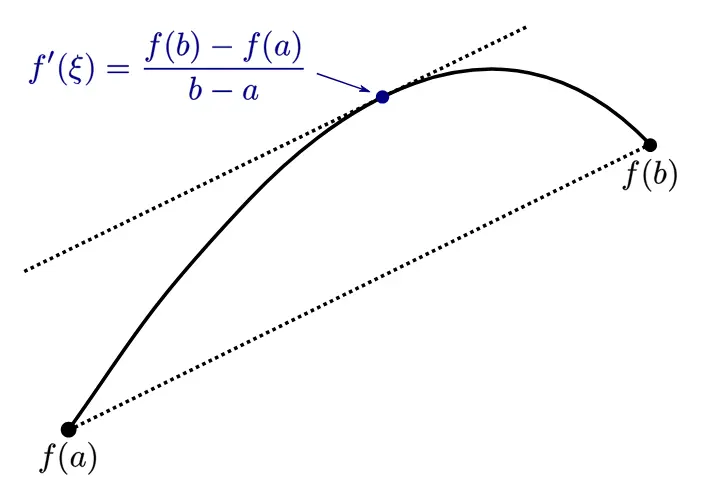
mean value theorem sample

Figure: mean value theorem sample


This is just a sample. In our question we are using g(x)g(x) and instead of ξ\xi we use x0x_0.

The Mean Value Theorem states that if a function gg is continuous on a closed interval [a,b][a, b] and differentiable on the open interval (a,b)(a, b), then there exists at least one point x0x_0 in (a,b)(a, b) such that:

g(x0)=g(b)g(a)ba g'(x_0) = \frac{g(b) - g(a)}{b - a}

The derivative at the special point x0x_0 equals the average rate of change of the function over the entire interval.

Step 2: Find the derivative of g(x)g(x)


g(x)=3x32x26x+5g(x)=9x24x6 \begin{align*}
& g(x) = 3x^3 - 2x^2 - 6x + 5 \\
& g'(x) = 9x^2 - 4x - 6
\end{align*}


Step 3: Calculate the function values at the endpoints


From our previous work, we already know:


g(3)=76g(2)=9 \begin{align*}
& g(-3) = -76 \\
& g(2) = 9
\end{align*}


Step 4: Find the average rate of change


g(2)g(3)2(3)=9(76)2+3g(2)g(3)2(3)=855g(2)g(3)2(3)=17 \begin{align*}
& \frac{g(2) - g(-3)}{2 - (-3)} = \frac{9 - (-76)}{2 + 3} \\
& \frac{g(2) - g(-3)}{2 - (-3)} = \frac{85}{5} \\
& \frac{g(2) - g(-3)}{2 - (-3)} = 17
\end{align*}


By the Mean Value Theorem, there exists at least one point x0x_0 in the interval (3,2)(-3, 2) such that g(x0)=17g'(x_0) = 17.

Step 5: Compare with the given options


Looking at the answer choices:
- (a) 17: This matches our calculated value ✓
- (b) 20: Not equal to 17 ✗
- (c) 27: Not equal to 17 ✗
- (d) 35: Not equal to 17 ✗
- (e) -2: Not equal to 17 ✗


The answer is (a) 17.\boxed{\text{The answer is (a) 17.}}
B3
Difficulty: 7/10
The vertical asymptote(s) of f(x)=3x6+7x35x2+6xf(x) = \frac{\sqrt{3x^6 + 7}}{x^3 - 5x^2 + 6x} is (are) best described by:

(a) x=0x = 0, (b) x=2x = 2, (c) x=3x = 3, (d) two asymptotes, (e) three asymptotes.

Exercise Tags

Intuitive Reasoning
graphing
Curve Sketching
Vertical Asymptotes
asymptotes

Tag:

Use the tag filtering feature on the course homepage to find all exercises with this tag.

Prerequisites for this Exercise

No prerequisite skills selected yet.

The vertical asymptote(s) of f(x)=3x6+7x35x2+6xf(x) = \frac{\sqrt{3x^6 + 7}}{x^3 - 5x^2 + 6x} is (are) best described by:

(a) x=0x = 0, (b) x=2x = 2, (c) x=3x = 3, (d) two asymptotes, (e) three asymptotes.

Step 1: Find where the denominator equals zero


Vertical asymptotes occur at values where the denominator equals zero.

x35x2+6x=0x(x25x+6)=0x(x2)(x3)=0 \begin{align*}
x^3 - 5x^2 + 6x &= 0 \\
x(x^2 - 5x + 6) &= 0 \\
x(x - 2)(x - 3) &= 0
\end{align*}


This gives us x=0x = 0, x=2x = 2, or x=3x = 3 as potential vertical asymptotes.

Step 2: Confirm these are asymptotes


For these points to be vertical asymptotes, we need to verify that the numerator is non-zero at these points.

The numerator is 3x6+7\sqrt{3x^6 + 7}. Since 3x63x^6 is always non-negative (as it's raised to an even power) and we're adding the positive constant 7, the expression under the square root is always positive. Therefore, the numerator is always positive and never zero.

Since the numerator is never zero at any of these points, all three values x=0x = 0, x=2x = 2, and x=3x = 3 are vertical asymptotes.

Step 3: Determine the answer


Since we've confirmed that the function has vertical asymptotes at x=0x = 0, x=2x = 2, and x=3x = 3, there are three vertical asymptotes in total.

Therefore:
The answer is (e) three asymptotes\boxed{\text{The answer is (e) three asymptotes}}

When analyzing rational functions with radicals, remember that expressions like x2n+kx^{2n} + k (where k > 0) are always positive, ensuring that vertical asymptotes occur at all zeros of the denominator.
The answer is (e) three asymptotes\boxed{\text{The answer is (e) three asymptotes}}
B4
Difficulty: 7/10
Which value of kk makes the following function continuous?

f(x)={cos(xπk)if x0sin(x)x1cos(x)if x>0
f(x) =
\begin{cases}
\cos(x - \pi k) & \text{if } x \leq 0 \\
\frac{\sin(x) - x}{1 - \cos(x)} & \text{if } x > 0
\end{cases}


(A) k=1/4 k = 1/4

(B) k=1/2 k = 1/2

(C) k=1 k = 1

(D) k=2 k = 2

(E) None of the above \text{None of the above}

Exercise Tags

continuity
Taylor Series
limits: general

Tag:

Use the tag filtering feature on the course homepage to find all exercises with this tag.

Prerequisites for this Exercise

No prerequisite skills selected yet.

Step 1: Definition of Continuity


A function f(x)f(x) is continuous at x=0x = 0 if:

limx0f(x)=limx0+f(x)=f(0)
\lim_{x \to 0^-} f(x) = \lim_{x \to 0^+} f(x) = f(0)


Step 2: Evaluate f(0)f(0)


f(0)=cos(0πk)=cos(πk)
f(0) = \cos(0 - \pi k) = \cos(\pi k)


Step 3: Compute the Left-Hand Limit limx0f(x) \lim_{x \to 0^-} f(x)


limx0f(x)=cos(πk)
\lim_{x \to 0^-} f(x) = \cos(\pi k)


Step 4: Compute the Right-Hand Limit limx0+f(x) \lim_{x \to 0^+} f(x)


Using Taylor expansions:

sin(x)=xx36+,cos(x)=1x22+
\sin(x) = x - \frac{x^3}{6} + \dots, \quad \cos(x) = 1 - \frac{x^2}{2} + \dots


sin(x)x1cos(x)=x36x22=x3
\frac{\sin(x) - x}{1 - \cos(x)} = \frac{-\frac{x^3}{6}}{\frac{x^2}{2}} = \frac{-x}{3}


Thus:

limx0+f(x)=0
\lim_{x \to 0^+} f(x) = 0


Step 5: Set Up the Continuity Condition


cos(πk)=0
\cos(\pi k) = 0


Step 6: Solve for kk


πk=π2,3π2,k=12,32,
\pi k = \frac{\pi}{2}, \frac{3\pi}{2}, \dots \quad \Rightarrow \quad k = \frac{1}{2}, \frac{3}{2}, \dots


The smallest positive value is:

k=12
k = \frac{1}{2}


Step 7: Final Answer


(B)k=12
\boxed{(B) \, k = \frac{1}{2}}
(B)k=12
\boxed{(B) \, k = \frac{1}{2}}
B5
Difficulty: 1/10
limx0(x+1x1ln(1+x))=
\lim_{x \to 0} \left( \frac{x + 1}{x} - \frac{1}{\ln(1 + x)} \right) =


(A) e \sqrt{e}

(B) 0 0

(C) 1 1

(D) 1/2 1/2

(E) Does not exist \text{Does not exist}

Exercise Tags

limits: with logarithms
limits: general

Tag:

Use the tag filtering feature on the course homepage to find all exercises with this tag.

Prerequisites for this Exercise

No prerequisite skills selected yet.

Step 1: Analyze ln(1+x) \ln(1 + x) as x0x \to 0


ln(1+x)=xx22+x33
\ln(1 + x) = x - \frac{x^2}{2} + \frac{x^3}{3} - \dots


Since higher-order terms become negligibly small for small xx, we approximate:

ln(1+x)xx22
\ln(1 + x) \approx x - \frac{x^2}{2}


Step 2: Approximate the Reciprocal 1ln(1+x) \frac{1}{\ln(1 + x)}


1ln(1+x)=1xx22
\frac{1}{\ln(1 + x)} = \frac{1}{x - \frac{x^2}{2}}


Factor out xx:

1ln(1+x)=1x(1x2)
\frac{1}{\ln(1 + x)} = \frac{1}{x \left( 1 - \frac{x}{2} \right)}


**Remember:** The approximation 11u1+u \frac{1}{1 - u} \approx 1 + u is useful for small uu.

Using this approximation:

1ln(1+x)1x+12
\frac{1}{\ln(1 + x)} \approx \frac{1}{x} + \frac{1}{2}


Step 3: Rewrite the Original Limit


limx0((1+1x)(1x+12))
\lim_{x \to 0} \left( \left( 1 + \frac{1}{x} \right) - \left( \frac{1}{x} + \frac{1}{2} \right) \right)


Simplify:

limx0(1+1x1x12)=limx0(112)
\lim_{x \to 0} \left( 1 + \frac{1}{x} - \frac{1}{x} - \frac{1}{2} \right) = \lim_{x \to 0} \left( 1 - \frac{1}{2} \right)


limx012=12
\lim_{x \to 0} \frac{1}{2} = \frac{1}{2}


Step 4: Final Answer


The value of the limit is:

12
\boxed{\frac{1}{2}}


Thus, the correct answer is:

(D)12
\boxed{(D) \, \frac{1}{2}}


Summary


This question is trying to teach you something about the comparative size of these two functions as we get closer to 0.

It turns out that x+1x \frac{x + 1}{x} is about 1/21/2 bigger than 1ln(1+x)\frac{1}{\ln(1 + x)} as we get close to 0, even though they both approach \infty. That's what this question is trying to teach you!
(D)12
\boxed{(D) \, \frac{1}{2}}

Long Answer Questions

Long Answer
C1
Difficulty: 9/10
(Max Marks: 8)
A painting hangs on a wall with its bottom edge 2 feet above your eye level and its top edge 6 feet above your eye level. How far from the wall should you stand to maximize your viewing angle?

Exercise Tags

optimization
inverse trig functions
trig derivatives
critical points

Tag:

Use the tag filtering feature on the course homepage to find all exercises with this tag.

Prerequisites for this Exercise

No prerequisite skills selected yet.

Step 1: Set up the geometry


Let x x = your distance from the wall.

Looking up at the painting, there are two angles:

α \alpha = angle from your eye to the top of the painting

β \beta = angle from your eye to the bottom of the painting

The viewing angle is θ=αβ \theta = \alpha - \beta .

Step 2: Express angles using inverse tangent


Since tangent = opposite/adjacent, and we know the heights and want the angles, we use arctangent!

The top is 6 ft above eye level, so:
tan(α)=6xα=arctan(6x) \tan(\alpha) = \frac{6}{x} \quad \Rightarrow \quad \alpha = \arctan\left(\frac{6}{x}\right)

The bottom is 2 ft above eye level, so:
tan(β)=2xβ=arctan(2x) \tan(\beta) = \frac{2}{x} \quad \Rightarrow \quad \beta = \arctan\left(\frac{2}{x}\right)

Therefore:
θ(x)=arctan(6x)arctan(2x) \theta(x) = \arctan\left(\frac{6}{x}\right) - \arctan\left(\frac{2}{x}\right)

Step 3: Take the derivative


Using ddxarctan(u)=u1+u2 \frac{d}{dx}\arctan(u) = \frac{u'}{1+u^2} :

θ(x)=6/x21+36/x22/x21+4/x2=6x2+36+2x2+4 \begin{align*} & \theta'(x) = \frac{-6/x^2}{1 + 36/x^2} - \frac{-2/x^2}{1 + 4/x^2} \\ &= \frac{-6}{x^2 + 36} + \frac{2}{x^2 + 4} \end{align*}

Step 4: Set derivative equal to zero


2x2+4=6x2+36 \frac{2}{x^2 + 4} = \frac{6}{x^2 + 36}

Cross multiply:
2(x2+36)=6(x2+4) 2(x^2 + 36) = 6(x^2 + 4)

2x2+72=6x2+24 2x^2 + 72 = 6x^2 + 24

48=4x2 48 = 4x^2

x2=12 x^2 = 12

x=12=23 x = \sqrt{12} = 2\sqrt{3}

Step 5: Verify this is a maximum


As x0+ x \to 0^+ , you are too close and the viewing angle approaches 0.

As x x \to \infty , you are too far and the viewing angle approaches 0.

Since θ(x)>0 \theta(x) > 0 for finite positive x x , the critical point must be a maximum.

x=233.46 feet \boxed{x = 2\sqrt{3} \approx 3.46 \text{ feet}}
23 feet (3.46 ft) \boxed{2\sqrt{3} \text{ feet } (\approx 3.46 \text{ ft})}
C2
Difficulty: 7/10
(Max Marks: 8)
A painting hangs on a wall with its bottom edge 2 feet above your eye level and its top edge 6 feet above your eye level. How far from the wall should you stand to maximize your viewing angle?

Exercise Tags

optimization
inverse trig functions
trig derivatives
critical points

Tag:

Use the tag filtering feature on the course homepage to find all exercises with this tag.

Prerequisites for this Exercise

No prerequisite skills selected yet.

Step 1: Set up the geometry


Let x x = your distance from the wall.

Looking up at the painting, there are two angles:

α \alpha = angle from your eye to the top of the painting

β \beta = angle from your eye to the bottom of the painting

The viewing angle is θ=αβ \theta = \alpha - \beta .

Step 2: Express angles using inverse tangent


Since tangent = opposite/adjacent, and we know the heights and want the angles, we use arctangent!

The top is 6 ft above eye level, so:
tan(α)=6xα=arctan(6x) \tan(\alpha) = \frac{6}{x} \quad \Rightarrow \quad \alpha = \arctan\left(\frac{6}{x}\right)

The bottom is 2 ft above eye level, so:
tan(β)=2xβ=arctan(2x) \tan(\beta) = \frac{2}{x} \quad \Rightarrow \quad \beta = \arctan\left(\frac{2}{x}\right)

Therefore:
θ(x)=arctan(6x)arctan(2x) \theta(x) = \arctan\left(\frac{6}{x}\right) - \arctan\left(\frac{2}{x}\right)

Step 3: Take the derivative


Using ddxarctan(u)=u1+u2 \frac{d}{dx}\arctan(u) = \frac{u'}{1+u^2} :

θ(x)=6/x21+36/x22/x21+4/x2=6x2+36+2x2+4 \begin{align*} & \theta'(x) = \frac{-6/x^2}{1 + 36/x^2} - \frac{-2/x^2}{1 + 4/x^2} \\ &= \frac{-6}{x^2 + 36} + \frac{2}{x^2 + 4} \end{align*}

Step 4: Set derivative equal to zero


2x2+4=6x2+36 \frac{2}{x^2 + 4} = \frac{6}{x^2 + 36}

Cross multiply:
2(x2+36)=6(x2+4) 2(x^2 + 36) = 6(x^2 + 4)

2x2+72=6x2+24 2x^2 + 72 = 6x^2 + 24

48=4x2 48 = 4x^2

x2=12 x^2 = 12

x=12=23 x = \sqrt{12} = 2\sqrt{3}

Step 5: Verify this is a maximum


As x0+ x \to 0^+ , you are too close and the viewing angle approaches 0.

As x x \to \infty , you are too far and the viewing angle approaches 0.

Since θ(x)>0 \theta(x) > 0 for finite positive x x , the critical point must be a maximum.

x=233.46 feet \boxed{x = 2\sqrt{3} \approx 3.46 \text{ feet}}
23 feet (3.46 ft) \boxed{2\sqrt{3} \text{ feet } (\approx 3.46 \text{ ft})}
C3
Difficulty: 5/10
Let f(x)=3x2 f(x) = \frac{3}{x-2} and g(x)=3x2 g(x) = -\frac{3}{x-2} .


(a) Evaluate limx2f(x) \lim_{x\to 2} f(x) and limx2g(x) \lim_{x\to 2} g(x) .


(b) Evaluate limx2[f(x)+g(x)] \lim_{x\to 2} [f(x) + g(x)] .


(c) Is it always true that limxa[f(x)+g(x)]=limxaf(x)+limxag(x) \lim_{x\to a} [f(x) + g(x)] = \lim_{x\to a} f(x) + \lim_{x\to a} g(x) ?

Exercise Tags

limits: general

Tag:

Use the tag filtering feature on the course homepage to find all exercises with this tag.

Prerequisites for this Exercise

No prerequisite skills selected yet.

Part (a): Evaluate Individual Limits


We must check the left-hand and right-hand limits for x2x \to 2.

For limx2f(x) \lim_{x\to 2} f(x)


limx2f(x)=limx23x2=30=
\begin{aligned}
& \quad \lim_{x\to 2^-} f(x) \\
&= \lim_{x\to 2^-} \frac{3}{x-2} \\
&= \frac{3}{0^-} \\
&= -\infty
\end{aligned}

limx2+f(x)=limx2+3x2=30+=
\begin{aligned}
& \quad \lim_{x\to 2^+} f(x) \\
&= \lim_{x\to 2^+} \frac{3}{x-2} \\
&= \frac{3}{0^+} \\
&= \infty
\end{aligned}

Since the limits from the left and right are not equal, limx2f(x) \lim_{x\to 2} f(x) Does Not Exist (DNE).

For limx2g(x) \lim_{x\to 2} g(x)


limx2g(x)=limx23x2=(30)=()=
\begin{aligned}
& \quad \lim_{x\to 2^-} g(x) \\
&= \lim_{x\to 2^-} -\frac{3}{x-2} \\
&= -(\frac{3}{0^-}) \\
&= -(-\infty) \\
&= \infty
\end{aligned}

limx2+g(x)=limx2+3x2=(30+)=
\begin{aligned}
& \quad \lim_{x\to 2^+} g(x) \\
&= \lim_{x\to 2^+} -\frac{3}{x-2} \\
&= -(\frac{3}{0^+}) \\
&= -\infty
\end{aligned}

Since the limits from the left and right are not equal, limx2g(x) \lim_{x\to 2} g(x) Does Not Exist (DNE).

Part (b): Evaluate the Limit of the Sum


First, simplify the function f(x)+g(x) f(x) + g(x) .
f(x)+g(x)=3x2+(3x2)=0
\begin{aligned}
& \quad f(x) + g(x) \\
&= \frac{3}{x-2} + \left(-\frac{3}{x-2}\right) \\
&= 0
\end{aligned}

Now, evaluate the limit of the simplified sum.
limx2[f(x)+g(x)]=limx2[0]=0
\begin{aligned}
& \quad \lim_{x\to 2} [f(x) + g(x)] \\
&= \lim_{x\to 2} [0] \\
&= \boxed{0}
\end{aligned}


Part (c): Is the Limit Law Always True?


The statement is: Is it always true that limxa[f(x)+g(x)]=limxaf(x)+limxag(x) \lim_{x\to a} [f(x) + g(x)] = \lim_{x\to a} f(x) + \lim_{x\to a} g(x) ?

The Limit Law for Sums only applies if the limits of the individual functions, limxaf(x)\lim_{x\to a} f(x) and limxag(x)\lim_{x\to a} g(x), both exist.

Based on the results from parts (a) and (b):
- The limit of the sum is limx2[f(x)+g(x)]=0 \lim_{x\to 2} [f(x) + g(x)] = 0 .
- The sum of the individual limits is limx2f(x)+limx2g(x) \lim_{x\to 2} f(x) + \lim_{x\to 2} g(x) , which is DNE + DNE.

Since DNE + DNE is undefined (or does not exist), it is not equal to 0. Therefore, the statement is **not always true**. It fails when the individual limits do not exist.
=No, the statement is NOT always true.
\begin{aligned}
&= \boxed{\text{No, the statement is NOT always true.}}
\end{aligned}

Word Problem Questions

Word Problem
D1
Difficulty: 9/10
A rectangular prism with a square base of side length ss feet is to have a volume of VV cubic feet. The material for the top and bottom costs $6\$6 per square foot and the material for the sides costs $4\$4 per square foot. Write down a formula for the total cost CC for the prism in terms of ss and VV. Then find the dimensions that minimize the cost, and determine the ratio of height to side length in this minimal cost configuration.

Exercise Tags

optimization

Tag:

Use the tag filtering feature on the course homepage to find all exercises with this tag.

Prerequisites for this Exercise

No prerequisite skills selected yet.

Step 1: Set up the basic relationships


Let's define our variables:
- ss = side length of the square base (in feet)
- hh = height of the rectangular prism (in feet)
- VV = volume (in cubic feet)

The volume of the rectangular prism is:

V=s2h V = s^2 \cdot h

Solving for hh:

h=Vs2 h = \frac{V}{s^2}

Step 2: Calculate the surface areas


The rectangular prism has 6 faces:
- 2 square faces (top and bottom) each with area s2s^2
- 4 rectangular faces (sides) each with area shs \cdot h

Total area of top and bottom = 2s22s^2 square feet
Total area of sides = 4sh=4sVs2=4Vs4s \cdot h = 4s \cdot \frac{V}{s^2} = \frac{4V}{s} square feet

Step 3: Calculate the total cost


Given:
- Cost of top and bottom material = $6\$6 per square foot
- Cost of side material = $4\$4 per square foot

Cost of top and bottom = 62s2=12s26 \cdot 2s^2 = 12s^2 dollars
Cost of sides = 44Vs=16Vs4 \cdot \frac{4V}{s} = \frac{16V}{s} dollars

Total cost:

C=12s2+16Vs C = 12s^2 + \frac{16V}{s}

Step 4: Find the value of s that minimizes the cost


To minimize the cost, we take the derivative of CC with respect to ss and set it equal to zero:

dCds=24s16Vs2 \frac{dC}{ds} = 24s - \frac{16V}{s^2}

Setting this equal to zero:

24s16Vs2=0 24s - \frac{16V}{s^2} = 0

24s=16Vs2 24s = \frac{16V}{s^2}

24s3=16V 24s^3 = 16V

s3=16V24=2V3 s^3 = \frac{16V}{24} = \frac{2V}{3}

s=2V33 s = \sqrt[3]{\frac{2V}{3}}

Step 5: Find the height and the ratio h/s


Using our earlier relation h=Vs2h = \frac{V}{s^2}, we can calculate hh when s=2V33s = \sqrt[3]{\frac{2V}{3}}:

h=Vs2=V(2V33)2=V(2V3)2/3 h = \frac{V}{s^2} = \frac{V}{\left(\sqrt[3]{\frac{2V}{3}}\right)^2} = \frac{V}{\left(\frac{2V}{3}\right)^{2/3}}

h=V(2V)2/332/3=V32/3(2V)2/3=V32/3V2/322/3 h = \frac{V}{\frac{(2V)^{2/3}}{3^{2/3}}} = \frac{V \cdot 3^{2/3}}{(2V)^{2/3}} = \frac{V \cdot 3^{2/3}}{V^{2/3} \cdot 2^{2/3}}

h=V1/332/322/3 h = \frac{V^{1/3} \cdot 3^{2/3}}{2^{2/3}}

Now let's find the ratio hs\frac{h}{s}:

hs=V1/332/322/32V33=V1/332/322/3(2V)1/331/3 \frac{h}{s} = \frac{\frac{V^{1/3} \cdot 3^{2/3}}{2^{2/3}}}{\sqrt[3]{\frac{2V}{3}}} = \frac{V^{1/3} \cdot 3^{2/3}}{2^{2/3} \cdot \frac{(2V)^{1/3}}{3^{1/3}}}

hs=V1/332/331/322/321/3V1/3 \frac{h}{s} = \frac{V^{1/3} \cdot 3^{2/3} \cdot 3^{1/3}}{2^{2/3} \cdot 2^{1/3} \cdot V^{1/3}}

hs=32/3+1/322/3+1/3=3121=32 \frac{h}{s} = \frac{3^{2/3 + 1/3}}{2^{2/3 + 1/3}} = \frac{3^1}{2^1} = \frac{3}{2}

In optimization problems with cost functions, setting the derivative equal to zero and solving for the critical points is the key technique for finding minimum or maximum values.

Therefore, when the cost is minimized, the ratio of height to side length is:
hs=32
\boxed{\frac{h}{s} = \frac{3}{2}}
C=12s2+16Vs \boxed{C = 12s^2 + \frac{16V}{s}}

s=2V33 \boxed{s = \sqrt[3]{\frac{2V}{3}}}

hs=32
\boxed{\frac{h}{s} = \frac{3}{2}}
D2
Difficulty: 8/10
A spherical snowball is melting such that its radius is decreasing at a constant rate of 2 centimeters per hour. Find the rate at which its surface area and volume are decreasing when the radius is 10 centimeters.

Exercise Tags

differentiation: implicit
implicit differentiation

Tag:

Use the tag filtering feature on the course homepage to find all exercises with this tag.

Prerequisites for this Exercise

No prerequisite skills selected yet.

Step 1: Identify Knowns and Unknowns

We are given the rate at which the radius r r is changing:
drdt=2 cm/hr \frac{dr}{dt} = -2 \text{ cm/hr}
(The rate is negative because the radius is decreasing).
We need to find the rates at which the surface area A A and the volume V V are changing at the instant when the radius is r=10 r = 10 cm.
That is, we need to find dAdt \frac{dA}{dt} and dVdt \frac{dV}{dt} when r=10 r = 10 .

Step 2: Write Down Relevant Formulas

The formulas for the surface area and volume of a sphere with radius r r are:
Surface Area: A=4πr2 A = 4 \pi r^2
Volume: V=43πr3 V = \frac{4}{3} \pi r^3

Step 3: Differentiate with Respect to Time

Now, we differentiate both formulas with respect to time t t , using implicit differentiation because A A , V V , and r r are all functions of t t .

For Surface Area A=4πr2 A = 4 \pi r^2 :
ddt(A)=ddt(4πr2)dAdt=4π(2r)drdtdAdt=8πrdrdt \begin{align*}
\frac{d}{dt}(A) &= \frac{d}{dt}(4 \pi r^2) \\
\frac{dA}{dt} &= 4 \pi \cdot (2r) \cdot \frac{dr}{dt} \\
\frac{dA}{dt} &= 8 \pi r \frac{dr}{dt}
\end{align*}

For Volume V=43πr3 V = \frac{4}{3} \pi r^3 :
ddt(V)=ddt(43πr3)dVdt=43π(3r2)drdtdVdt=4πr2drdt \begin{align*}
\frac{d}{dt}(V) &= \frac{d}{dt}(\frac{4}{3} \pi r^3) \\
\frac{dV}{dt} &= \frac{4}{3} \pi \cdot (3r^2) \cdot \frac{dr}{dt} \\
\frac{dV}{dt} &= 4 \pi r^2 \frac{dr}{dt}
\end{align*}

When performing implicit differentiation with respect to time t t , remember that differentiating a term involving r r requires multiplying by drdt \frac{dr}{dt} . For example, ddt(rn)=nrn1drdt \frac{d}{dt}(r^n) = n r^{n-1} \frac{dr}{dt} . Similarly, ddt(A)=dAdt \frac{d}{dt}(A) = \frac{dA}{dt} and ddt(V)=dVdt \frac{d}{dt}(V) = \frac{dV}{dt} .

Step 4: Substitute Known Values and Solve for Surface Area Rate

Substitute r=10 r = 10 cm and drdt=2 \frac{dr}{dt} = -2 cm/hr into the equation for dAdt \frac{dA}{dt} :
dAdt=8πrdrdt=8π(10)(2)=160π \begin{align*}
\frac{dA}{dt} &= 8 \pi r \frac{dr}{dt} \\
&= 8 \pi (10) (-2) \\
&= -160 \pi
\end{align*}

The surface area is decreasing at a rate of 160π 160 \pi square centimeters per hour.

Step 5: Substitute Known Values and Solve for Volume Rate

Substitute r=10 r = 10 cm and drdt=2 \frac{dr}{dt} = -2 cm/hr into the equation for dVdt \frac{dV}{dt} :
dVdt=4πr2drdt=4π(10)2(2)=4π(100)(2)=800π \begin{align*}
\frac{dV}{dt} &= 4 \pi r^2 \frac{dr}{dt} \\
&= 4 \pi (10)^2 (-2) \\
&= 4 \pi (100) (-2) \\
&= -800 \pi
\end{align*}

The volume is decreasing at a rate of 800π 800 \pi cubic centimeters per hour.
Notice that the formula for dVdt \frac{dV}{dt} is 4πr2drdt 4 \pi r^2 \frac{dr}{dt} . Since the surface area A=4πr2 A = 4 \pi r^2 , we can also write dVdt=Adrdt \frac{dV}{dt} = A \frac{dr}{dt} . This sometimes provides a shortcut if the surface area is already known or easily calculated.

Final Answer

When the radius is 10 cm, the surface area is decreasing at a rate of 160π 160 \pi cm²/hr and the volume is decreasing at a rate of 800π 800 \pi cm³/hr.
dAdt=160π cm2/hr \boxed{ \frac{dA}{dt} = -160 \pi \text{ cm}^2/\text{hr} }
dVdt=800π cm3/hr \boxed{ \frac{dV}{dt} = -800 \pi \text{ cm}^3/\text{hr} }
dAdt=160π cm2/hr \boxed{ \frac{dA}{dt} = -160 \pi \text{ cm}^2/\text{hr} }
dVdt=800π cm3/hr \boxed{ \frac{dV}{dt} = -800 \pi \text{ cm}^3/\text{hr} }

Multi Part Questions

Multi-Part
E1
Difficulty: 1/10
(Max Marks: 6)
This question is presented in two parts. In Part (a), you will perform an algebraic manipulation involving polynomials. The result you obtain in Part (a) will then be directly used to help you evaluate the integral in Part (b).

Exercise Tags

Polynomial Long Division
Integrals: u-substitution
integrals: inverse trig
inverse trig functions

Tag:

Use the tag filtering feature on the course homepage to find all exercises with this tag.

Prerequisites for this Exercise

No prerequisite skills selected yet.

Sub-questions:

E1 Part a)
Difficulty: 1/10
(Max Marks: 3)
Use polynomial long division to write x3+5x22x+1=s(x)(x2+2)+r(x) x^3 + 5x^2 - 2x + 1 = s(x)(x^2 + 2) + r(x) for polynomials s(x) s(x) and r(x) r(x) with deg(r(x))<2 \text{deg}(r(x)) < 2 .

Exercise Tags

Polynomial Long Division

Tag:

Use the tag filtering feature on the course homepage to find all exercises with this tag.

Prerequisites for this Exercise

No prerequisite skills selected yet.

Step 1: Set up the Polynomial Long Division

We want to divide P(x)=x3+5x22x+1 P(x) = x^3 + 5x^2 - 2x + 1 by D(x)=x2+0x+2 D(x) = x^2 + 0x + 2 .
The initial setup is:
      ___________
x^2+2 | x^3 + 5x^2 - 2x + 1


Step 2: Perform the Long Division Algorithm Iteratively


1. First term of quotient: Divide the leading term of the dividend (x3 x^3 ) by the leading term of the divisor (x2 x^2 ): x3x2=x \frac{x^3}{x^2} = x . Write x x in the quotient area.
        x             
___________
x^2+2 | x^3 + 5x^2 - 2x + 1


2. First multiplication: Multiply the term x x by the entire divisor (x2+2 x^2 + 2 ): x(x2+2)=x3+2x x(x^2 + 2) = x^3 + 2x . Write this result below the dividend, aligning terms by power.
        x             
___________
x^2+2 | x^3 + 5x^2 - 2x + 1
x^3 + 2x


3. First subtraction: Subtract the result (x3+2x) (x^3 + 2x) from the dividend. Draw a line and write the result below. Remember to subtract corresponding terms: (x3x3=0) (x^3 - x^3 = 0) , (5x20x2=5x2) (5x^2 - 0x^2 = 5x^2) , (2x2x=4x) (-2x - 2x = -4x) . Bring down the next term (+1 +1 ) from the dividend.
        x             
___________
x^2+2 | x^3 + 5x^2 - 2x + 1
-(x^3 + 2x)
________________
5x^2 - 4x + 1


4. Second term of quotient: Divide the leading term of the new remainder (5x2 5x^2 ) by the leading term of the divisor (x2 x^2 ): 5x2x2=5 \frac{5x^2}{x^2} = 5 . Write +5 +5 in the quotient area.
        x   + 5       
___________
x^2+2 | x^3 + 5x^2 - 2x + 1
-(x^3 + 2x)
________________
5x^2 - 4x + 1


5. Second multiplication: Multiply the term +5 +5 by the divisor (x2+2 x^2 + 2 ): 5(x2+2)=5x2+10 5(x^2 + 2) = 5x^2 + 10 . Write this result below the current remainder, aligning terms.
        x   + 5       
___________
x^2+2 | x^3 + 5x^2 - 2x + 1
-(x^3 + 2x)
________________
5x^2 - 4x + 1
5x^2 + 10


6. Second subtraction: Subtract the result (5x2+10) (5x^2 + 10) from (5x24x+1) (5x^2 - 4x + 1) . Draw a line and write the final result. (5x25x2=0) (5x^2 - 5x^2 = 0) , (4x0x=4x) (-4x - 0x = -4x) , (110=9) (1 - 10 = -9) . The result is 4x9 -4x - 9 .
        x   + 5       <-- Quotient s(x)
___________
x^2+2 | x^3 + 5x^2 - 2x + 1
-(x^3 + 2x)
________________
5x^2 - 4x + 1
-(5x^2 + 10)
____________
-4x - 9 <-- Remainder r(x)

The degree of this result (4x9 -4x - 9 , degree 1) is less than the degree of the divisor (x2+2 x^2 + 2 , degree 2), so the algorithm stops.
Double-check each subtraction step carefully, especially handling signs and aligning terms correctly (like the +2x+2x under 2x-2x and +10+10 under +1+1).

Step 3: Identify Quotient and Remainder

From the final division layout:
The quotient is s(x)=x+5 s(x) = x + 5 .
The remainder is r(x)=4x9 r(x) = -4x - 9 .

The degree of r(x) r(x) is 1, which is less than the degree of the divisor (2 2 ). The condition is satisfied.

The result is: x3+5x22x+1=(x+5)(x2+2)+(4x9) x^3 + 5x^2 - 2x + 1 = (x + 5)(x^2 + 2) + (-4x - 9) .

Step 4: Conclusion


Using polynomial long division, we found the quotient s(x)=x+5 s(x) = x + 5 and the remainder r(x)=4x9 r(x) = -4x - 9 . The degree of r(x) r(x) is 1, which is less than 2.
So, x3+5x22x+1=(x+5)(x2+2)4x9 x^3 + 5x^2 - 2x + 1 = (x + 5)(x^2 + 2) - 4x - 9 .

Using polynomial long division, we found the quotient s(x)=x+5 s(x) = x + 5 and the remainder r(x)=4x9 r(x) = -4x - 9 . The degree of r(x) r(x) is 1, which is less than 2.
So, x3+5x22x+1=(x+5)(x2+2)4x9 x^3 + 5x^2 - 2x + 1 = (x + 5)(x^2 + 2) - 4x - 9 .
E1 Part b)
Difficulty: 1/10
(Max Marks: 3)
Use the result from Part A (x3+5x22x+1x2+2=(x+5)+4x9x2+2 \frac{x^3 + 5x^2 - 2x + 1}{x^2 + 2} = (x + 5) + \frac{-4x - 9}{x^2 + 2} ) to find x3+5x22x+1x2+2dx \int \frac{x^3 + 5x^2 - 2x + 1}{x^2 + 2} \, dx .

Exercise Tags

integrals
Integrals: Improper
Integrals: u-substitution

Tag:

Use the tag filtering feature on the course homepage to find all exercises with this tag.

Prerequisites for this Exercise

No prerequisite skills selected yet.

Step 1: Rewrite the Integral using the Result from Part A

Using the quotient s(x)=x+5 s(x) = x+5 and remainder r(x)=4x9 r(x) = -4x-9 found previously, we rewrite the integrand:
x3+5x22x+1x2+2dx=((x+5)+4x9x2+2)dx \begin{align*}
& \int \frac{x^3 + 5x^2 - 2x + 1}{x^2 + 2} \, dx \\
&= \int \left( (x + 5) + \frac{-4x - 9}{x^2 + 2} \right) \, dx
\end{align*}

We can split this into the sum of two integrals:
=(x+5)dx+4x9x2+2dx
= \int (x + 5) \, dx + \int \frac{-4x - 9}{x^2 + 2} \, dx


Step 2: Integrate the Polynomial Part

The first integral is a simple polynomial integration:
(x+5)dx=x22+5x+C1 \begin{align}
& \int (x + 5) \, dx \\
&= \frac{x^2}{2} + 5x + C_1
\end{align}


Step 3: Integrate the Rational Part

The second integral involves the proper rational function 4x9x2+2 \frac{-4x - 9}{x^2 + 2} . Since the denominator x2+2 x^2+2 is an irreducible quadratic, we split the fraction based on the derivative of the denominator and a constant term. The derivative of x2+2 x^2+2 is 2x 2x .
4x9x2+2dx=(4xx2+2+9x2+2)dx=4xx2+2dx91x2+2dx \begin{align*}
& \int \frac{-4x - 9}{x^2 + 2} \, dx \\
&= \int \left( \frac{-4x}{x^2 + 2} + \frac{-9}{x^2 + 2} \right) \, dx \\
&= -4 \int \frac{x}{x^2 + 2} \, dx - 9 \int \frac{1}{x^2 + 2} \, dx
\end{align*}

This split is strategic: the first part (xx2+2 \propto \frac{x}{x^2+2} ) can be solved with a u-substitution for the denominator, leading to a logarithm. The second part (1x2+2 \propto \frac{1}{x^2+2} ) matches the arctangent integration form.

Step 3a: Evaluate xx2+2dx \int \frac{x}{x^2 + 2} \, dx

Use u-substitution. Let u=x2+2 u = x^2 + 2 . Then du=2xdx du = 2x \, dx , which means xdx=12du x \, dx = \frac{1}{2} du .
xx2+2dx=1u(12du)=121udu=12lnu+C2=12ln(x2+2)+C2 \begin{align*}
& \int \frac{x}{x^2 + 2} \, dx \\
&= \int \frac{1}{u} \left( \frac{1}{2} du \right) \\
&= \frac{1}{2} \int \frac{1}{u} \, du \\
&= \frac{1}{2} \ln|u| + C_2 \\
&= \frac{1}{2} \ln(x^2 + 2) + C_2
\end{align*}

(Absolute value is dropped since x2+2 x^2+2 is always positive).
Therefore, the first part of the rational integral evaluates to 4xx2+2dx=2ln(x2+2) -4 \int \frac{x}{x^2 + 2} \, dx = -2 \ln(x^2 + 2) .

Step 3b: Evaluate 1x2+2dx \int \frac{1}{x^2 + 2} \, dx

This matches the arctangent integration formula 1v2+a2dv=1aarctan(va)+C \int \frac{1}{v^2 + a^2} \, dv = \frac{1}{a} \arctan(\frac{v}{a}) + C .
Here, v=x v = x and a2=2 a^2 = 2 , so a=2 a = \sqrt{2} .
1x2+2dx=1x2+(2)2dx=12arctan(x2)+C3 \begin{align*}
& \int \frac{1}{x^2 + 2} \, dx \\
&= \int \frac{1}{x^2 + (\sqrt{2})^2} \, dx \\
&= \frac{1}{\sqrt{2}} \arctan\left(\frac{x}{\sqrt{2}}\right) + C_3
\end{align*}

Therefore, the second part of the rational integral evaluates to 91x2+2dx=92arctan(x2) -9 \int \frac{1}{x^2 + 2} \, dx = -\frac{9}{\sqrt{2}} \arctan\left(\frac{x}{\sqrt{2}}\right) .

Step 4: Combine All Parts

Combine the results from Step 2, Step 3a, and Step 3b. Don't forget a single constant of integration C C at the end. The integral is:
x3+5x22x+1x2+2dx=(x22+5x)+(2ln(x2+2))+(92arctan(x2))+C \begin{align*}
& \int \frac{x^3 + 5x^2 - 2x + 1}{x^2 + 2} \, dx \\
&= \left( \frac{x^2}{2} + 5x \right) \\
&\quad + \left( -2 \ln(x^2 + 2) \right) \\
&\quad + \left( -\frac{9}{\sqrt{2}} \arctan\left(\frac{x}{\sqrt{2}}\right) \right) + C
\end{align*}


Step 5: Conclusion


The integral evaluates to:
x22+5x2ln(x2+2)92arctan(x2)+C \begin{align*}
&\frac{x^2}{2} + 5x - 2 \ln(x^2 + 2) \\
&\quad - \frac{9}{\sqrt{2}} \arctan\left(\frac{x}{\sqrt{2}}\right) + C
\end{align*}


The integral evaluates to:
x22+5x2ln(x2+2)92arctan(x2)+C \begin{align*}
&\frac{x^2}{2} + 5x - 2 \ln(x^2 + 2) \\
&\quad - \frac{9}{\sqrt{2}} \arctan\left(\frac{x}{\sqrt{2}}\right) + C
\end{align*}

E2
Difficulty: 10/10
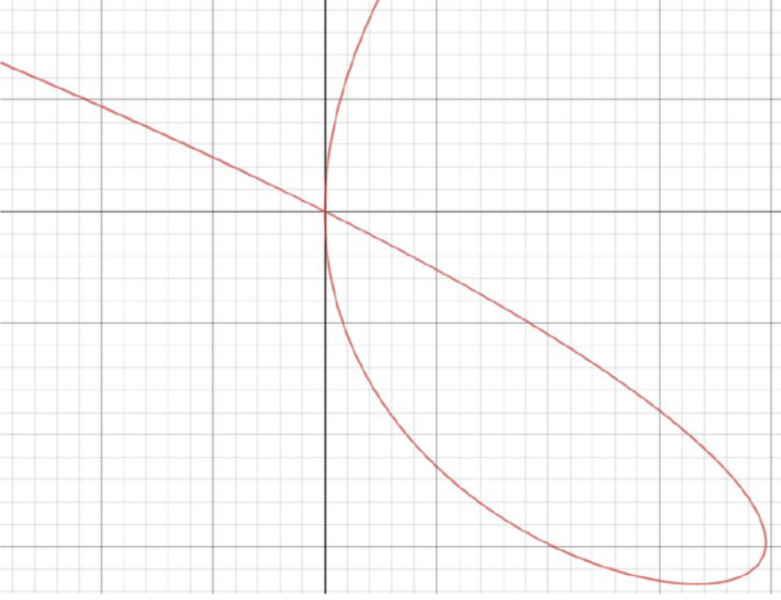
The graph of the curve defined by the implicit equation

3y32xy=x23y^3 - 2xy = x^2

is given.
Current Exercise Image

Exercise Tags

Curve Sketching

Tag:

Use the tag filtering feature on the course homepage to find all exercises with this tag.

Prerequisites for this Exercise

No prerequisite skills selected yet.

Sub-questions:

E2 Part a)
Difficulty: 1/10
Find dydx \frac{dy}{dx} .

Exercise Tags

differentiation: implicit

Tag:

Use the tag filtering feature on the course homepage to find all exercises with this tag.

Prerequisites for this Exercise

No prerequisite skills selected yet.

Step 1: Implicitly differentiate both sides with respect to x x


We start with the implicit equation:

3y32xy=x2
3y^3 - 2xy = x^2


Differentiate both sides with respect to x x . For terms involving y y , we will use the chain rule because y y is a function of x x .

ddx(3y3)ddx(2xy)=ddx(x2)
\frac{d}{dx}(3y^3) - \frac{d}{dx}(2xy) = \frac{d}{dx}(x^2)


**First term**: ddx(3y3) \frac{d}{dx}(3y^3)

Using the chain rule:

ddx(3y3)=9y2dydx
\frac{d}{dx}(3y^3) = 9y^2 \cdot \frac{dy}{dx}


**Second term**: ddx(2xy) \frac{d}{dx}(2xy)

Using the product rule:

ddx(2xy)=2(xddx(y)+yddx(x))=2(xdydx+y)
\frac{d}{dx}(2xy) = 2 \left( x \frac{d}{dx}(y) + y \frac{d}{dx}(x) \right) = 2 \left( x \frac{dy}{dx} + y \right)


**Third term**: ddx(x2) \frac{d}{dx}(x^2)

ddx(x2)=2x\frac{d}{dx}(x^2) = 2x

Now, putting everything together:

9y2dydx2(xdydx+y)=2x
9y^2 \cdot \frac{dy}{dx} - 2 \left( x \frac{dy}{dx} + y \right) = 2x


Step 2: Solve for dydx \frac{dy}{dx}


Distribute the 2 -2 :

9y2dydx2xdydx2y=2x
9y^2 \cdot \frac{dy}{dx} - 2x \cdot \frac{dy}{dx} - 2y = 2x


Now group terms involving dydx \frac{dy}{dx} :

(9y22x)dydx=2x+2y
(9y^2 - 2x) \frac{dy}{dx} = 2x + 2y


Solve for dydx \frac{dy}{dx} :

dydx=2x+2y9y22x
\boxed{\frac{dy}{dx} = \frac{2x + 2y}{9y^2 - 2x}}
dydx=2x+2y9y22x
\boxed{\frac{dy}{dx} = \frac{2x + 2y}{9y^2 - 2x}}
E2 Part b)
Difficulty: 1/10
Find the equation in the form y=mx+c y = mx + c of the tangent line at (3,1) (-3, 1) .

Exercise Tags

point slope form

Tag:

Use the tag filtering feature on the course homepage to find all exercises with this tag.

Prerequisites for this Exercise

No prerequisite skills selected yet.

Step 1: Use the derivative from part (a)


From part (a), we found the derivative of the curve to be:

dydx=2x+2y9y22x
\frac{dy}{dx} = \frac{2x + 2y}{9y^2 - 2x}


We need to find the slope of the tangent line at (3,1) (-3, 1) .

Substitute x=3 x = -3 and y=1 y = 1 into the derivative:

dydx=2(3)+2(1)9(1)22(3)
\frac{dy}{dx} = \frac{2(-3) + 2(1)}{9(1)^2 - 2(-3)}


Simplify:

dydx=6+29+6=415
\frac{dy}{dx} = \frac{-6 + 2}{9 + 6} = \frac{-4}{15}


Thus, the slope of the tangent line at (3,1) (-3, 1) is m=415 m = \frac{-4}{15} .

Step 2: Use the point-slope form to find the equation of the tangent line


The point-slope form of the equation of a line is:

yy1=m(xx1)
y - y_1 = m(x - x_1)


Substitute the point (3,1) (-3, 1) and the slope m=415 m = \frac{-4}{15} :

y1=415(x(3))
y - 1 = \frac{-4}{15}(x - (-3))


Simplify:

y1=415(x+3)
y - 1 = \frac{-4}{15}(x + 3)


Step 3: Convert to slope-intercept form


Now, expand the equation:

y1=415x45
y - 1 = \frac{-4}{15}x - \frac{4}{5}


Add 1 to both sides to solve for y y :

y=415x45+1
y = \frac{-4}{15}x - \frac{4}{5} + 1


Simplify:

y=415x+15
y = \frac{-4}{15}x + \frac{1}{5}


Thus, the equation of the tangent line is:

y=415x+15
\boxed{y = \frac{-4}{15}x + \frac{1}{5}}
y=415x+15
\boxed{y = \frac{-4}{15}x + \frac{1}{5}}