Practice Final #6

Full Course
McGill University, MATH 122

Exam Settings

Show Tags
Show Difficulty
Back to Course

Short Answer Questions

Short Answer
A1
Difficulty: 2/10
(Max Marks: 3)
Evaluate x3x3t3sin(t4)dt \int_{-x^3}^{x^3} t^3 \sin(t^4) \, dt .

Exercise Tags

integrals
Integrals: Symmetry

Tag:

Use the tag filtering feature on the course homepage to find all exercises with this tag.

Prerequisites for this Exercise

No prerequisite skills selected yet.

Evaluate x3x3t3sin(t4)dt \int_{-x^3}^{x^3} t^3 \sin(t^4) \, dt .

Step 1: Check for symmetry


Always check for symmetry properties first when evaluating definite integrals over intervals like [-a,a]. This can save significant calculation time.

Let's examine if the integrand t3sin(t4) t^3 \sin(t^4) has symmetry properties:
- t4 t^4 is even (same value for t t and t -t )
- sin(t4) \sin(t^4) will have the same value at t t and t -t since t4 t^4 is even
- t3 t^3 is odd (changes sign when t t changes to t -t )

Therefore, t3sin(t4) t^3 \sin(t^4) is an odd function because an even function multiplied by an odd function results in another odd function:
(t)3sin((t)4)=t3sin(t4) (-t)^3 \sin((-t)^4) = -t^3 \sin(t^4)

Step 2: Apply symmetry property of odd functions


For any odd function f(t)=f(t) f(-t) = -f(t) , the definite integral over a symmetric interval [a,a] [-a, a] is always zero:

aaf(t)dt=0 \int_{-a}^{a} f(t) \, dt = 0

Since our integrand is odd and the interval [x3,x3] [-x^3, x^3] is symmetric about the origin, we can immediately conclude:

x3x3t3sin(t4)dt=0 \boxed{\int_{-x^3}^{x^3} t^3 \sin(t^4) \, dt = 0}

Prof's perspective


This problem tests your ability to:

1. Recognize and apply symmetry properties of functions
2. Understand how odd functions behave when integrated over symmetric intervals

The professor included this problem to teach you to always look for structural properties and symmetry before attempting more complicated integration techniques. Recognizing oddness/evenness can save significant time and effort in many calculus problems.
x3x3t3sin(t4)dt=0 \boxed{\int_{-x^3}^{x^3} t^3 \sin(t^4) \, dt = 0}
A2
Difficulty: 4/10
(Max Marks: 3)
Find the area of one complete positive region bounded by the curve y=2cos(x) y = 2\cos(x) and the x-axis.

Exercise Tags

integrals
Area: General

Tag:

Use the tag filtering feature on the course homepage to find all exercises with this tag.

Prerequisites for this Exercise

No prerequisite skills selected yet.

Find the area of one complete positive region bounded by the curve y=2cos(x) y = 2\cos(x) and the x-axis.

Step 1: Understand the region we're finding


We need to find the area of one complete positive region bounded by:
- The curve y=2cos(x) y = 2\cos(x)
- The x-axis where y=0 y = 0

Step 2: Find the points of intersection with the x-axis


At the x-axis, y=0 y = 0 :

0=2cos(x) 0 = 2\cos(x)
cos(x)=0 \cos(x) = 0

This occurs at x=π2+nπ x = \frac{\pi}{2} + n\pi for integer values of n n .

Since we want one complete positive region, we need to identify where the function is positive. The cosine function is positive in the interval (π2,π2)+2nπ (-\frac{\pi}{2}, \frac{\pi}{2}) + 2n\pi for integer values of n n .

For simplicity, let's choose the interval [π2,π2] [-\frac{\pi}{2}, \frac{\pi}{2}] , which contains one complete positive region.

Step 3: Analyze the function behavior


In the interval [π2,π2] [-\frac{\pi}{2}, \frac{\pi}{2}] , the cosine function is positive, with its maximum value of 1 at x=0 x = 0 . This means our function y=2cos(x) y = 2\cos(x) is non-negative throughout the interval and reaches a maximum value of 2 at x=0 x = 0 .

Step 4: Set up the integral


For a region bounded by y=f(x) y = f(x) , the x-axis, x=a x = a , and x=b x = b , the area is abf(x)dx \int_{a}^{b} f(x) \, dx

For our problem:
Area=π2π22cos(x)dx \text{Area} = \int_{-\frac{\pi}{2}}^{\frac{\pi}{2}} 2\cos(x) \, dx

Step 5: Evaluate the integral


Area=π2π22cos(x)dx \text{Area} = \int_{-\frac{\pi}{2}}^{\frac{\pi}{2}} 2\cos(x) \, dx
=2π2π2cos(x)dx = 2\int_{-\frac{\pi}{2}}^{\frac{\pi}{2}} \cos(x) \, dx
=2sin(x)π2π2 = 2\sin(x) \Big|_{-\frac{\pi}{2}}^{\frac{\pi}{2}}


=2[sin(π2)sin(π2)] = 2[\sin(\frac{\pi}{2}) - \sin(-\frac{\pi}{2})]
=2[1(1)] = 2[1 - (-1)]
=22 = 2 \cdot 2
=4 = 4


Therefore:
Area=4 square units \boxed{\text{Area} = 4 \text{ square units}}
A3
Difficulty: 3/10
(Max Marks: 3)
Find G(x) G'(x) , given:

G(x)=1x35+t1+sin2(t)dt G(x) = \int_{1}^{x^3} \frac{5+t}{1+\sin^2(t)} dt

Exercise Tags

Fundamental Theorem of Calculus
Differentiation: general

Tag:

Use the tag filtering feature on the course homepage to find all exercises with this tag.

Prerequisites for this Exercise

No prerequisite skills selected yet.

Find G(x) G'(x) , given:

G(x)=1x35+t1+sin2(t)dt G(x) = \int_{1}^{x^3} \frac{5+t}{1+\sin^2(t)} dt

Step 1: Identify the problem


We need to find the derivative G(x) G'(x) of a function defined by a definite integral with a variable upper limit.

Step 2: Apply the Fundamental Theorem of Calculus


Using the Fundamental Theorem of Calculus:

If G(x)=ag(x)f(t)dt G(x) = \int_{a}^{g(x)} f(t) dt , then G(x)=f(g(x))g(x) G'(x) = f(g(x)) \cdot g'(x)

In our case:
- g(x)=x3 g(x) = x^3 (the upper limit of integration)
- f(t)=5+t1+sin2(t) f(t) = \frac{5+t}{1+\sin^2(t)} (the integrand)
- g(x)=3x2 g'(x) = 3x^2 (the derivative of the upper limit)

Step 3: Substitute into the formula


G(x)=f(g(x))g(x)=f(x3)3x2=5+x31+sin2(x3)3x2 G'(x) = f(g(x)) \cdot g'(x) = f(x^3) \cdot 3x^2 = \frac{5+x^3}{1+\sin^2(x^3)} \cdot 3x^2


Step 4: Simplify the expression


G(x)=3x2(5+x3)1+sin2(x3)=15x2+3x51+sin2(x3) G'(x) = \frac{3x^2(5+x^3)}{1+\sin^2(x^3)} = \frac{15x^2+3x^5}{1+\sin^2(x^3)}


Therefore:

G(x)=15x2+3x51+sin2(x3) \boxed{G'(x) = \frac{15x^2+3x^5}{1+\sin^2(x^3)}}

Prof's perspective


Your professor designed this problem to test your understanding of the Fundamental Theorem of Calculus with variable limits.
G(x)=15x2+3x51+sin2(x3) \boxed{G'(x) = \frac{15x^2+3x^5}{1+\sin^2(x^3)}}
A4
Difficulty: 3/10
Find

limx2(tan((x3x2x2)πx2+17x38))
\lim_{x \to 2} \left( \tan \left( \frac{(x^3 - x^2 - x - 2)\pi }{x^2 + 17x - 38} \right) \right)

Exercise Tags

factoring: grouping
unit circle values
limits: general

Tag:

Use the tag filtering feature on the course homepage to find all exercises with this tag.

Prerequisites for this Exercise

No prerequisite skills selected yet.

PREMIUM WALKTHROUGH

Unlock Premium Content

Get instant access to detailed walkthroughs, step-by-step explanations, and exclusive learning materials.

Unlock Now
Secure & Instant Access
Step 1: Simplify the expression inside the tangent function


To evaluate this limit, start by simplifying the expression within the tangent function. We’ll try factoring the numerator and the denominator.
The numerator x3x2x2 x^3 - x^2 - x - 2 can be factored by grouping terms.

Factoring by Grouping


To factor x3x2x2 x^3 - x^2 - x - 2 , we group the terms in pairs:

x3x2x2=(x3x2)(x+2)
x^3 - x^2 - x - 2 = (x^3 - x^2) - (x + 2)


Now, factor out x2 x^2 from the first group and factor out 1 -1 from the second group:

=x2(x1)1(x1)
= x^2(x - 1) - 1(x - 1)


Now we have a common factor of (x2) (x - 2) :

=(x2)(x2+x+1)
= (x - 2)(x^2 + x + 1)


The denominator x2+17x38 x^2 + 17x - 38 factors as:

x2+17x38=(x2)(x+19)
x^2 + 17x - 38 = (x - 2)(x + 19)


So, the expression becomes:

tan((x2)(x2+x+1)(x2)(x+19)π)
\tan \left( \frac{(x - 2)(x^2 + x + 1)}{(x - 2)(x + 19)} \pi \right)


Step 2: Cancel common terms


Now, cancel the common factor (x2) (x - 2) from both the numerator and the denominator:

tan(x2+x+1x+19π)
\tan \left( \frac{x^2 + x + 1}{x + 19} \pi \right)


Step 3: Substitute the limit


Now that we’ve simplified the expression, we can substitute x=2 x = 2 directly:

tan(22+2+12+19π)=
\tan \left( \frac{2^2 + 2 + 1}{2 + 19} \pi \right) =


tan(4+2+121π)=
\tan \left( \frac{4 + 2 + 1}{21} \pi \right) =


tan(721π)=
\tan \left( \frac{7}{21} \pi \right) =


tan(π3)
\tan \left( \frac{\pi}{3} \right)


Tip: You need to know the unit circle and the values of common trigonometric functions at special angles, such as π3 \frac{\pi}{3} , to solve problems like this.


Since tan(π3)=3 \tan \left( \frac{\pi}{3} \right) = \sqrt{3} , we have:

3
\boxed{\sqrt{3}}


Prof's perspective


This question is designed to test your ability to handle limits involving trigonometric functions, especially by simplifying rational expressions through factoring. The professor likely included this question to emphasize the importance of **factoring and cancelling terms** before evaluating limits, a common approach in calculus to avoid indeterminate forms.
PREMIUM SOLUTION

Unlock Premium Content

Get instant access to detailed solutions, step-by-step explanations, and exclusive learning materials.

Unlock Now
Secure & Instant Access
3
\boxed{\sqrt{3}}
A5
Difficulty: 3/10
Find ddx(1+exx2+9). \frac{d}{dx} \left( \frac{1 + e^x}{x^2 + 9} \right).

Exercise Tags

quotient rule
Differentiation: general

Tag:

Use the tag filtering feature on the course homepage to find all exercises with this tag.

Prerequisites for this Exercise

No prerequisite skills selected yet.

PREMIUM WALKTHROUGH

Unlock Premium Content

Get instant access to detailed walkthroughs, step-by-step explanations, and exclusive learning materials.

Unlock Now
Secure & Instant Access
Step 1: Recognize the need for the quotient rule


To differentiate 1+exx2+9 \frac{1 + e^x}{x^2 + 9} , we use the quotient rule, which states:

Quotient Rule: If f(x)=uv f(x) = \frac{u}{v} , then f(x)=uvuvv2 f'(x) = \frac{u'v - uv'}{v^2}

In this case:
- u=1+ex u = 1 + e^x
- v=x2+9 v = x^2 + 9

Step 2: Differentiate the numerator and denominator


**Derivative of** u=1+ex u = 1 + e^x :

u=ddx(1+ex)=ex
u' = \frac{d}{dx} (1 + e^x) = e^x


**Derivative of** v=x2+9 v = x^2 + 9 :

v=ddx(x2+9)=2x
v' = \frac{d}{dx} (x^2 + 9) = 2x


Step 3: Apply the quotient rule


Now, substitute u u , u u' , v v , and v v' into the quotient rule formula:


ddx(1+exx2+9)=(ex)(x2+9)(1+ex)(2x)(x2+9)2
\frac{d}{dx} \left( \frac{1 + e^x}{x^2 + 9} \right) = \frac{(e^x)(x^2 + 9) - (1 + e^x)(2x)}{(x^2 + 9)^2}


Step 4: Simplify the expression (if possible)


Distribute ex e^x and 2x 2x :

=exx2+9ex2x2xex(x2+9)2
= \frac{e^x \cdot x^2 + 9e^x - 2x - 2x e^x}{(x^2 + 9)^2}


exx2+9ex2x2xex(x2+9)2
\boxed{\frac{e^x \cdot x^2 + 9e^x - 2x - 2x e^x}{(x^2 + 9)^2}}
PREMIUM SOLUTION

Unlock Premium Content

Get instant access to detailed solutions, step-by-step explanations, and exclusive learning materials.

Unlock Now
Secure & Instant Access
exx2+9ex2x2xex(x2+9)2
\boxed{\frac{e^x \cdot x^2 + 9e^x - 2x - 2x e^x}{(x^2 + 9)^2}}

Long Answer Questions

Long Answer
B1
Difficulty: 1/10
(Max Marks: 3)
Determine whether the following improper integral converges or diverges:
02dx(2x)4/3. \int_{0}^{2} \frac{dx}{(2-x)^{4/3}}.

Exercise Tags

integrals
Integrals: Improper

Tag:

Use the tag filtering feature on the course homepage to find all exercises with this tag.

Prerequisites for this Exercise

No prerequisite skills selected yet.

Step 1: Identify the improper behavior


For the integral
02dx(2x)4/3 \int_{0}^{2} \frac{dx}{(2-x)^{4/3}}
you need to identify where the integrand becomes improper.

The denominator
(2x)4/3 (2-x)^{4/3}
equals zero when x=2 x = 2 , which is the upper limit of integration. This makes the integral improper since the integrand becomes unbounded at x=2 x = 2 .

When evaluating improper integrals, check if the integrand becomes unbounded at any point in the interval of integration, including the endpoints.

Step 2: Convert to a limit


To handle the improper behavior at x=2 x = 2 , rewrite the integral as a limit:

02dx(2x)4/3 \int_{0}^{2} \frac{dx}{(2-x)^{4/3}}
=limb20bdx(2x)4/3 = \lim_{b \to 2^-} \int_{0}^{b} \frac{dx}{(2-x)^{4/3}}

Step 3: Evaluate the indefinite integral


First, find the indefinite integral:

dx(2x)4/3 \int \frac{dx}{(2-x)^{4/3}}

Use substitution with u=2x u = 2-x , so du=dx du = -dx or dx=du dx = -du :

dx(2x)4/3 \int \frac{dx}{(2-x)^{4/3}}
=duu4/3 = -\int \frac{du}{u^{4/3}}
=u4/3du = -\int u^{-4/3} \, du

Apply the power rule:

u4/3du -\int u^{-4/3} \, du
=u4/3+14/3+1+C = -\frac{u^{-4/3+1}}{-4/3+1} + C
=u1/31/3+C = -\frac{u^{-1/3}}{-1/3} + C
=3u1/3+C = 3u^{-1/3} + C
=3(2x)1/3+C = \frac{3}{(2-x)^{1/3}} + C

Step 4: Evaluate the definite integral as a limit


Now evaluate using the limits:

limb20bdx(2x)4/3 \lim_{b \to 2^-} \int_{0}^{b} \frac{dx}{(2-x)^{4/3}}
=limb2[3(2x)1/3]0b = \lim_{b \to 2^-} \left[ \frac{3}{(2-x)^{1/3}} \right]_{0}^{b}
=limb2(3(2b)1/33(20)1/3) = \lim_{b \to 2^-} \left( \frac{3}{(2-b)^{1/3}} - \frac{3}{(2-0)^{1/3}} \right)
=limb2(3(2b)1/3321/3) = \lim_{b \to 2^-} \left( \frac{3}{(2-b)^{1/3}} - \frac{3}{2^{1/3}} \right)

As b b approaches 2 2 , the term
3(2b)1/3 \frac{3}{(2-b)^{1/3}}
approaches infinity:

limb23(2b)1/3= \lim_{b \to 2^-} \frac{3}{(2-b)^{1/3}} = \infty

Therefore:

limb2(3(2b)1/3321/3) \lim_{b \to 2^-} \left( \frac{3}{(2-b)^{1/3}} - \frac{3}{2^{1/3}} \right)
=321/3 = \infty - \frac{3}{2^{1/3}}
= = \infty

Step 5: Conclusion


Since the limit diverges to infinity, the improper integral diverges:

The improper integral 02dx(2x)4/3 diverges \boxed{\text{The improper integral } \int_{0}^{2} \frac{dx}{(2-x)^{4/3}} \text{ diverges}}
B2
Difficulty: 1/10
(Max Marks: 3)
Find the area of the region enclosed between y=sin2x y = \sin^2 x and y=cos2x y = \cos^2 x from x=0 x = 0 to x=π2 x = \frac{\pi}{2} .

Exercise Tags

Formula: Double and Half-Angle
integrals
Find Intersection Points

Tag:

Use the tag filtering feature on the course homepage to find all exercises with this tag.

Prerequisites for this Exercise

No prerequisite skills selected yet.

Find the area of the region enclosed between y=sin2x y = \sin^2 x and y=cos2x y = \cos^2 x from x=0 x = 0 to x=π2 x = \frac{\pi}{2} .

Step 1: Understand the region


We need to find the area between the curves y=sin2x y = \sin^2 x and y=cos2x y = \cos^2 x over the interval [0,π2] [0, \frac{\pi}{2}] .

First, let's evaluate these functions at the endpoints:

At x=0 x = 0 :
sin2(0)=0 \sin^2(0) = 0
cos2(0)=1 \cos^2(0) = 1

At x=π2 x = \frac{\pi}{2} :
sin2(π2)=1 \sin^2(\frac{\pi}{2}) = 1
cos2(π2)=0 \cos^2(\frac{\pi}{2}) = 0

Step 2: Find the intersection point


Let's find where sin2x=cos2x \sin^2 x = \cos^2 x :
sin2x=cos2x \sin^2 x = \cos^2 x

Since sin2x+cos2x=1 \sin^2 x + \cos^2 x = 1 , we have:
sin2x=cos2x=12 \sin^2 x = \cos^2 x = \frac{1}{2}

This occurs when sinx=cosx=12 \sin x = \cos x = \frac{1}{\sqrt{2}} , which happens at x=π4 x = \frac{\pi}{4} .

Step 3: Set up the integral


Based on our analysis:
- For 0<x<π4 0 < x < \frac{\pi}{4} : cos2x>sin2x \cos^2 x > \sin^2 x
- For π4<x<π2 \frac{\pi}{4} < x < \frac{\pi}{2} : sin2x>cos2x \sin^2 x > \cos^2 x

When finding area between curves that cross, split the integral at intersection points and use absolute value of the difference in each region.

Using the tip: the area is calculated as:


Area \text{Area}
=0π4(cos2xsin2x)dx+π4π2(sin2xcos2x)dx = \int_{0}^{\frac{\pi}{4}} (\cos^2 x - \sin^2 x) \, dx + \int_{\frac{\pi}{4}}^{\frac{\pi}{2}} (\sin^2 x - \cos^2 x) \, dx


Step 4: Simplify using trigonometric identities


When working with expressions like sin2xcos2x\sin^2 x - \cos^2 x or cos2xsin2x\cos^2 x - \sin^2 x, always try to apply the double angle formula cos(2x)=cos2xsin2x\cos(2x) = \cos^2 x - \sin^2 x to simplify integration.


We can simplify using the identity cos2xsin2x=cos(2x) \cos^2 x - \sin^2 x = \cos(2x) :


Area=0π4cos(2x)dx+π4π2(cos(2x))dx \text{Area} = \int_{0}^{\frac{\pi}{4}} \cos(2x) \, dx + \int_{\frac{\pi}{4}}^{\frac{\pi}{2}} (-\cos(2x)) \, dx
=0π4cos(2x)dxπ4π2cos(2x)dx = \int_{0}^{\frac{\pi}{4}} \cos(2x) \, dx - \int_{\frac{\pi}{4}}^{\frac{\pi}{2}} \cos(2x) \, dx


Step 5: Evaluate the integrals


cos(2x)dx=12sin(2x)+C \int \cos(2x) \, dx = \frac{1}{2}\sin(2x) + C


0π4cos(2x)dx=12sin(2x)0π4 \int_{0}^{\frac{\pi}{4}} \cos(2x) \, dx = \frac{1}{2}\sin(2x) \Big|_{0}^{\frac{\pi}{4}}
=12sin(π2)12sin(0) = \frac{1}{2}\sin(\frac{\pi}{2}) - \frac{1}{2}\sin(0)
=1210 = \frac{1}{2} \cdot 1 - 0
=12 = \frac{1}{2}

π4π2cos(2x)dx=12sin(2x)π4π2 \int_{\frac{\pi}{4}}^{\frac{\pi}{2}} \cos(2x) \, dx = \frac{1}{2}\sin(2x) \Big|_{\frac{\pi}{4}}^{\frac{\pi}{2}}
=12sin(π)12sin(π2) = \frac{1}{2}\sin(\pi) - \frac{1}{2}\sin(\frac{\pi}{2})
=012 = 0 - \frac{1}{2}
=12 = -\frac{1}{2}


Step 6: Calculate the total area


Total Area=12(12)=12+12=1 \text{Total Area} = \frac{1}{2} - (-\frac{1}{2}) = \frac{1}{2} + \frac{1}{2} = 1


Therefore:

The area between y=sin2x and y=cos2xfrom x=0 to x=π2 is 1 \boxed{ \begin{array}{c}
\text{The area between } y = \sin^2 x \text{ and } y = \cos^2 x \\
\text{from } x = 0 \text{ to } x = \frac{\pi}{2} \text{ is } 1
\end{array} }


Prof's perspective


This problem tests your ability to:

1. Recognize trigonometric identities that simplify the calculation
2. Find intersection points of curves algebraically
3. Set up integrals correctly based on where one curve is above the other
4. Use the double-angle formula for cosine to simplify integration
1 \boxed{ 1}
B3
Difficulty: 6/10
Find the domain of the function

ln(cot1(x2)π6)\ln \left( \cot^{-1}(x^2) - \frac{\pi}{6} \right)

Exercise Tags

logarithms
find the domain
inverse trig functions
unit circle values

Tag:

Use the tag filtering feature on the course homepage to find all exercises with this tag.

Prerequisites for this Exercise

No prerequisite skills selected yet.

PREMIUM WALKTHROUGH

Unlock Premium Content

Get instant access to detailed walkthroughs, step-by-step explanations, and exclusive learning materials.

Unlock Now
Secure & Instant Access
Step 1: Determine the domain of the logarithmic function


For the natural logarithm ln(y) \ln(y) , the argument y y must be greater than zero. In this case that means:

cot1(x2)π6>0
\cot^{-1}(x^2) - \frac{\pi}{6} > 0


which is therefore our first condition that we need to satisfy.

Step 2: Analyze the domain of cot1(x2) \cot^{-1}(x^2)


The function cot1(x2) \cot^{-1}(x^2) is defined for all x x because x20 x^2 \geq 0 for all real values of x x .

So there are no added restrictions on the domain from cot1(x2) \cot^{-1}(x^2) .

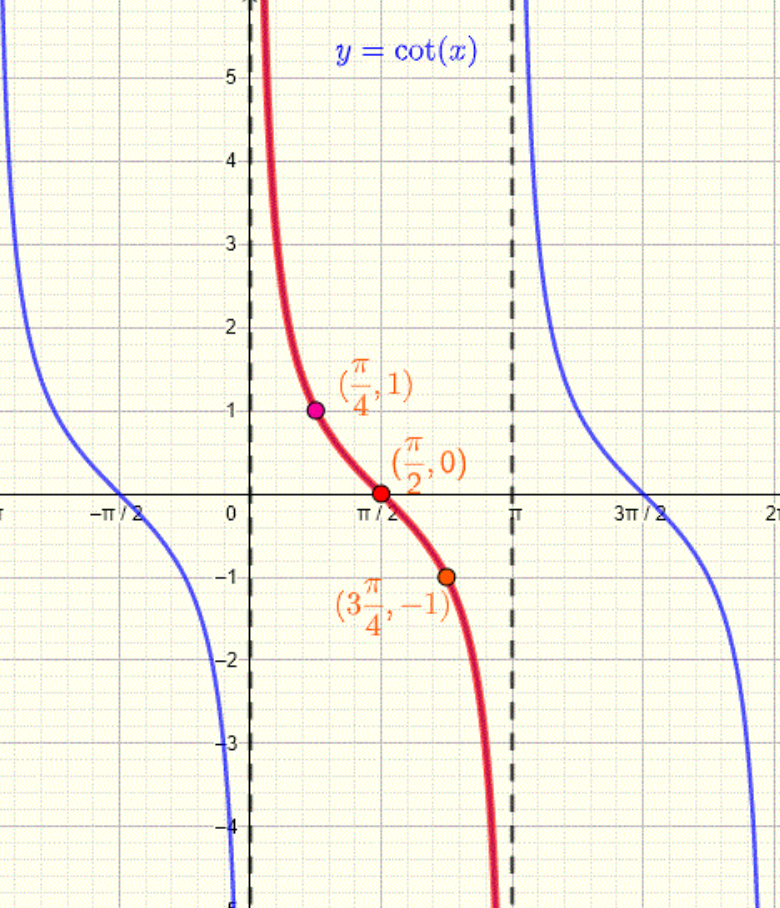
You need to know the graph of cot(x)\cot(x). You can use this for finding info about cot1(x)\cot^{-1}(x) by switching axis.


cotangent graph

Figure: graph of cotangent


You also will need to know the unit circle values.


Step 3: Set up the inequality


To satisfy the condition for the logarithm, we need:

cot1(x2)π6>0
\cot^{-1}(x^2) - \frac{\pi}{6} > 0


This simplifies to:

cot1(x2)>π6
\cot^{-1}(x^2) > \frac{\pi}{6}


Step 4: Solve for x x


Now, we find the values of x x such that cot1(x2)>π6 \cot^{-1}(x^2) > \frac{\pi}{6} .

Since cot1(x2) \cot^{-1}(x^2) decreases as x2 x^2 increases, we need:

x2<cot(π6)
x^2 < \cot\left( \frac{\pi}{6} \right)


From the unit circle, we know cot(π6)=3 \cot\left( \frac{\pi}{6} \right) = \sqrt{3} , so:

x2<3
x^2 < \sqrt{3}


Taking the square root of both sides:

x<34
|x| < \sqrt[4]{3}


Thus, the domain of the function is:

34<x<34
\boxed{-\sqrt[4]{3} < x < \sqrt[4]{3}}


Prof's perspective


This problem tests your understanding of the domain of composite functions, especially when involving inverse trigonometric functions and logarithms. The professor likely included this question to ensure you know how to work with domain restrictions and analyze inequalities involving inverse trigonometric expressions.
PREMIUM SOLUTION

Unlock Premium Content

Get instant access to detailed solutions, step-by-step explanations, and exclusive learning materials.

Unlock Now
Secure & Instant Access
34<x<34
\boxed{-\sqrt[4]{3} < x < \sqrt[4]{3}}