Practice Final #2

Full Course
McGill University, MATH 122

Exam Settings

Show Tags
Show Difficulty
Back to Course

Short Answer Questions

Short Answer
A1
Difficulty: 3/10
Let the function be defined by
f(x)={sinh(x)if x<0,b3cos(x)if x0. f(x) =
\begin{cases}
\sinh(x) & \text{if } x < 0, \\
b - 3\cos(x) & \text{if } x \geq 0.
\end{cases}

Find the value of bb that makes f(x)f(x) continuous everywhere.

Exercise Tags

hyperbolic trig functions
Piecewise functions
continuity

Tag:

Use the tag filtering feature on the course homepage to find all exercises with this tag.

Prerequisites for this Exercise

No prerequisite skills selected yet.

Step 1: Understand what continuity means


For a piecewise function to be continuous at the transition point (in this case x=0x = 0), the limits from both sides must be equal:

limx0f(x)=limx0+f(x) \begin{align*}
& \lim_{x \to 0^-} f(x) = \lim_{x \to 0^+} f(x)
\end{align*}


Step 2: Calculate the left-hand limit


The left-hand limit uses the first piece of the function:

limx0f(x)=limx0sinh(x)=sinh(0)=0 \begin{align*}
& \lim_{x \to 0^-} f(x) \\
&= \lim_{x \to 0^-} \sinh(x) \\
&= \sinh(0) \\
&= 0
\end{align*}


Step 3: Calculate the right-hand limit


The right-hand limit uses the second piece:

limx0+f(x)=limx0+(b3cos(x))=b3cos(0)=b3(1)=b3 \begin{align*}
& \lim_{x \to 0^+} f(x) \\
&= \lim_{x \to 0^+} (b - 3\cos(x)) \\
&= b - 3\cos(0) \\
&= b - 3(1) \\
&= b - 3
\end{align*}


Step 4: Set the limits equal


For continuity, these limits must be equal:

limx0f(x)=limx0+f(x) \lim_{x \to 0^-} f(x) = \lim_{x \to 0^+} f(x)
sinh(0)=b3cos(0) \sinh(0) = b - 3\cos(0)
0=b3(1) 0 = b - 3(1)
0=b3 0 = b - 3
b=3 b = 3

When working with piecewise functions, always check the value of each piece at the transition point to ensure continuity.

Therefore, the value of bb that makes f(x)f(x) continuous everywhere is:

b=3 \boxed{b = 3}
b=3 \boxed{b = 3}
A2
Difficulty: 3/10
Find dydx\frac{dy}{dx} if tanh(x)=xy\tanh(x) = xy at the point (1,tanh(1))(1, \tanh(1)).

Exercise Tags

differentiation: implicit
hyperbolic trig functions
Differentiation: general

Tag:

Use the tag filtering feature on the course homepage to find all exercises with this tag.

Prerequisites for this Exercise

No prerequisite skills selected yet.

Step 1: Use implicit differentiation


We need to differentiate both sides of the equation with respect to xx:
tanh(x)=xy \begin{align*}
\tanh(x) &= xy
\end{align*}


Differentiating the left side:
ddx[tanh(x)]=sech2(x) \begin{align*}
\frac{d}{dx}[\tanh(x)] &= \text{sech}^2(x)
\end{align*}


Differentiating the right side:
ddx[xy]=y+xdydx \begin{align*}
\frac{d}{dx}[xy] &= y + x\frac{dy}{dx}
\end{align*}


Step 2: Set the derivatives equal and solve for dydx\frac{dy}{dx}


sech2(x)=y+xdydxsech2(x)y=xdydxdydx=sech2(x)yx \begin{align*}
\text{sech}^2(x) &= y + x\frac{dy}{dx} \\
\text{sech}^2(x) - y &= x\frac{dy}{dx} \\
\frac{dy}{dx} &= \frac{\text{sech}^2(x) - y}{x}
\end{align*}


Step 3: Evaluate at the given point


At the point (1,tanh(1))(1, \tanh(1)), we have x=1x = 1 and y=tanh(1)y = \tanh(1).

Let's substitute these values:
dydx(1,tanh(1))=sech2(1)tanh(1)1=sech2(1)tanh(1) \begin{align*}
\frac{dy}{dx}\bigg|_{(1,\tanh(1))} &= \frac{\text{sech}^2(1) - \tanh(1)}{1} \\
&= \text{sech}^2(1) - \tanh(1)
\end{align*}


Now we need to calculate these values:
sech2(1)=1cosh2(1)=1(e+e12)2=4(e+e1)2 \begin{align*}
\text{sech}^2(1) &= \frac{1}{\cosh^2(1)} \\
&= \frac{1}{(\frac{e + e^{-1}}{2})^2} \\
&= \frac{4}{(e + e^{-1})^2}
\end{align*}


And:
tanh(1)=sinh(1)cosh(1)=ee12e+e12=ee1e+e1 \begin{align*}
\tanh(1) &= \frac{\sinh(1)}{\cosh(1)} \\
&= \frac{\frac{e - e^{-1}}{2}}{\frac{e + e^{-1}}{2}} \\
&= \frac{e - e^{-1}}{e + e^{-1}}
\end{align*}


Therefore:

dydx=4(e+e1)2ee1e+e1=4(e+e1)2(ee1)(e+e1)(e+e1)2=4(e2e2)(e+e1)2=4(e2e2)(e+e1)2 \begin{align*}
\frac{dy}{dx} &= \frac{4}{(e + e^{-1})^2} - \frac{e - e^{-1}}{e + e^{-1}} \\
&= \frac{4}{(e + e^{-1})^2} - \frac{(e - e^{-1})(e + e^{-1})}{(e + e^{-1})^2} \\
&= \frac{4 - (e^2 - e^{-2})}{(e + e^{-1})^2} \\
&= \frac{4 - (e^2 - e^{-2})}{(e + e^{-1})^2}
\end{align*}


We can simplify further:
dydx=4e2+e2(e+e1)2 \begin{align*}
\frac{dy}{dx} &= \frac{4 - e^2 + e^{-2}}{(e + e^{-1})^2}
\end{align*}


Therefore:
dydx=4e2+e2(e+e1)2\boxed{\frac{dy}{dx} = \frac{4 - e^2 + e^{-2}}{(e + e^{-1})^2}}

When differentiating hyperbolic functions, remember that ddx[tanh(x)]=sech2(x)=1cosh2(x)\frac{d}{dx}[\tanh(x)] = \text{sech}^2(x) = \frac{1}{\cosh^2(x)}, similar to how the derivative of tan(x)\tan(x) is sec2(x)\sec^2(x) for trigonometric functions.
dydx=4e2+e2(e+e1)2\boxed{\frac{dy}{dx} = \frac{4 - e^2 + e^{-2}}{(e + e^{-1})^2}}
A3
Difficulty: 2/10
Let f(x)=3x235x34f(x) = 3x^{\frac{2}{3}} - 5x^{-\frac{3}{4}}. Find f(1)f'(1).

Exercise Tags

taking derivatives

Tag:

Use the tag filtering feature on the course homepage to find all exercises with this tag.

Prerequisites for this Exercise

No prerequisite skills selected yet.

Let f(x)=3x235x34f(x) = 3x^{\frac{2}{3}} - 5x^{-\frac{3}{4}}. Find f(1)f'(1).

Step 1: Find the derivative of f(x)f(x)


We need to use the power rule for differentiation: ddx(xn)=nxn1\frac{d}{dx}(x^n) = nx^{n-1}

For the first term: 3x233x^{\frac{2}{3}}
ddx(3x23)=323x231=2x13=2x13 \begin{align*}
\frac{d}{dx}(3x^{\frac{2}{3}}) &= 3 \cdot \frac{2}{3} \cdot x^{\frac{2}{3}-1} \\
&= 2 \cdot x^{-\frac{1}{3}} \\
&= \frac{2}{x^{\frac{1}{3}}}
\end{align*}


For the second term: 5x34-5x^{-\frac{3}{4}}
ddx(5x34)=5(34)x341=5(34)x74=154x74=154x74 \begin{align*}
\frac{d}{dx}(-5x^{-\frac{3}{4}}) &= -5 \cdot (-\frac{3}{4}) \cdot x^{-\frac{3}{4}-1} \\
&= -5 \cdot (-\frac{3}{4}) \cdot x^{-\frac{7}{4}} \\
&= \frac{15}{4} \cdot x^{-\frac{7}{4}} \\
&= \frac{15}{4 \cdot x^{\frac{7}{4}}}
\end{align*}


Now we combine these results to find f(x)f'(x):
f(x)=2x13+154x74 \begin{align*}
f'(x) &= \frac{2}{x^{\frac{1}{3}}} + \frac{15}{4 \cdot x^{\frac{7}{4}}}
\end{align*}


Step 2: Evaluate f(1)f'(1)


When we substitute x=1x = 1:
f(1)=2113+154174=21+1541=2+154=2+154=84+154=234 \begin{align*}
f'(1) &= \frac{2}{1^{\frac{1}{3}}} + \frac{15}{4 \cdot 1^{\frac{7}{4}}} \\
&= \frac{2}{1} + \frac{15}{4 \cdot 1} \\
&= 2 + \frac{15}{4} \\
&= \frac{8}{4} + \frac{15}{4} \\
&= \frac{23}{4}
\end{align*}


Therefore:
f(1)=234\boxed{f'(1) = \frac{23}{4}}
A4
Difficulty: 2/10
Evaluate the following limit:
limh0(4+h)216h \lim_{h \to 0} \frac{(-4 + h)^2 - 16}{h}

Exercise Tags

limits: general

Tag:

Use the tag filtering feature on the course homepage to find all exercises with this tag.

Prerequisites for this Exercise

No prerequisite skills selected yet.

I understand now. Let me correct the formatting with proper math brackets and vertical alignment:

Question

Evaluate the following limit:
limh0(4+h)216h \lim_{h \to 0} \frac{(-4 + h)^2 - 16}{h}

Step 1: Expand the numerator


(4+h)216=((4)2+2(4)(h)+h2)16=16+2(4)(h)+h216=2(4)(h)+h2=8h+h2 \begin{align*}
&(-4 + h)^2 - 16\\
&= ((-4)^2 + 2(-4)(h) + h^2) - 16 \\
&= 16 + 2(-4)(h) + h^2 - 16 \\
&= 2(-4)(h) + h^2 \\
&= -8h + h^2
\end{align*}


Step 2: Substitute into the original limit


limh0(4+h)216h=limh08h+h2h=limh0h(8+h)h=limh0(8+h) \begin{align*}
& \lim_{h \to 0} \frac{(-4 + h)^2 - 16}{h} \\
&= \lim_{h \to 0} \frac{-8h + h^2}{h} \\
&= \lim_{h \to 0} \frac{h(-8 + h)}{h} \\
&= \lim_{h \to 0} (-8 + h)
\end{align*}


Step 3: Evaluate the limit

limh0(8+h)=8+0=8 \begin{align*}
\lim_{h \to 0} (-8 + h) &= -8 + 0 \\
&= -8
\end{align*}


Therefore:
limh0(4+h)216h=8\boxed{\lim_{h \to 0} \frac{(-4 + h)^2 - 16}{h} = -8}
A5
Difficulty: 1/10
Solve limt3t293t2+11t+6. \lim_{t \to -3} \frac{t^2 - 9}{3t^2 + 11t + 6}.

Exercise Tags

limits: general
Factoring: basic

Tag:

Use the tag filtering feature on the course homepage to find all exercises with this tag.

Prerequisites for this Exercise

No prerequisite skills selected yet.

Step 1: Factor the expressions


limt3t293t2+11t+6 \lim_{t \to -3} \frac{t^2 - 9}{3t^2 + 11t + 6}

For the numerator:
t29=(t3)(t+3) t^2 - 9 = (t-3)(t+3)

For the denominator:

3t2+11t+6=3t2+9t+2t+6=3t(t+3)+2(t+3)=(3t+2)(t+3) \begin{align*}
3t^2 + 11t + 6 &= 3t^2 + 9t + 2t + 6 \\
&= 3t(t+3) + 2(t+3) \\
&= (3t+2)(t+3)
\end{align*}


Step 2: Cancel common factors


limt3t293t2+11t+6 \lim_{t \to -3} \frac{t^2 - 9}{3t^2 + 11t + 6}
=limt3(t3)(t+3)(3t+2)(t+3) = \lim_{t \to -3} \frac{(t-3)(t+3)}{(3t+2)(t+3)}
=limt3(t3)(t+3)(3t+2)(t+3) = \lim_{t \to -3} \frac{(t-3)\cancel{(t+3)}}{(3t+2)\cancel{(t+3)}}
=limt3t33t+2 = \lim_{t \to -3} \frac{t-3}{3t+2}

Step 3: Evaluate the limit


limt3t33t+2 \lim_{t \to -3} \frac{t-3}{3t+2}
=333(3)+2 = \frac{-3-3}{3(-3)+2}
=69+2 = \frac{-6}{-9+2}
=67 = \frac{-6}{-7}
=67 = \frac{6}{7}

Therefore:
limt3t293t2+11t+6=67\boxed{\lim_{t \to -3} \frac{t^2 - 9}{3t^2 + 11t + 6} = \frac{6}{7}}

Long Answer Questions

Long Answer
B1
Difficulty: 8/10
Let f(x)=x43(9x)f(x) = |x|^{\frac{4}{3}}(9 - x). Find the set on which the function is increasing.

Exercise Tags

Absolute Value
critical points
Intervals of Increase and Decrease

Tag:

Use the tag filtering feature on the course homepage to find all exercises with this tag.

Prerequisites for this Exercise

No prerequisite skills selected yet.

Let me revise the solution to explicitly find the critical points and exclude them from the interval:

Let f(x)=x43(9x)f(x) = |x|^{\frac{4}{3}}(9 - x). Find the set on which the function is increasing.

Step 1: Find the derivative for x > 0


When x>0x > 0, x=x|x| = x, so:
f(x)=x43(9x)f(x)=43x13(9x)x43f(x)=x13[43(9x)x]f(x)=x13[1273x] \begin{align*}
& f(x) = x^{\frac{4}{3}}(9 - x) \\
& f'(x) = \frac{4}{3}x^{\frac{1}{3}}(9 - x) - x^{\frac{4}{3}} \\
& f'(x) = x^{\frac{1}{3}}[\frac{4}{3}(9 - x) - x] \\
& f'(x) = x^{\frac{1}{3}}[12 - \frac{7}{3}x]
\end{align*}


Step 2: Find the derivative for x < 0


When x<0x < 0, x=x|x| = -x, so:
f(x)=(x)43(9x)f(x)=(x)13[12+13x] \begin{align*}
& f(x) = (-x)^{\frac{4}{3}}(9 - x) \\
& f'(x) = (-x)^{\frac{1}{3}}[-12 + \frac{1}{3}x]
\end{align*}


Step 3: Find the critical points


Critical points occur when f(x)=0f'(x) = 0 or when f(x)f'(x) is undefined.

For x>0x > 0:
f(x)=x13[1273x]=0 \begin{align*}
& f'(x) = x^{\frac{1}{3}}[12 - \frac{7}{3}x] = 0
\end{align*}


This occurs when:
- x13=0x^{\frac{1}{3}} = 0, which is impossible for x>0x > 0
- 1273x=012 - \frac{7}{3}x = 0, which gives x=367x = \frac{36}{7}

For x<0x < 0:
f(x)=(x)13[12+13x]=0 \begin{align*}
& f'(x) = (-x)^{\frac{1}{3}}[-12 + \frac{1}{3}x] = 0
\end{align*}


This occurs when:
- (x)13=0(-x)^{\frac{1}{3}} = 0, which is impossible for x<0x < 0
- 12+13x=0-12 + \frac{1}{3}x = 0, which gives x=36x = 36, but this is outside our domain of x<0x < 0

For x=0x = 0:
Both formulations of the derivative approach 0 as xx approaches 0, so x=0x = 0 is also a critical point.

Therefore, our critical points are x=0x = 0 and x=367x = \frac{36}{7}.

Step 4: Determine where f'(x) > 0


For x<0x < 0:
f(x)=(x)13[12+13x] f'(x) = (-x)^{\frac{1}{3}}[-12 + \frac{1}{3}x]

Since (x)13>0(-x)^{\frac{1}{3}} > 0 for x<0x < 0, and [12+13x]<0[-12 + \frac{1}{3}x] < 0 for x<0x < 0 (because 13x<0\frac{1}{3}x < 0 and 12<0-12 < 0), we have f(x)<0f'(x) < 0 for all x<0x < 0.

For 0<x<3670 < x < \frac{36}{7}:
f(x)=x13[1273x] f'(x) = x^{\frac{1}{3}}[12 - \frac{7}{3}x]

Since x13>0x^{\frac{1}{3}} > 0 for x>0x > 0, and [1273x]>0[12 - \frac{7}{3}x] > 0 for x<367x < \frac{36}{7}, we have f(x)>0f'(x) > 0 for 0<x<3670 < x < \frac{36}{7}.

For x>367x > \frac{36}{7}:
f(x)=x13[1273x] f'(x) = x^{\frac{1}{3}}[12 - \frac{7}{3}x]

Since x13>0x^{\frac{1}{3}} > 0 for x>0x > 0, and [1273x]<0[12 - \frac{7}{3}x] < 0 for x>367x > \frac{36}{7}, we have f(x)<0f'(x) < 0 for x>367x > \frac{36}{7}.

Step 5: Identify the interval where f is increasing


Based on our analysis:
- For x<0x < 0: f(x)<0f'(x) < 0 (function is decreasing)
- For 0<x<3670 < x < \frac{36}{7}: f(x)>0f'(x) > 0 (function is increasing)
- For x>367x > \frac{36}{7}: f(x)<0f'(x) < 0 (function is decreasing)
- At x=0x = 0 and x=367x = \frac{36}{7}: f(x)=0f'(x) = 0 (function is neither increasing nor decreasing)

Since we're looking for where the function is strictly increasing (not just non-decreasing), we exclude the critical points.

Therefore, the set on which f(x)=x43(9x)f(x) = |x|^{\frac{4}{3}}(9 - x) is increasing is:

(0,367) \boxed{(0, \frac{36}{7})}

When finding intervals of increase/decrease, exclude critical points where the derivative equals zero, as the function is not strictly increasing or decreasing at those points.
(0,367) \boxed{(0, \frac{36}{7})}
B2
Difficulty: 6/10
Does the tangent to the curve y=(x1)2x+2y = \frac{(x - 1)^2}{x + 2} at (2,1)(2, 1) passes through the point (x,y)=(0,18)(x, y) = (0, \frac{1}{8})?

Exercise Tags

equation of tangent
differentiation: quotient rule
quotient rule

Tag:

Use the tag filtering feature on the course homepage to find all exercises with this tag.

Prerequisites for this Exercise

No prerequisite skills selected yet.

Step 1: Find the derivative of the function


Let u(x)=(x1)2u(x) = (x - 1)^2 and v(x)=x+2v(x) = x + 2

dydx=u(x)v(x)u(x)v(x)[v(x)]2 \begin{align*}
& \frac{dy}{dx} \\
&= \frac{u'(x)v(x) - u(x)v'(x)}{[v(x)]^2}
\end{align*}


Finding the derivatives:

u(x)=ddx[(x1)2]=2(x1) \begin{align*}
& u'(x) \\
&= \frac{d}{dx}[(x - 1)^2] \\
&= 2(x - 1)
\end{align*}


v(x)=ddx[x+2]=1 \begin{align*}
& v'(x) \\
&= \frac{d}{dx}[x + 2] \\
&= 1
\end{align*}


Substituting into the quotient rule:

dydx=2(x1)(x+2)(x1)21(x+2)2 \begin{align*}
& \frac{dy}{dx} \\
&= \frac{2(x - 1)(x + 2) - (x - 1)^2 \cdot 1}{(x + 2)^2}
\end{align*}


Step 2: Evaluate the derivative at the point (2, 1)


At x=2x = 2:

dydxx=2=2(21)(2+2)(21)2(2+2)2=2(1)(4)(1)242=8116=716 \begin{align*}
& \frac{dy}{dx}\bigg|_{x=2} \\
&= \frac{2(2 - 1)(2 + 2) - (2 - 1)^2}{(2 + 2)^2} \\
&= \frac{2(1)(4) - (1)^2}{4^2} \\
&= \frac{8 - 1}{16} \\
&= \frac{7}{16}
\end{align*}


Step 3: Find the equation of the tangent line


The slope of the tangent line at (2,1)(2, 1) is m=716m = \frac{7}{16}

Using the point-slope form of a line:

yy1=m(xx1)y1=716(x2)y1=716x78y=716x78+1y=716x78+88y=716x+18 \begin{align*}
& y - y_1 = m(x - x_1) \\
&y - 1 = \frac{7}{16}(x - 2) \\
&y - 1 = \frac{7}{16}x - \frac{7}{8} \\
&y = \frac{7}{16}x - \frac{7}{8} + 1 \\
&y = \frac{7}{16}x - \frac{7}{8} + \frac{8}{8} \\
&y = \frac{7}{16}x + \frac{1}{8}
\end{align*}


Step 4: Find a point on the tangent line


Let's find a point with a simple x-value, say x=0x = 0:

y=7160+18y=0+18y=18 \begin{align*}
& y = \frac{7}{16} \cdot 0 + \frac{1}{8} \\
&y = 0 + \frac{1}{8} \\
&y = \frac{1}{8}
\end{align*}


Therefore, the point (0,18)(0, \frac{1}{8}) lies on the tangent line.

(x,y)=(0,18) \boxed{(x,y) = \left(0, \frac{1}{8}\right)}
Therefore, the point (0,18)(0, \frac{1}{8}) lies on the tangent line.

(x,y)=(0,18) \boxed{(x,y) = \left(0, \frac{1}{8}\right)}
B3
Difficulty: 8/10
(Max Marks: 9)
For a constant b>0b > 0, consider the plane region bounded by the curves y=bx(1x)y = bx(1-x) and y=bsin(πx)y = b\sin(\pi x) in the first quadrant. Rotating this region around the x-axis produces a solid; let VxV_x denote the resulting volume. Similarly, let VyV_y denote the volume produced by rotating the same region around the y-axis.

Find the value of bb for which Vx(1π112)=VyV_x\left(\frac{1}{\pi} - \frac{1}{12}\right) = V_y.

Exercise Tags

Find Intersection Points
Volume: Rotating Regions
Volume: Disks/Rings Method
Volume: Cylindrical Shells
Integrals: Integration By Parts
integrals

Tag:

Use the tag filtering feature on the course homepage to find all exercises with this tag.

Prerequisites for this Exercise

No prerequisite skills selected yet.

Revised Solution: Finding the value of b


For a constant b>0b > 0, consider the plane region bounded by the curves y=bx(1x)y = bx(1-x) and y=bsin(πx)y = b\sin(\pi x) in the first quadrant.

Step 1: Find the points of intersection


The curves intersect when:
bx(1x)=bsin(πx) bx(1-x) = b\sin(\pi x)
x(1x)=sin(πx) x(1-x) = \sin(\pi x)

The solutions are x=0x = 0 and x=1x = 1 since:
- At x=0x = 0: 0(10)=sin(0)0=00 \cdot (1-0) = \sin(0) \Rightarrow 0 = 0
- At x=1x = 1: 1(11)=sin(π)0=01 \cdot (1-1) = \sin(\pi) \Rightarrow 0 = 0

For problems with intersecting curves, identify where they cross and determine which function has larger values in each subinterval to properly set up the volume integrals.

Step 2: Determine which function is larger


Let's compare f(x)=x(1x)f(x) = x(1-x) and g(x)=sin(πx)g(x) = \sin(\pi x) in the interval [0,1][0,1].

Both functions reach their maximum values at x=0.5x = 0.5:
- f(0.5)=0.50.5=0.25f(0.5) = 0.5 \cdot 0.5 = 0.25
- g(0.5)=sin(π/2)=1g(0.5) = \sin(\pi/2) = 1

Since g(0.5)>f(0.5)g(0.5) > f(0.5), the sine function is always above the parabola in the interval (0,1)(0,1).

Step 3: Calculate VxV_x using the washer method


When rotating around the x-axis, we use the washer method where:
- Outer radius R=bsin(πx)R = b\sin(\pi x) (sine function)
- Inner radius r=bx(1x)r = bx(1-x) (parabola)

Vx=π01[(bsin(πx))2(bx(1x))2]dx V_x = \pi\int_{0}^{1} [(b\sin(\pi x))^2 - (bx(1-x))^2] dx

Vx=πb201[sin2(πx)x2(1x)2]dx V_x = \pi b^2\int_{0}^{1} [\sin^2(\pi x) - x^2(1-x)^2] dx

For the first term, using sin2(πx)=1cos(2πx)2\sin^2(\pi x) = \frac{1-\cos(2\pi x)}{2}:
01sin2(πx)dx=011cos(2πx)2dx \int_{0}^{1} \sin^2(\pi x) dx = \int_{0}^{1} \frac{1-\cos(2\pi x)}{2} dx

=1201dx1201cos(2πx)dx = \frac{1}{2}\int_{0}^{1} dx - \frac{1}{2}\int_{0}^{1} \cos(2\pi x) dx

=121212π[sin(2πx)]01 = \frac{1}{2} - \frac{1}{2} \cdot \frac{1}{2\pi}[\sin(2\pi x)]_{0}^{1}

=120=12 = \frac{1}{2} - 0 = \frac{1}{2}

For the second term:
01x2(1x)2dx=01x2(12x+x2)dx \int_{0}^{1} x^2(1-x)^2 dx = \int_{0}^{1} x^2(1-2x+x^2) dx

=01(x22x3+x4)dx = \int_{0}^{1} (x^2 - 2x^3 + x^4) dx

=[x332x44+x55]01 = \left[\frac{x^3}{3} - \frac{2x^4}{4} + \frac{x^5}{5}\right]_{0}^{1}

=1312+15=1015+630=130 = \frac{1}{3} - \frac{1}{2} + \frac{1}{5} = \frac{10-15+6}{30} = \frac{1}{30}

Therefore:
Vx=πb2(12130) V_x = \pi b^2\left(\frac{1}{2} - \frac{1}{30}\right)

Vx=πb215130 V_x = \pi b^2 \cdot \frac{15-1}{30}

Vx=πb21430=πb2715 V_x = \pi b^2 \cdot \frac{14}{30} = \pi b^2 \cdot \frac{7}{15}

Step 4: Calculate VyV_y using the shell method


When rotating around the y-axis, we use the cylindrical shell method.

For each x from 0 to 1:
- Shell circumference = 2πx\pi x
- Shell height = bsin(πx)bx(1x)b\sin(\pi x) - bx(1-x) (difference between the two curves)
- Shell thickness = dx

Vy=2π01x[bsin(πx)bx(1x)]dx V_y = 2\pi\int_{0}^{1} x \cdot [b\sin(\pi x) - bx(1-x)] dx

Vy=2πb01[xsin(πx)x2(1x)]dx V_y = 2\pi b\int_{0}^{1} [x\sin(\pi x) - x^2(1-x)] dx

Vy=2πb01[xsin(πx)x2+x3]dx V_y = 2\pi b\int_{0}^{1} [x\sin(\pi x) - x^2 + x^3] dx

For the first term, using integration by parts:
01xsin(πx)dx=[xcos(πx)π]01+1π01cos(πx)dx \int_{0}^{1} x\sin(\pi x) dx = \left[-\frac{x\cos(\pi x)}{\pi}\right]_{0}^{1} + \frac{1}{\pi}\int_{0}^{1} \cos(\pi x) dx

=1(1)π0+1π1π[sin(πx)]01 = -\frac{1\cdot(-1)}{\pi} - 0 + \frac{1}{\pi} \cdot \frac{1}{\pi}[\sin(\pi x)]_{0}^{1}

=1π+0=1π = \frac{1}{\pi} + 0 = \frac{1}{\pi}

For the second term:
01x2dx=x3301=13 \int_{0}^{1} -x^2 dx = -\frac{x^3}{3}\bigg|_{0}^{1} = -\frac{1}{3}

For the third term:
01x3dx=x4401=14 \int_{0}^{1} x^3 dx = \frac{x^4}{4}\bigg|_{0}^{1} = \frac{1}{4}

Therefore:
Vy=2πb(1π13+14) V_y = 2\pi b\left(\frac{1}{\pi} - \frac{1}{3} + \frac{1}{4}\right)

Vy=2πb(1π+3412) V_y = 2\pi b\left(\frac{1}{\pi} + \frac{3-4}{12}\right)

Vy=2πb(1π112) V_y = 2\pi b\left(\frac{1}{\pi} - \frac{1}{12}\right)

Step 5: Find the value of b where Vx(1π112)=VyV_x\left(\frac{1}{\pi} - \frac{1}{12}\right) = V_y


We want:
Vx(1π112)=Vy V_x\left(\frac{1}{\pi} - \frac{1}{12}\right) = V_y

πb2715(1π112)=2πb(1π112) \pi b^2 \cdot \frac{7}{15} \cdot \left(\frac{1}{\pi} - \frac{1}{12}\right) = 2\pi b\left(\frac{1}{\pi} - \frac{1}{12}\right)

The term (1π112)\left(\frac{1}{\pi} - \frac{1}{12}\right) appears on both sides, so we can divide by it:

πb2715=2πb \pi b^2 \cdot \frac{7}{15} = 2\pi b

7b215=2b \frac{7b^2}{15} = 2b

7b2=30b 7b^2 = 30b

7b=30 7b = 30

b=307 b = \frac{30}{7}

Therefore:
b=307 \boxed{b = \frac{30}{7}}

Multi Part Questions

Multi-Part
C1
Difficulty: 5/10
Find the equation of the line tangent to f(x)=tan(x)f(x) = \tan(x) at x=π4x = \frac{\pi}{4}.

Exercise Tags

point slope form
equation of tangent

Tag:

Use the tag filtering feature on the course homepage to find all exercises with this tag.

Prerequisites for this Exercise

No prerequisite skills selected yet.

PREMIUM WALKTHROUGH

Unlock Premium Content

Get instant access to detailed walkthroughs, step-by-step explanations, and exclusive learning materials.

Unlock Now
Secure & Instant Access
Step 1: Recall the formula for the tangent line


To find the equation of the tangent line to a function f(x) f(x) at a specific point x=a x = a , we use the **point-slope form** of a line:

yf(a)=f(a)(xa)
y - f(a) = f'(a)(x - a)


Here, f(x)=tan(x) f(x) = \tan(x) , and we need to find the tangent line at x=π4 x = \frac{\pi}{4} .

Step 2: Find f(a) f(a)


First, evaluate the function at x=π4 x = \frac{\pi}{4} :

f(π4)=tan(π4)=1.
f\left( \frac{\pi}{4} \right) = \tan\left( \frac{\pi}{4} \right) = 1.


Thus, the point on the curve is (π4,1) \left( \frac{\pi}{4}, 1 \right) .

Step 3: Find f(x) f'(x)


The derivative of f(x)=tan(x) f(x) = \tan(x) is:

f(x)=sec2(x).
f'(x) = \sec^2(x).


Now, evaluate the derivative at x=π4 x = \frac{\pi}{4} :


f(π4)=sec2(π4)
f'\left( \frac{\pi}{4} \right) = \sec^2\left( \frac{\pi}{4} \right)

=(1cos(π4))2
= \left( \frac{1}{\cos\left( \frac{\pi}{4} \right)} \right)^2

=(122)2
= \left( \frac{1}{\frac{\sqrt{2}}{2}} \right)^2

=2.
= 2.


Thus, the slope of the tangent line at x=π4 x = \frac{\pi}{4} is 2 2 .

Remember, the slope of the tangent line is the derivative evaluated at the given point.

Step 4: Write the equation of the tangent line


We have the slope m=2 m = 2 and the point (π4,1) \left( \frac{\pi}{4}, 1 \right) . Using the point-slope form:

y1=2(xπ4).
y - 1 = 2\left( x - \frac{\pi}{4} \right).


Simplify the equation:

y1=2xπ2
y - 1 = 2x - \frac{\pi}{2}


y=2xπ2+1.
y = 2x - \frac{\pi}{2} + 1.


Thus, the equation of the tangent line is:

y=2xπ2+1.
y = 2x - \frac{\pi}{2} + 1.


Final Answer


The equation of the line tangent to f(x)=tan(x) f(x) = \tan(x) at x=π4 x = \frac{\pi}{4} is:

y=2xπ2+1.
\boxed{y = 2x - \frac{\pi}{2} + 1}.


Prof's perspective


This problem helps you practice finding the **equation of a tangent line** using the **point-slope formula**.
PREMIUM SOLUTION

Unlock Premium Content

Get instant access to detailed solutions, step-by-step explanations, and exclusive learning materials.
Unlock Now
Secure & Instant Access
The equation of the line tangent to f(x)=tan(x) f(x) = \tan(x) at x=π4 x = \frac{\pi}{4} is:

y=2xπ2+1
\boxed{y = 2x - \frac{\pi}{2} + 1}

Sub-questions:

C1 Part a)
Difficulty: 4/10
Deduce a linear approximation of tan(π5)\tan\left(\frac{\pi}{5}\right).

Exercise Tags

linear approximation

Tag:

Use the tag filtering feature on the course homepage to find all exercises with this tag.

Prerequisites for this Exercise

No prerequisite skills selected yet.

PREMIUM WALKTHROUGH

Unlock Premium Content

Get instant access to detailed walkthroughs, step-by-step explanations, and exclusive learning materials.

Unlock Now
Secure & Instant Access
Step 1: Use the equation of the tangent line from part (a)


From part (a), the equation of the tangent line to f(x)=tan(x) f(x) = \tan(x) at x=π4 x = \frac{\pi}{4} was:

y=2xπ2+1.
y = 2x - \frac{\pi}{2} + 1.


This equation gives us a linear approximation for tan(x) \tan(x) around x=π4 x = \frac{\pi}{4} .

Step 2: Apply the linear approximation


Linear approximations are most accurate near the point where the tangent line is calculated. Here, we use the tangent line to estimate tan(π5) \tan\left( \frac{\pi}{5} \right) .

1. **Substitute x=π5 x = \frac{\pi}{5} into the tangent line equation:**

y=2(π5)π2+1.
y = 2\left( \frac{\pi}{5} \right) - \frac{\pi}{2} + 1.


2. **Simplify the expression:**

We start by rewriting the fractions with a common denominator. The least common denominator of 2π5 \frac{2\pi}{5} and π2 \frac{\pi}{2} is 10:

y=4π105π10+1.
y = \frac{4\pi}{10} - \frac{5\pi}{10} + 1.


Now simplify:

y=π10+1.
y = -\frac{\pi}{10} + 1.


Thus, the linear approximation for tan(π5) \tan\left( \frac{\pi}{5} \right) is:

y=1π10.
y = 1 - \frac{\pi}{10}.


Step 3: Final Answer


The linear approximation of tan(π5) \tan\left( \frac{\pi}{5} \right) based on the tangent line at x=π4 x = \frac{\pi}{4} is:

1π10.
\boxed{1 - \frac{\pi}{10}}.


Linear approximations work best for values close to the point of tangency. Here, the approximation is most accurate for x x near π4 \frac{\pi}{4} .
PREMIUM SOLUTION

Unlock Premium Content

Get instant access to detailed solutions, step-by-step explanations, and exclusive learning materials.

Unlock Now
Secure & Instant Access
The linear approximation of tan(π5) \tan\left( \frac{\pi}{5} \right) based on the tangent line at x=π4 x = \frac{\pi}{4} is:

1π10
\boxed{1 - \frac{\pi}{10}}
C2
Difficulty: 3/10
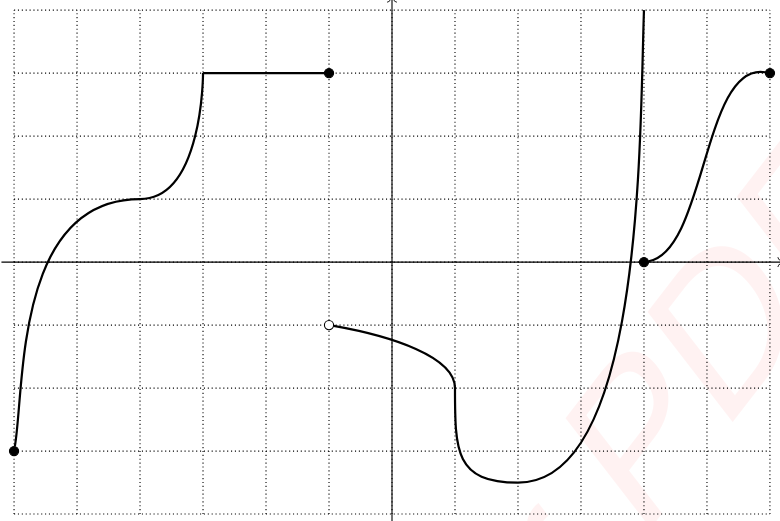
Consider the function f(x)f(x) whose graph is given below. Find the set of all numbers xx satisfying the following properties. No justifications required.
Current Exercise Image

Exercise Tags

Curve Sketching
concavity
critical points
find critical numbers

Tag:

Use the tag filtering feature on the course homepage to find all exercises with this tag.

Prerequisites for this Exercise

No prerequisite skills selected yet.

PREMIUM WALKTHROUGH

Unlock Premium Content

Get instant access to detailed walkthroughs, step-by-step explanations, and exclusive learning materials.

Unlock Now
Secure & Instant Access
PREMIUM SOLUTION

Unlock Premium Content

Get instant access to detailed solutions, step-by-step explanations, and exclusive learning materials.

Unlock Now
Secure & Instant Access

Sub-questions:

C2 Part a)
Difficulty: 3/10
ff is not differentiable at xx.

Exercise Tags

graphing

Tag:

Use the tag filtering feature on the course homepage to find all exercises with this tag.

Prerequisites for this Exercise

No prerequisite skills selected yet.

PREMIUM WALKTHROUGH

Unlock Premium Content

Get instant access to detailed walkthroughs, step-by-step explanations, and exclusive learning materials.

Unlock Now
Secure & Instant Access
Let's start from left to right.

The first place to look is where x=4x=-4. But this is just a derivative of 0, so that's totally fine.

Next we look at x=3x=-3. This is a 'cusp' since it's a 'sharp turn' or 'corner'.

Any 'sharp turn' in a function are called a cusp and the derivative does not exist there.

So at x=3x=-3 we know the derivative does not exist.

Next we look at x=1x=-1. Since the function is not even continuous there, we therefore also know that the function is not differentiable there.

So we add x=1x=-1 to our list.

The next point in question is when x=1x=1. Since it looks like the slope is completely vertical at x=1x=1, that makes the slope essentially infinite. That means the derivative does not exist there!

The derivative does not exist for any xx value where the function is totally vertical.

Moving on to the next point in question would be where x=4x=4. The function is not continuous there so therefore it is also not differentiable.
PREMIUM SOLUTION

Unlock Premium Content

Get instant access to detailed solutions, step-by-step explanations, and exclusive learning materials.

Unlock Now
Secure & Instant Access
{xx{3,1,1}}
\{ x \mid x \in \{-3, -1, 1\} \}


which is the same as:
x=3,x=1,x=1
x=-3, x=-1, x=1
C2 Part b)
Difficulty: 3/10
f(x)<0f'(x) < 0.

Exercise Tags

graphing

Tag:

Use the tag filtering feature on the course homepage to find all exercises with this tag.

Prerequisites for this Exercise

No prerequisite skills selected yet.

PREMIUM WALKTHROUGH

Unlock Premium Content

Get instant access to detailed walkthroughs, step-by-step explanations, and exclusive learning materials.

Unlock Now
Secure & Instant Access
This is asking for all the xx values where the slope is strictly less than 0.

From the graph we can see the slope is negative starting when x=1x = -1 and continues to be negative until x=2x=2.

There are two important exceptions when x=1x=-1 and when x=1x=1. The derivative does not exist at either of those points, so we can't include them in our final answer. Let's explain this:

When x=1x=-1 we have no left side limit, so the derivative does not exist.

When x=1x=1 the derivative does not exist because the left hand limit and right hand limit both approach infinity.

So for our final answer we have only:
{x1<x<2 and x1}
\{ x \mid -1 < x < 2 \text{ and } x \neq 1 \}
PREMIUM SOLUTION

Unlock Premium Content

Get instant access to detailed solutions, step-by-step explanations, and exclusive learning materials.

Unlock Now
Secure & Instant Access
The set of x x such that x x is in the interval [1,2][-1, 2] but not equal to 1-1 or 11 is given by:
{x1<x<2 and x1}
\{ x \mid -1 < x < 2 \text{ and } x \neq 1 \}


Another way to say it is this:
(1,2){1,1}
(-1, 2) \setminus \{-1, 1\}
C2 Part c)
Difficulty: 4/10
f(x)=0f''(x) =0.

Exercise Tags

graphing

Tag:

Use the tag filtering feature on the course homepage to find all exercises with this tag.

Prerequisites for this Exercise

No prerequisite skills selected yet.

PREMIUM WALKTHROUGH

Unlock Premium Content

Get instant access to detailed walkthroughs, step-by-step explanations, and exclusive learning materials.

Unlock Now
Secure & Instant Access
Here we are looking for xx values where the second derivative is 0.

NOTE: These points do not necessarily indicate an inflection point! For instance take the parabola y=x4y=x^4 when x=0x=0.

From the graph we can see an inflection point at x=4x=-4 together with a tangent line of finite slope (in this case the slope is 0), so the second derivative must be 0 there.

We also definitively have an inflection point when x=5x=5 since the graph changes from concave up to concave down together with a tangent line. So for sure we have f(x)=0f''(x)=0 here at x=5x=5 too.

We can't really tell what's happening when x=2x=2, but for this case the answer key will almost certainly not include this point. It's a local min which can indeed sometimes have f(x)=0f''(x)=0 (an example was given earlier with f(x)=x4f(x)=x^4 at x=0x=0).

Careful with x=1x=1. Since the first derivative doesn't exist there, the second derivative can't exist either. So we have f(x)=0f''(x) =0 only at x=4x = -4 and x=5x=5.

Final solution is:
{xx=4,x=5}
\{ x \mid x = -4, x=5 \}


or just :
{4,5}
\{-4, 5 \}
PREMIUM SOLUTION

Unlock Premium Content

Get instant access to detailed solutions, step-by-step explanations, and exclusive learning materials.

Unlock Now
Secure & Instant Access
Final solution is:
{xx=4,x=5}
\{ x \mid x = -4, x=5 \}


or just :
{4,5}
\{-4, 5 \}
C2 Part d)
Difficulty: 5/10
f(x)>0f''(x) >0.

Exercise Tags

concavity
graphing

Tag:

Use the tag filtering feature on the course homepage to find all exercises with this tag.

Prerequisites for this Exercise

No prerequisite skills selected yet.

PREMIUM WALKTHROUGH

Unlock Premium Content

Get instant access to detailed walkthroughs, step-by-step explanations, and exclusive learning materials.

Unlock Now
Secure & Instant Access
Here we are looking for when the graph f(x)f(x) is concave up.

We can see a small concave up segment from when xx is between 4-4 and 3-3.

Then it looks like another small segment when xx is between 1 and 4.

Then finally there is a small interval where f(x)f(x) is concave up right near then end when xx is between 4 and 5.

Note that x=4 is not included.
PREMIUM SOLUTION

Unlock Premium Content

Get instant access to detailed solutions, step-by-step explanations, and exclusive learning materials.

Unlock Now
Secure & Instant Access
(4,3)(1,4)(4,5)
(-4, -3) \cup (1, 4) \cup (4, 5)
C2 Part e)
Difficulty: 1/10
ff has an absolute minimum at xx.

Exercise Tags

graphing

Tag:

Use the tag filtering feature on the course homepage to find all exercises with this tag.

Prerequisites for this Exercise

No prerequisite skills selected yet.

PREMIUM WALKTHROUGH

Unlock Premium Content

Get instant access to detailed walkthroughs, step-by-step explanations, and exclusive learning materials.

Unlock Now
Secure & Instant Access
The absolute minimum can clearly be seen when x=2x=2.
PREMIUM SOLUTION

Unlock Premium Content

Get instant access to detailed solutions, step-by-step explanations, and exclusive learning materials.

Unlock Now
Secure & Instant Access
The absolute minimum can clearly be seen when x=2x=2.