Practice Final #5

Full Course
McGill University, MATH 122

Exam Settings

Show Tags
Show Difficulty
Back to Course

Short Answer Questions

Short Answer
A1
Difficulty: 1/10
(Max Marks: 3)
Compute the indefinite integral x9+x2dx \int x\sqrt{9+x^2} \, dx .

Exercise Tags

integrals
Integrals: u-substitution

Tag:

Use the tag filtering feature on the course homepage to find all exercises with this tag.

Prerequisites for this Exercise

No prerequisite skills selected yet.

Step 1: Identify the Integration Technique

We need to compute the indefinite integral x9+x2dx \int x\sqrt{9+x^2} \, dx . The integrand involves a function inside a square root, 9+x2 9+x^2 , and its derivative (up to a constant factor), 2x 2x , is present as the x x term outside the square root. This structure suggests using integration by substitution (u-substitution).

Step 2: Choose the Substitution

Let u u be the inner function:
u=9+x2
u = 9+x^2

Now, find the differential du du by differentiating u u with respect to x x :
dudx=2x
\frac{du}{dx} = 2x

Rearrange to solve for du du :
du=2xdx
du = 2x \, dx

Notice that our integral has xdx x \, dx , not 2xdx 2x \, dx . We can solve the differential equation for xdx x \, dx : xdx=12du x \, dx = \frac{1}{2} du . This allows us to substitute perfectly.

Step 3: Substitute into the Integral

Rewrite the original integral using u u and du du .
Substitute 9+x2=u=u1/2 \sqrt{9+x^2} = \sqrt{u} = u^{1/2} and xdx=12du x \, dx = \frac{1}{2} du :
x9+x2dx=u(12du)=12u1/2du \begin{align*}
& \int x\sqrt{9+x^2} \, dx \\
&= \int \sqrt{u} \left( \frac{1}{2} du \right) \\
&= \frac{1}{2} \int u^{1/2} \, du
\end{align*}


Step 4: Integrate with Respect to u

Now integrate u1/2 u^{1/2} using the power rule for integration: undu=un+1n+1+C \int u^n \, du = \frac{u^{n+1}}{n+1} + C (for n1 n \neq -1 ).
Here, n=1/2 n = 1/2 , so n+1=3/2 n+1 = 3/2 .
12u1/2du=12(u1/2+11/2+1)+C=12(u3/23/2)+C=1223u3/2+C=13u3/2+C \begin{align*}
& \frac{1}{2} \int u^{1/2} \, du \\
&= \frac{1}{2} \left( \frac{u^{1/2 + 1}}{1/2 + 1} \right) + C \\
&= \frac{1}{2} \left( \frac{u^{3/2}}{3/2} \right) + C \\
&= \frac{1}{2} \cdot \frac{2}{3} u^{3/2} + C \\
&= \frac{1}{3} u^{3/2} + C
\end{align*}

Don't forget the constant of integration, +C + C , when computing indefinite integrals!

Step 5: Substitute Back to x

Replace u u with its expression in terms of x x , which is u=9+x2 u = 9+x^2 .
13(9+x2)3/2+C
\frac{1}{3} (9+x^2)^{3/2} + C


x9+x2dx=13(9+x2)3/2+C
\boxed{ \int x\sqrt{9+x^2} \, dx = \frac{1}{3} (9+x^2)^{3/2} + C }
A2
Difficulty: 1/10
Compute the definite integral 0π/2sinxdx \int_{0}^{\pi/2} \sin x \, dx .

Exercise Tags

integrals

Tag:

Use the tag filtering feature on the course homepage to find all exercises with this tag.

Prerequisites for this Exercise

No prerequisite skills selected yet.

Step 1: Understand the Goal

We need to evaluate the definite integral of the function f(x)=sinx f(x) = \sin x over the interval [0,π/2][0, \pi/2]. This involves finding the antiderivative of sinx \sin x and evaluating it at the upper and lower limits of integration using the Fundamental Theorem of Calculus, Part 2.

Step 2: Find the Antiderivative

We need to find a function F(x) F(x) such that its derivative F(x) F'(x) is equal to f(x)=sinx f(x) = \sin x .
Remember the basic derivative rules for trigonometric functions: the derivative of cosx \cos x is sinx -\sin x . Therefore, the antiderivative of sinx \sin x is cosx -\cos x , because the derivative of cosx -\cos x is (sinx)=sinx -(-\sin x) = \sin x .
So, the antiderivative is F(x)=cosx F(x) = -\cos x .

Step 3: Apply the Fundamental Theorem of Calculus

The Fundamental Theorem of Calculus, Part 2, states that if F F is an antiderivative of f f , then:
abf(x)dx=F(b)F(a)
\int_{a}^{b} f(x) \, dx = F(b) - F(a)

In our case, f(x)=sinx f(x) = \sin x , F(x)=cosx F(x) = -\cos x , a=0 a = 0 , and b=π/2 b = \pi/2 .
0π/2sinxdx=[cosx]0π/2=(cos(π/2))(cos(0)) \begin{align*}
& \int_{0}^{\pi/2} \sin x \, dx \\
&= [-\cos x]_{0}^{\pi/2} \\
&= (-\cos(\pi/2)) - (-\cos(0))
\end{align*}


Step 4: Evaluate at the Limits

Now we need to evaluate cosx -\cos x at the upper limit x=π/2 x = \pi/2 and the lower limit x=0 x = 0 .
Recall the values of cosine at these key angles: cos(π/2)=0 \cos(\pi/2) = 0 and cos(0)=1 \cos(0) = 1 .
Substitute these values into the expression:
(cos(π/2))(cos(0))=(0)(1)=0+1=1 \begin{align*}
& (-\cos(\pi/2)) - (-\cos(0)) \\
&= (-0) - (-1) \\
&= 0 + 1 \\
&= 1
\end{align*}


The value of the definite integral is 1.

0π/2sinxdx=1
\boxed{ \int_{0}^{\pi/2} \sin x \, dx = 1 }
0π/2sinxdx=1
\boxed{ \int_{0}^{\pi/2} \sin x \, dx = 1 }
A3
Difficulty: 2/10
The maximum value attained by the function (x1)2x+2\frac{(x - 1)^2}{x + 2} on the interval [0,5][0, 5] is ___.

Exercise Tags

critical points
find critical numbers
maximizing and minimizing

Tag:

Use the tag filtering feature on the course homepage to find all exercises with this tag.

Prerequisites for this Exercise

No prerequisite skills selected yet.

Step 1: Recall the derivative we found earlier


We already found that:

f(x)=2(x1)(x+2)(x1)2(x+2)2=(x1)[2(x+2)(x1)](x+2)2=(x1)[2x+4x+1](x+2)2=(x1)(x+5)(x+2)2 \begin{align*}
& f'(x) \\
&= \frac{2(x - 1)(x + 2) - (x - 1)^2}{(x + 2)^2} \\
&= \frac{(x - 1)[2(x + 2) - (x - 1)]}{(x + 2)^2} \\
&= \frac{(x - 1)[2x + 4 - x + 1]}{(x + 2)^2} \\
&= \frac{(x - 1)(x + 5)}{(x + 2)^2}
\end{align*}


Step 2: Find critical points


Setting the derivative equal to zero:

(x1)(x+5)(x+2)2=0 \begin{align*}
& \frac{(x - 1)(x + 5)}{(x + 2)^2} = 0
\end{align*}


Since the denominator is never zero on our interval, we have:
(x1)(x+5)=0(x - 1)(x + 5) = 0

This gives us x=1x = 1 or x=5x = -5. Since 5-5 is outside our interval [0,5][0,5], we only consider x=1x = 1.

Step 3: Evaluate at endpoints and critical points


We need to check the function value at x=0x = 0, x=1x = 1, and x=5x = 5.

At x=0x = 0:

f(0)=(01)20+2=12=0.5 \begin{align*}
& f(0) \\
&= \frac{(0 - 1)^2}{0 + 2} \\
&= \frac{1}{2} \\
&= 0.5
\end{align*}


At x=1x = 1:

f(1)=(11)21+2=03=0 \begin{align*}
& f(1) \\
&= \frac{(1 - 1)^2}{1 + 2} \\
&= \frac{0}{3} \\
&= 0
\end{align*}


At x=5x = 5:

f(5)=(51)25+2=1672.29 \begin{align*}
& f(5) \\
&= \frac{(5 - 1)^2}{5 + 2} \\
&= \frac{16}{7} \\
&\approx 2.29
\end{align*}


Step 4: Determine the maximum value


Comparing all three values:
- f(0)=12=0.5f(0) = \frac{1}{2} = 0.5
- f(1)=0f(1) = 0
- f(5)=1672.29f(5) = \frac{16}{7} \approx 2.29

The maximum value is 167\frac{16}{7} which occurs at x=5x = 5.

Maximum value=167 \boxed{\text{Maximum value} = \frac{16}{7}}

For rational functions, the behavior may be very different on different intervals. Always check all critical points within the interval AND both endpoints!
Maximum value=167 \boxed{\text{Maximum value} = \frac{16}{7}}
A4
Difficulty: 4/10
The maximum value attained by the function (x1)2x+2\frac{(x - 1)^2}{x + 2} on the interval [8,4][-8, -4] is ___.

Exercise Tags

Extreme Value Theorem
critical points
find critical numbers
maximizing and minimizing

Tag:

Use the tag filtering feature on the course homepage to find all exercises with this tag.

Prerequisites for this Exercise

No prerequisite skills selected yet.

Step 1: Find the critical points


We already found the derivative of this function in our previous question:

dydx=2(x1)(x+2)(x1)2(x+2)2 \begin{align*}
& \frac{dy}{dx} \\
&= \frac{2(x - 1)(x + 2) - (x - 1)^2}{(x + 2)^2}
\end{align*}


To find critical points, we set this equal to zero:

2(x1)(x+2)(x1)2(x+2)2=0 \begin{align*}
& \frac{2(x - 1)(x + 2) - (x - 1)^2}{(x + 2)^2} = 0
\end{align*}


Since the denominator cannot be zero on our interval (as x+2>0x + 2 > 0 when x1.9x \geq -1.9), we only need:

2(x1)(x+2)(x1)2=0(x1)[2(x+2)(x1)]=0(x1)[2x+4x+1]=0(x1)[x+5]=0 \begin{align*}
& 2(x - 1)(x + 2) - (x - 1)^2 = 0 \\
&(x - 1)[2(x + 2) - (x - 1)] = 0 \\
&(x - 1)[2x + 4 - x + 1] = 0 \\
&(x - 1)[x + 5] = 0
\end{align*}


So x=1x = 1 or x=5x = -5 are our critical points.

Step 2: Check the interval endpoints


Our interval is [8,4][-8, -4], and we found one critical point at x=5x = -5 which is within this interval.

Extreme Value Theorem tells us that the maximum must occur either at a critical point within the interval or at an endpoint.

We need to evaluate the function at x=8x = -8, x=5x = -5, and x=4x = -4.

Step 3: Evaluate at x = -8


f(8)=(81)28+2=(9)26=816=13.5 \begin{align*}
& f(-8) \\
&= \frac{(-8 - 1)^2}{-8 + 2} \\
&= \frac{(-9)^2}{-6} \\
&= \frac{81}{-6} \\
&= -13.5
\end{align*}


Step 4: Evaluate at x = -5


f(5)=(51)25+2=(6)23=363=12 \begin{align*}
& f(-5) \\
&= \frac{(-5 - 1)^2}{-5 + 2} \\
&= \frac{(-6)^2}{-3} \\
&= \frac{36}{-3} \\
&= -12
\end{align*}


Step 5: Evaluate at x = -4


f(4)=(41)24+2=(5)22=252=12.5 \begin{align*}
& f(-4) \\
&= \frac{(-4 - 1)^2}{-4 + 2} \\
&= \frac{(-5)^2}{-2} \\
&= \frac{25}{-2} \\
&= -12.5
\end{align*}


When finding extreme values on a closed interval, always check both the critical points inside the interval AND the endpoint values!

Step 6: Compare all values


Comparing all three values:
- f(8)=13.5f(-8) = -13.5
- f(5)=12f(-5) = -12
- f(4)=12.5f(-4) = -12.5

The maximum value is 12-12 which occurs at x=5x = -5.

Maximum value=12 \boxed{\text{Maximum value} = -12}
A5
Difficulty: 2/10
Let f(x)=x3e2x+3(x2)2exf(x) = x^3e^{2x} + 3(x - 2)^2e^{-x}. Find f(0)f'(0).

Exercise Tags

taking derivatives
Exponentials

Tag:

Use the tag filtering feature on the course homepage to find all exercises with this tag.

Prerequisites for this Exercise

No prerequisite skills selected yet.

Step 1: Break down the function


We have a function with two terms:
1. x3e2xx^3e^{2x}
2. 3(x2)2ex3(x - 2)^2e^{-x}

We'll need to find the derivative of each term using the product rule, then evaluate at x=0x = 0.

Step 2: Apply the product rule to the first term


For the first term, x3e2xx^3e^{2x}, we use the product rule:

ddx[x3e2x]=ddx[x3]e2x+x3ddx[e2x]=3x2e2x+x32e2x=3x2e2x+2x3e2x=e2x(3x2+2x3) \begin{align*}
& \frac{d}{dx}[x^3e^{2x}] \\
&= \frac{d}{dx}[x^3] \cdot e^{2x} + x^3 \cdot \frac{d}{dx}[e^{2x}] \\
&= 3x^2 \cdot e^{2x} + x^3 \cdot 2e^{2x} \\
&= 3x^2e^{2x} + 2x^3e^{2x} \\
&= e^{2x}(3x^2 + 2x^3)
\end{align*}


Step 3: Apply the product rule to the second term


For the second term, 3(x2)2ex3(x - 2)^2e^{-x}, we use the product rule again:


ddx[3(x2)2ex]=ddx[3(x2)2]ex+3(x2)2ddx[ex]=32(x2)ex+3(x2)2(1)ex=6(x2)ex3(x2)2ex=ex[6(x2)3(x2)2] \begin{align*}
& \frac{d}{dx}[3(x - 2)^2e^{-x}] \\
&= \frac{d}{dx}[3(x - 2)^2] \cdot e^{-x} + 3(x - 2)^2 \cdot \frac{d}{dx}[e^{-x}] \\
&= 3 \cdot 2(x - 2) \cdot e^{-x} + 3(x - 2)^2 \cdot (-1)e^{-x} \\
&= 6(x - 2)e^{-x} - 3(x - 2)^2e^{-x} \\
&= e^{-x}[6(x - 2) - 3(x - 2)^2]
\end{align*}


When differentiating terms with eaxe^{ax}, remember that ddx[eax]=aeax\frac{d}{dx}[e^{ax}] = a \cdot e^{ax}. The coefficient comes out front!

Step 4: Combine the derivatives and evaluate at x = 0


The complete derivative is:


f(x)=e2x(3x2+2x3)+ex[6(x2)3(x2)2] \begin{align*}
& f'(x) \\
&= e^{2x}(3x^2 + 2x^3) \\
&+ e^{-x}[6(x - 2) - 3(x - 2)^2]
\end{align*}


Now we evaluate at x=0x = 0:

f(0)=e2(0)(3(0)2+2(0)3)+e(0)[6(02)3(02)2]=e0(0)+e0[6(2)3(2)2]=10+1[(12)34]=0+[1212]=24 \begin{align*}
& f'(0) \\
&= e^{2(0)}(3(0)^2 + 2(0)^3) \\
&+ e^{-(0)}[6(0 - 2) - 3(0 - 2)^2] \\
&= e^0(0) \\
&+ e^0[6(-2) - 3(-2)^2] \\
&= 1 \cdot 0 \\
&+ 1 \cdot [(-12) - 3 \cdot 4] \\
&= 0 \\
&+ [-12 - 12] \\
&= -24
\end{align*}

Therefore:

f(0)=24 \boxed{f'(0) = -24}

Mcq Questions

MCQ
B1
Difficulty: 1/10
Find the equation for the tangent line y=mx+b y = mx + b to the graph of

f(x)=x21+x2f(x) = \frac{x^2}{1 + x^2}

at the point x=1 x = 1 .

What is b b ? (2.5 points)

(A) 0 0

(B) 1/2 1/2

(C) 1/2 -1/2

(D) 3/2 3/2

(E) None of the above \text{None of the above}

Exercise Tags

equation of tangent

Tag:

Use the tag filtering feature on the course homepage to find all exercises with this tag.

Prerequisites for this Exercise

No prerequisite skills selected yet.

PREMIUM WALKTHROUGH

Unlock Premium Content

Get instant access to detailed walkthroughs, step-by-step explanations, and exclusive learning materials.

Unlock Now
Secure & Instant Access
Step 1: Find the slope mm of the tangent line


We already know the derivative is:

f(x)=2x(1+x2)2
f'(x) = \frac{2x}{(1 + x^2)^2}


Evaluating it at x=1x = 1:

f(1)=2(1)(1+12)2=24=12
f'(1) = \frac{2(1)}{(1 + 1^2)^2} = \frac{2}{4} = \frac{1}{2}


So:

m=12
m = \frac{1}{2}


Step 2: Find the point on the curve at x=1x = 1


f(1)=121+12=12
f(1) = \frac{1^2}{1 + 1^2} = \frac{1}{2}


Thus, the point is:

(1,12)
(1, \frac{1}{2})


Step 3: Write the equation of the tangent line


The equation of the line is:

y=mx+b
y = mx + b


Substitute m=12m = \frac{1}{2} and (1,12)(1, \frac{1}{2}):

12=12(1)+b
\frac{1}{2} = \frac{1}{2}(1) + b


Simplify:

12=12+b
\frac{1}{2} = \frac{1}{2} + b


Solve for bb:

b=0
b = 0


Step 4: Final Answer


The yy-intercept is:

0
\boxed{0}


Thus, the correct answer is:

(A)0
\boxed{(A) \, 0}
PREMIUM SOLUTION

Unlock Premium Content

Get instant access to detailed solutions, step-by-step explanations, and exclusive learning materials.
Unlock Now
Secure & Instant Access
(A)0
\boxed{(A) \, 0}
B2
Difficulty: 1/10
Find the equation for the tangent line y=mx+b y = mx + b to the graph of

f(x)=x21+x2f(x) = \frac{x^2}{1 + x^2}

at the point x=1 x = 1 .

What is m m ? (2.5 points)

(A) 0 0

(B) 1/2 1/2

(C) 1/2 -1/2

(D) 3/2 3/2

(E) None of the above \text{None of the above}

Exercise Tags

differentiation: quotient rule
equation of tangent

Tag:

Use the tag filtering feature on the course homepage to find all exercises with this tag.

Prerequisites for this Exercise

No prerequisite skills selected yet.

PREMIUM WALKTHROUGH

Unlock Premium Content

Get instant access to detailed walkthroughs, step-by-step explanations, and exclusive learning materials.

Unlock Now
Secure & Instant Access
Step 1: Find the derivative f(x)f'(x)


We use the quotient rule to differentiate:

f(x)=x21+x2
f(x) = \frac{x^2}{1 + x^2}


The quotient rule states:

ddx(u(x)v(x))=u(x)v(x)u(x)v(x)(v(x))2
\frac{d}{dx} \left( \frac{u(x)}{v(x)} \right) = \frac{u'(x) v(x) - u(x) v'(x)}{(v(x))^2}


where u(x)=x2 u(x) = x^2 and v(x)=1+x2 v(x) = 1 + x^2 .

Step 2: Apply the quotient rule


u(x)=2x,v(x)=2x
u'(x) = 2x, \quad v'(x) = 2x


Now:

f(x)=(2x)(1+x2)(x2)(2x)(1+x2)2
f'(x) = \frac{(2x)(1 + x^2) - (x^2)(2x)}{(1 + x^2)^2}


Simplify:

(2x)(1+x2)(x2)(2x)=2x+2x32x3=2x
(2x)(1 + x^2) - (x^2)(2x) = 2x + 2x^3 - 2x^3 = 2x


Thus:

f(x)=2x(1+x2)2
f'(x) = \frac{2x}{(1 + x^2)^2}


Step 3: Evaluate the derivative at x=1x = 1


f(1)=2(1)(1+12)2=2(1+1)2=24=12
f'(1) = \frac{2(1)}{(1 + 1^2)^2} = \frac{2}{(1 + 1)^2} = \frac{2}{4} = \frac{1}{2}


Step 4: Final Answer


The slope of the tangent line at x=1x = 1 is:

12
\boxed{\frac{1}{2}}


Thus, the correct answer is:

(B)12
\boxed{(B) \, \frac{1}{2}}
PREMIUM SOLUTION

Unlock Premium Content

Get instant access to detailed solutions, step-by-step explanations, and exclusive learning materials.
Unlock Now
Secure & Instant Access
(B)12
\boxed{(B) \, \frac{1}{2}}
B3
Difficulty: 1/10
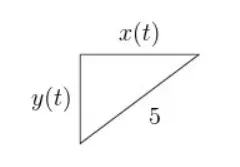
A right-angled triangle is transforming in such a way that the length of the hypotenuse is always 5 cm long.


right triangle

Figure: right triangle


What is the ratio y/x y'/x' when x=4 x = 4 ? Assume that x x' is non-zero.

(A) 4/3 -4/3

(B) 3/4 -3/4

(C) 4/3 4/3

(D) 3/5 -3/5

(E) None of the above \text{None of the above}

Exercise Tags

implicit differentiation
relates rates

Tag:

Use the tag filtering feature on the course homepage to find all exercises with this tag.

Prerequisites for this Exercise

No prerequisite skills selected yet.

PREMIUM WALKTHROUGH

Unlock Premium Content

Get instant access to detailed walkthroughs, step-by-step explanations, and exclusive learning materials.

Unlock Now
Secure & Instant Access
Step 1: Set up the right triangle relationship


We are given a right-angled triangle with a hypotenuse that is always 5 cm long. The sides are xx, yy, and the hypotenuse is 55. So the Pythagorean theorem gives:

x2+y2=52=25
x^2 + y^2 = 5^2 = 25


Step 2: Differentiate both sides implicitly with respect to time tt


2xdxdt+2ydydt=0
2x \frac{dx}{dt} + 2y \frac{dy}{dt} = 0


Simplify:

xdxdt+ydydt=0
x \frac{dx}{dt} + y \frac{dy}{dt} = 0


Step 3: Solve for dydt \frac{dy}{dt} in terms of dxdt \frac{dx}{dt}


ydydt=xdxdt
y \frac{dy}{dt} = -x \frac{dx}{dt}


Divide both sides by x0x' \neq 0:

dydt=xydxdt
\frac{dy}{dt} = -\frac{x}{y} \frac{dx}{dt}


Thus:

yx=xy
\frac{y'}{x'} = -\frac{x}{y}


Step 4: Evaluate at x=4x = 4


Using the Pythagorean theorem:

42+y2=2516+y2=25y2=9y=3
4^2 + y^2 = 25 \quad \Rightarrow \quad 16 + y^2 = 25 \quad \Rightarrow \quad y^2 = 9 \quad \Rightarrow \quad y = 3


Step 5: Find the ratio yx \frac{y'}{x'}


yx=xy=43
\frac{y'}{x'} = -\frac{x}{y} = -\frac{4}{3}


Step 6: Final Answer


The ratio yx \frac{y'}{x'} when x=4x = 4 is:

43
\boxed{-\frac{4}{3}}


Thus, the correct answer is:

(A)43
\boxed{(A) \, -\frac{4}{3}}
PREMIUM SOLUTION

Unlock Premium Content

Get instant access to detailed solutions, step-by-step explanations, and exclusive learning materials.

Unlock Now
Secure & Instant Access
(A)43
\boxed{(A) \, -\frac{4}{3}}
B4
Difficulty: 1/10
Find the most general antiderivative of 11+x2+sin(x).
\quad \frac{1}{1 + x^2} + \sin(x).


(A) arctan(x)cos(x)+C \arctan(x) - \cos(x) + C

(B) ln(1+x2)cos(x)+C \ln(1 + x^2) - \cos(x) + C

(C) x1x+cos(x)+C x - \frac{1}{x} + \cos(x) + C

(D) 2x(1+x2)2cos(x)+C \frac{-2x}{(1 + x^2)^2} - \cos(x) + C

(E) None of the above \text{None of the above}

Exercise Tags

integrals
integrals: inverse trig
inverse trig functions

Tag:

Use the tag filtering feature on the course homepage to find all exercises with this tag.

Prerequisites for this Exercise

No prerequisite skills selected yet.

PREMIUM WALKTHROUGH

Unlock Premium Content

Get instant access to detailed walkthroughs, step-by-step explanations, and exclusive learning materials.

Unlock Now
Secure & Instant Access
Step 1: Integrate the first term 11+x2 \frac{1}{1 + x^2}


We recognize that the integral of 11+x2 \frac{1}{1 + x^2} is the well-known inverse tangent function:

11+x2dx=arctan(x)+C1
\int \frac{1}{1 + x^2} \, dx = \arctan(x) + C_1


Step 2: Integrate the second term sin(x) \sin(x)


The integral of sin(x) \sin(x) is:

sin(x)dx=cos(x)+C2
\int \sin(x) \, dx = -\cos(x) + C_2


Step 3: Combine the results


Now we combine the two integrals:

(11+x2+sin(x))dx=arctan(x)cos(x)+C
\int \left( \frac{1}{1 + x^2} + \sin(x) \right) \, dx = \arctan(x) - \cos(x) + C


where C=C1+C2 C = C_1 + C_2 is the most general constant of integration.

Step 4: Final Answer


Thus, the most general antiderivative is:

arctan(x)cos(x)+C
\boxed{\arctan(x) - \cos(x) + C}


The correct answer is:

(A)arctan(x)cos(x)+C
\boxed{(A) \, \arctan(x) - \cos(x) + C}
PREMIUM SOLUTION

Unlock Premium Content

Get instant access to detailed solutions, step-by-step explanations, and exclusive learning materials.

Unlock Now
Secure & Instant Access
(A)arctan(x)cos(x)+C
\boxed{(A) \, \arctan(x) - \cos(x) + C}
B5
Difficulty: 1/10
limx0+sin(x)(ex1)x3=
\lim_{x \to 0^+} \frac{\sin(x)(e^x - 1)}{x^3} =

(A) 12 -\frac{1}{2}

(B) 1 1

(C) \infty

(D) 0 0

(E) None of the above \text{None of the above}

Exercise Tags

limits: general
limits: using identities

Tag:

Use the tag filtering feature on the course homepage to find all exercises with this tag.

Prerequisites for this Exercise

No prerequisite skills selected yet.

PREMIUM WALKTHROUGH

Unlock Premium Content

Get instant access to detailed walkthroughs, step-by-step explanations, and exclusive learning materials.

Unlock Now
Secure & Instant Access
Step 1: Split the limit into three parts


We are trying to evaluate:

limx0+sin(x)(ex1)x3
\lim_{x \to 0^+} \frac{\sin(x)(e^x - 1)}{x^3}


We can rewrite this as:

limx0+(sin(x)xex1x1x)
\lim_{x \to 0^+} \left( \frac{\sin(x)}{x} \cdot \frac{e^x - 1}{x} \cdot \frac{1}{x} \right)


By splitting it like this, we can analyze each part separately, making it easier to solve.

Step 2: Evaluate each limit individually


1. **Evaluate** limx0+sin(x)x \lim_{x \to 0^+} \frac{\sin(x)}{x} :

limx0+sin(x)x=1
\lim_{x \to 0^+} \frac{\sin(x)}{x} = 1


This is a standard limit that often appears in exams.

[Remember this limit: limx0sin(x)x=1
\lim_{x \to 0} \frac{\sin(x)}{x} = 1

They love to test this! It shows that sin(x)\sin(x) and xx are almost identical for small values of xx.]


2. **Evaluate** limx0+ex1x \lim_{x \to 0^+} \frac{e^x - 1}{x} :

limx0+ex1x=1
\lim_{x \to 0^+} \frac{e^x - 1}{x} = 1


For small xx, the function ex1e^x - 1 behaves similarly to xx.

[This limit is another must-know: limx0ex1x=1
\lim_{x \to 0} \frac{e^x - 1}{x} = 1

This shows that for small xx, the numerator and denominator act like the same function.]


3. **Evaluate** limx0+1x \lim_{x \to 0^+} \frac{1}{x} :

limx0+1x=
\lim_{x \to 0^+} \frac{1}{x} = \infty


This tells us that the function grows without bound as xx approaches 0 from the positive side.

Step 3: Combine the results


Using the property that:

limx0+(f(x)g(x)h(x))=limx0+f(x)limx0+g(x)limx0+h(x)
\lim_{x \to 0^+} \left( f(x) \cdot g(x) \cdot h(x) \right) = \lim_{x \to 0^+} f(x) \cdot \lim_{x \to 0^+} g(x) \cdot \lim_{x \to 0^+} h(x)


**(only if all limits are finite or one limit goes to infinity without any undefined behavior like 00 \cdot \infty)**, we get:

11=
1 \cdot 1 \cdot \infty = \infty


Since the multiplication involves finite values and one \infty, the result is:


\boxed{\infty}


This approach works here because each limit we evaluated behaves predictably and does not lead to an undefined form like 00 \cdot \infty. Therefore, we can confidently multiply the individual limits.

Summary

In this tough question they are testing your knowledge of the these two limits:
limx0sin(x)x=1
\lim_{x \to 0} \frac{\sin(x)}{x} = 1
and

limx0ex1x=1
\lim_{x \to 0} \frac{e^x - 1}{x} = 1
. As long as you know those limits then you'll have no problem with this question.


The reciprocal of each limit is also 1:

limx0xsin(x)=1andlimx0xex1=1
\lim_{x \to 0} \frac{x}{\sin(x)} = 1 \quad \text{and} \quad \lim_{x \to 0} \frac{x}{e^x - 1} = 1


These limits show that sin(x) \sin(x) and ex1 e^x - 1 behave almost exactly like x x when x x is close to 0. Knowing these will help you solve many tricky limits that appear in calculus exams!


You can also therefore mix these terms:

limx0sin(x)ex1=1
\lim_{x \to 0} \frac{\sin(x)}{e^x - 1} = 1


Both sin(x) \sin(x) and ex1 e^x - 1 behave like xx when xx is close to 0, so this limit simplifies to:

limx0xx=1
\lim_{x \to 0} \frac{x}{x} = 1


This is another handy limit to keep in mind for calculus exams!
PREMIUM SOLUTION

Unlock Premium Content

Get instant access to detailed solutions, step-by-step explanations, and exclusive learning materials.

Unlock Now
Secure & Instant Access
(C)
\boxed{(C) \quad \infty}

Long Answer Questions

Long Answer
C1
Difficulty: 1/10
(Max Marks: 6)
Find the indefinite integral x24x6dx \int \frac{x^2}{\sqrt{4-x^6}} \, dx .

Exercise Tags

integrals
Integrals: Improper
integrals: inverse trig
Integrals: u-substitution

Tag:

Use the tag filtering feature on the course homepage to find all exercises with this tag.

Prerequisites for this Exercise

No prerequisite skills selected yet.

Step 1: Analyze the Integrand and Choose a Technique

The integral is x24x6dx \int \frac{x^2}{\sqrt{4-x^6}} \, dx .

The denominator contains 4x6 \sqrt{4-x^6} . This looks similar to the form a2u2 \sqrt{a^2 - u^2} , which appears in the derivative of arcsin and arccos.

Let's try to match the form a2u2 \sqrt{a^2 - u^2} . We can write 4=22 4 = 2^2 and x6=(x3)2 x^6 = (x^3)^2 . So, the term inside the square root is 22(x3)2 2^2 - (x^3)^2 .

This suggests choosing a=2 a=2 and making the substitution u=x3 u = x^3 .

Let's check the derivative: ddx(x3)=3x2 \frac{d}{dx}(x^3) = 3x^2 . The numerator of the integrand is x2 x^2 , which is proportional to this derivative.

This confirms that u-substitution with u=x3 u = x^3 is a good strategy, aiming for the arcsine integral form.

Step 2: Perform the u-Substitution

Let u=x3 u = x^3 .
Find the differential du du :
du=ddx(x3)dx=3x2dx
du = \frac{d}{dx}(x^3) \, dx = 3x^2 \, dx

Our integral contains the term x2dx x^2 \, dx . Solve for it from the differential:
x2dx=13du
x^2 \, dx = \frac{1}{3} du

Now substitute u=x3 u = x^3 (so u2=x6 u^2 = x^6 ) and x2dx=13du x^2 \, dx = \frac{1}{3} du into the integral:
x24x6dx=14(x3)2(x2dx)=14u2(13du)=1314u2du=13122u2du \begin{align*}
& \int \frac{x^2}{\sqrt{4-x^6}} \, dx \\
&= \int \frac{1}{\sqrt{4-(x^3)^2}} (x^2 \, dx) \\
&= \int \frac{1}{\sqrt{4-u^2}} \left( \frac{1}{3} du \right) \\
&= \frac{1}{3} \int \frac{1}{\sqrt{4-u^2}} \, du \\
&= \frac{1}{3} \int \frac{1}{\sqrt{2^2-u^2}} \, du
\end{align*}


Step 3: Integrate with Respect to u

The integral is now in a standard form.
Recall the integration rule involving arcsine: 1a2u2du=arcsin(ua)+C \int \frac{1}{\sqrt{a^2-u^2}} \, du = \arcsin\left(\frac{u}{a}\right) + C .
In our case, a=2 a = 2 . Applying this rule:
13122u2du=13arcsin(u2)+C \begin{align*}
& \frac{1}{3} \int \frac{1}{\sqrt{2^2-u^2}} \, du \\
&= \frac{1}{3} \arcsin\left(\frac{u}{2}\right) + C
\end{align*}


Step 4: Substitute Back to x

Replace u u with its expression in terms of x x , which is u=x3 u = x^3 .
13arcsin(x32)+C
\frac{1}{3} \arcsin\left(\frac{x^3}{2}\right) + C


Step 5: Conclusion

The indefinite integral is 13arcsin(x32)+C \frac{1}{3} \arcsin(\frac{x^3}{2}) + C . This result is concise enough for the KaTeX `\boxed{}`.
x24x6dx=13arcsin(x32)+C
\boxed{ \int \frac{x^2}{\sqrt{4-x^6}} \, dx = \frac{1}{3} \arcsin\left(\frac{x^3}{2}\right) + C }
x24x6dx=13arcsin(x32)+C
\boxed{ \int \frac{x^2}{\sqrt{4-x^6}} \, dx = \frac{1}{3} \arcsin\left(\frac{x^3}{2}\right) + C }
C2
Difficulty: 5/10
Find the first derivative and second derivative of the function

f(x)=(x24x+4)ex.f(x) = (x^2 - 4x + 4)e^x.

Determine where the function is increasing and decreasing.

Determine where the function is concave up and concave down.

Exercise Tags

concavity
concavity tables
Intervals of Increase and Decrease

Tag:

Use the tag filtering feature on the course homepage to find all exercises with this tag.

Prerequisites for this Exercise

No prerequisite skills selected yet.

Step 1: Find the first derivative


Let's work with the function: f(x)=(x24x+4)exf(x) = (x^2 - 4x + 4)e^x

To find the first derivative, I'll use the product rule: (uv)=uv+uv(u \cdot v)' = u' \cdot v + u \cdot v'

Where:
- u=x24x+4u = x^2 - 4x + 4
- v=exv = e^x

First, I'll find uu':
u=(x24x+4)=2x4 \begin{align*}
u' &= (x^2 - 4x + 4)' \\
&= 2x - 4
\end{align*}


Now applying the product rule:
f(x)=(2x4)ex+(x24x+4)ex=(2x4+x24x+4)ex=(x22x)ex=x(x2)ex \begin{align*}
f'(x) &= (2x - 4)e^x + (x^2 - 4x + 4)e^x \\
&= (2x - 4 + x^2 - 4x + 4)e^x \\
&= (x^2 - 2x)e^x \\
&= x(x-2)e^x
\end{align*}


Step 2: Find the second derivative


For the second derivative, I'll apply the product rule again to f(x)=x(x2)exf'(x) = x(x-2)e^x

Where:
- u=x(x2)u = x(x-2)
- v=exv = e^x

First, I'll find uu':
u=(x(x2))=(x2)+x1=2x2 \begin{align*}
u' &= (x(x-2))' \\
&= (x-2) + x \cdot 1 \\
&= 2x - 2
\end{align*}


Now applying the product rule:
f(x)=(2x2)ex+x(x2)ex=(2x2+x22x)ex=(x22)ex \begin{align*}
f''(x) &= (2x - 2)e^x + x(x-2)e^x \\
&= (2x - 2 + x^2 - 2x)e^x \\
&= (x^2 - 2)e^x
\end{align*}


Step 3: Determine where the function is increasing and decreasing


A function is increasing when f(x)>0f'(x) > 0 and decreasing when f(x)<0f'(x) < 0.

Let's find where f(x)=0f'(x) = 0:
f(x)=x(x2)ex=0 \begin{align*}
f'(x) &= x(x-2)e^x = 0
\end{align*}


Since ex>0e^x > 0 for all xx, we need to solve:
x(x2)=0 \begin{align*}
x(x-2) &= 0
\end{align*}


This gives us x=0x = 0 or x=2x = 2

When analyzing where a function is increasing or decreasing, focus on where the first derivative changes sign.

Testing regions:
- For x<0x < 0: x<0x < 0 and x2<0x-2 < 0, so x(x2)>0x(x-2) > 0, meaning f(x)>0f'(x) > 0
- For 0<x<20 < x < 2: x>0x > 0 and x2<0x-2 < 0, so x(x2)<0x(x-2) < 0, meaning f(x)<0f'(x) < 0
- For x>2x > 2: x>0x > 0 and x2>0x-2 > 0, so x(x2)>0x(x-2) > 0, meaning f(x)>0f'(x) > 0

Therefore:
- ff is increasing for x<0x < 0
- ff is decreasing for 0<x<20 < x < 2
- ff is increasing for x>2x > 2

Step 4: Determine where the function is concave up and concave down


A function is concave up when f(x)>0f''(x) > 0 and concave down when f(x)<0f''(x) < 0.

From our second derivative:
f(x)=(x22)ex \begin{align*}
f''(x) = (x^2 - 2)e^x
\end{align*}


Since ex>0e^x > 0 for all xx, we need to solve x22=0x^2 - 2 = 0:
x2=2x=±2 \begin{align*}
x^2 &= 2 \\
x &= \pm \sqrt{2}
\end{align*}


Testing regions:
- For x<2x < -\sqrt{2}: x2>2x^2 > 2, so f(x)>0f''(x) > 0
- For 2<x<2-\sqrt{2} < x < \sqrt{2}: x2<2x^2 < 2, so f(x)<0f''(x) < 0
- For x>2x > \sqrt{2}: x2>2x^2 > 2, so f(x)>0f''(x) > 0

Therefore:
- ff is concave up for x<2x < -\sqrt{2}
- ff is concave down for 2<x<2-\sqrt{2} < x < \sqrt{2}
- ff is concave up for x>2x > \sqrt{2}

Final Answer

f(x)=x(x2)ex
\boxed{f'(x) = x(x-2)e^x}

f(x)=(x22)ex
\boxed{f''(x) = (x^2 - 2)e^x}

Increasing: x<0 or x>2Decreasing: 0<x<2
\boxed{\begin{align*}
&\text{Increasing: } x < 0 \text{ or } x > 2\\
&\text{Decreasing: } 0 < x < 2
\end{align*}}

Concave up: x<2 or x>2Concave down: 2<x<2
\boxed{\begin{align*}
&\text{Concave up: } x < -\sqrt{2} \text{ or } x > \sqrt{2}\\
&\text{Concave down: } -\sqrt{2} < x < \sqrt{2}
\end{align*}}
f(x)=x(x2)ex
\boxed{f'(x) = x(x-2)e^x}

f(x)=(x22)ex
\boxed{f''(x) = (x^2 - 2)e^x}

Increasing: x<0 or x>2Decreasing: 0<x<2
\boxed{\begin{align*}
&\text{Increasing: } x < 0 \text{ or } x > 2\\
&\text{Decreasing: } 0 < x < 2
\end{align*}}

Concave up: x<2 or x>2Concave down: 2<x<2
\boxed{\begin{align*}
&\text{Concave up: } x < -\sqrt{2} \text{ or } x > \sqrt{2}\\
&\text{Concave down: } -\sqrt{2} < x < \sqrt{2}
\end{align*}}
C3
Difficulty: 6/10
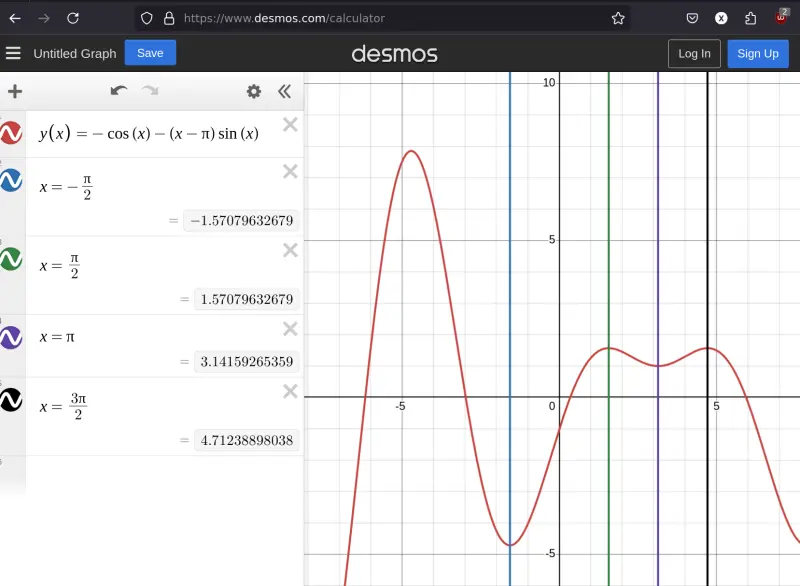
Find all critical points of the function f(x)=cos(x)(xπ)sin(x)f(x) = -\cos(x) - (x - \pi)\sin(x) in the interval 3π2<x<5π2-\frac{3\pi}{2} < x < \frac{5\pi}{2}.

Classify each such point as a local minimum, a local maximum or some other kind of critical point.

Exercise Tags

critical points
find critical numbers
Classify crit points

Tag:

Use the tag filtering feature on the course homepage to find all exercises with this tag.

Prerequisites for this Exercise

No prerequisite skills selected yet.

I'll solve a slightly different question that tests the same calculus concepts of finding and classifying critical points.

Let's work with the function: f(x)=cos(x)(xπ)sin(x)f(x) = -\cos(x) - (x-\pi)\sin(x) in the interval 3π2<x<5π2-\frac{3\pi}{2} < x < \frac{5\pi}{2}.

Step 1: Find the derivative

To find critical points, I need to take the derivative and set it equal to zero.


f(x)=sin(x)sin(x)(xπ)cos(x)=(xπ)cos(x) \begin{align*}
f'(x) &= \sin(x) - \sin(x) - (x-\pi)\cos(x) \\
&= -(x-\pi)\cos(x)
\end{align*}


When differentiating products, remember that the derivative of (xπ)sin(x)(x-\pi)\sin(x) follows the product rule: (xπ)cos(x)+sin(x)1(x-\pi)\cos(x) + \sin(x) \cdot 1

Step 2: Set the derivative equal to zero

f(x)=(xπ)cos(x)=0 f'(x) = -(x-\pi)\cos(x) = 0

This equation equals zero when either:
- (xπ)=0(x-\pi) = 0, which gives x=πx = \pi
- cos(x)=0\cos(x) = 0, which gives x=π2+nπx = \frac{\pi}{2} + n\pi where nn is an integer

In our interval 3π2,5π2-\frac{3\pi}{2}, \frac{5\pi}{2}, cos(x)=0\cos(x) = 0 when:
x=π2,π2,3π2x = -\frac{\pi}{2}, \frac{\pi}{2}, \frac{3\pi}{2}

Step 3: Check the critical points in the given interval

So our critical points are:
- x=π2x = -\frac{\pi}{2}
- x=π2x = \frac{\pi}{2}
- x=πx = \pi
- x=3π2x = \frac{3\pi}{2}

Step 4: Classify the critical points

To classify, I'll use the second derivative test.


f(x)=(cos(x)(xπ)(sin(x)))=cos(x)+(xπ)sin(x) \begin{align*}
f''(x) &= -(cos(x) - (x-\pi)(-\sin(x))) \\
&= -\cos(x) + (x-\pi)\sin(x)
\end{align*}


Now I'll evaluate f(x)f''(x) at each critical point:


At x=π2x = -\frac{\pi}{2}:

f(π2)=cos(π2)+(π2π)sin(π2)=0+(3π2)(1)=3π2 \begin{align*}
f''(-\frac{\pi}{2}) &= -\cos(-\frac{\pi}{2}) + (-\frac{\pi}{2}-\pi)\sin(-\frac{\pi}{2}) \\
&= 0 + (-\frac{3\pi}{2})(-1) \\
&= \frac{3\pi}{2}
\end{align*}


Since f(π2)>0f''(-\frac{\pi}{2}) > 0, this is a local minimum.

At x=π2x = \frac{\pi}{2}:

f(π2)=cos(π2)+(π2π)sin(π2)=0+(π2)(1)=π2 \begin{align*}
f''(\frac{\pi}{2}) &= -\cos(\frac{\pi}{2}) + (\frac{\pi}{2}-\pi)\sin(\frac{\pi}{2}) \\
&= 0 + (-\frac{\pi}{2})(1) \\
&= -\frac{\pi}{2}
\end{align*}


Since f(π2)<0f''(\frac{\pi}{2}) < 0, this is a local maximum.

At x=πx = \pi:
f(π)=cos(π)+(ππ)sin(π)=(1)+0=1 \begin{align*}
f''(\pi) &= -\cos(\pi) + (\pi-\pi)\sin(\pi) \\
&= -(-1) + 0 \\
&= 1
\end{align*}

Since f(π)>0f''(\pi) > 0, this is a local minimum.

At x=3π2x = \frac{3\pi}{2}:

f(3π2)=cos(3π2)+(3π2π)sin(3π2)=0+(π2)(1)=π2 \begin{align*}
f''(\frac{3\pi}{2}) &= -\cos(\frac{3\pi}{2}) + (\frac{3\pi}{2}-\pi)\sin(\frac{3\pi}{2}) \\
&= 0 + (\frac{\pi}{2})(-1) \\
&= -\frac{\pi}{2}
\end{align*}


Since f(3π2)<0f''(\frac{3\pi}{2}) < 0, this is a local maximum.

Final Answer


Critical points: x=π2,π2,π,3π2
\boxed{\text{Critical points: } x = -\frac{\pi}{2}, \frac{\pi}{2}, \pi, \frac{3\pi}{2}}


x=π2:local minimumx=π2:local maximumx=π:local minimumx=3π2:local maximum
\boxed{\begin{align*}
&x = -\frac{\pi}{2}: \text{local minimum}\\
&x = \frac{\pi}{2}: \text{local maximum}\\
&x = \pi: \text{local minimum}\\
&x = \frac{3\pi}{2}: \text{local maximum}
\end{align*}}
Critical points: x=π2,π2,π,3π2
\boxed{\text{Critical points: } x = -\frac{\pi}{2}, \frac{\pi}{2}, \pi, \frac{3\pi}{2}}


x=π2:local minimumx=π2:local maximumx=π:local minimumx=3π2:local maximum
\boxed{\begin{align*}
&x = -\frac{\pi}{2}: \text{local minimum}\\
&x = \frac{\pi}{2}: \text{local maximum}\\
&x = \pi: \text{local minimum}\\
&x = \frac{3\pi}{2}: \text{local maximum}
\end{align*}}


solution

Figure: solution

Multi Part Questions

Multi-Part
D1
Difficulty: 8/10
Consider the function f(x)=2xex2+1 f(x) = 2x e^{-x^2} + 1 .

Exercise Tags

graphing

Tag:

Use the tag filtering feature on the course homepage to find all exercises with this tag.

Prerequisites for this Exercise

No prerequisite skills selected yet.

PREMIUM WALKTHROUGH

Unlock Premium Content

Get instant access to detailed walkthroughs, step-by-step explanations, and exclusive learning materials.

Unlock Now
Secure & Instant Access
PREMIUM SOLUTION

Unlock Premium Content

Get instant access to detailed solutions, step-by-step explanations, and exclusive learning materials.

Unlock Now
Secure & Instant Access

Sub-questions:

D1 Part a)
Difficulty: 1/10
Find the discontinuities, critical points, and inflection points (if any).

Exercise Tags

graphing
continuity
critical points
inflection points

Tag:

Use the tag filtering feature on the course homepage to find all exercises with this tag.

Prerequisites for this Exercise

No prerequisite skills selected yet.

PREMIUM WALKTHROUGH

Unlock Premium Content

Get instant access to detailed walkthroughs, step-by-step explanations, and exclusive learning materials.

Unlock Now
Secure & Instant Access
(i) Discontinuities


The function is:

f(x)=2xex2+1.
f(x) = 2x e^{-x^2} + 1.


Both 2x2x (a polynomial) and ex2e^{-x^2} (an exponential function) are continuous for all xRx \in \mathbb{R}. Therefore, the sum of these functions is continuous everywhere.

Conclusion: There are no discontinuities.
\text{Conclusion: There are no discontinuities.}


(ii) Critical Points


**Step 1: Find the First Derivative f(x) f'(x) **

Using the product rule:

f(x)=2xex2+1,
f(x) = 2x e^{-x^2} + 1,


f(x)=ddx(2xex2)+ddx(1).
f'(x) = \frac{d}{dx} \left( 2x \cdot e^{-x^2} \right) + \frac{d}{dx}(1).


Applying the product rule to the first term:

ddx(2xex2)=2ex2+2x(2xex2).
\frac{d}{dx} \left( 2x \cdot e^{-x^2} \right) = 2 e^{-x^2} + 2x \cdot \left( -2x e^{-x^2} \right).


Simplify:

f(x)=2ex24x2ex2.
f'(x) = 2 e^{-x^2} - 4x^2 e^{-x^2}.


Factor out 2ex2 2 e^{-x^2} :

f(x)=2ex2(12x2).
f'(x) = 2 e^{-x^2} \left( 1 - 2x^2 \right).


**Step 2: Solve f(x)=0 f'(x) = 0 for Critical Points**

2ex2(12x2)=0.
2 e^{-x^2} \left( 1 - 2x^2 \right) = 0.


Since ex20 e^{-x^2} \neq 0 for all real xx, solve:

12x2=0.
1 - 2x^2 = 0.


2x2=1x2=12.
2x^2 = 1 \quad \Rightarrow \quad x^2 = \frac{1}{2}.


x=±12=±22.
x = \pm \frac{1}{\sqrt{2}} = \pm \frac{\sqrt{2}}{2}.


**Critical Points:**

x=±22.
x = \pm \frac{\sqrt{2}}{2}.


(iii) Inflection Points


**Step 1: Find the Second Derivative f(x) f''(x) **

Using the product rule on the first derivative:

f(x)=2ex2(12x2).
f'(x) = 2 e^{-x^2} \left( 1 - 2x^2 \right).


Differentiate:

f(x)=ddx(2ex2)(12x2)+2ex2ddx(12x2).
f''(x) = \frac{d}{dx} \left( 2 e^{-x^2} \right) \cdot \left( 1 - 2x^2 \right) + 2 e^{-x^2} \cdot \frac{d}{dx} \left( 1 - 2x^2 \right).


The derivative of 2ex2 2 e^{-x^2} is:

ddx(2ex2)=4xex2.
\frac{d}{dx} \left( 2 e^{-x^2} \right) = -4x e^{-x^2}.


Now substitute:

f(x)=4xex2(12x2)+2ex2(4x).
f''(x) = -4x e^{-x^2} \left( 1 - 2x^2 \right) + 2 e^{-x^2} \cdot (-4x).


Simplify:

f(x)=4xex2(12x2)8xex2.
f''(x) = -4x e^{-x^2} \left( 1 - 2x^2 \right) - 8x e^{-x^2}.


Factor out 4xex2 -4x e^{-x^2} :

f(x)=4xex2(32x2).
f''(x) = -4x e^{-x^2} \left( 3 - 2x^2 \right).


**Step 2: Solve f(x)=0 f''(x) = 0 for Inflection Points**

4xex2(32x2)=0.
-4x e^{-x^2} \left( 3 - 2x^2 \right) = 0.


Since ex20 e^{-x^2} \neq 0 , solve:

4x(32x2)=0.
-4x \left( 3 - 2x^2 \right) = 0.


This gives two cases:

1. x=0 x = 0 .
2. 32x2=0 3 - 2x^2 = 0 .

Solve the second equation:

2x2=3x2=32.
2x^2 = 3 \quad \Rightarrow \quad x^2 = \frac{3}{2}.


x=±32=±62.
x = \pm \sqrt{\frac{3}{2}} = \pm \frac{\sqrt{6}}{2}.


**Inflection Points:**

x=0,x=±62.
x = 0, \quad x = \pm \frac{\sqrt{6}}{2}.


---

Final Answer


- **Discontinuities:** None.
- **Critical Points:** x=±22 x = \pm \frac{\sqrt{2}}{2} .
- **Inflection Points:** x=0,x=±62. x = 0, \quad x = \pm \frac{\sqrt{6}}{2}.
PREMIUM SOLUTION

Unlock Premium Content

Get instant access to detailed solutions, step-by-step explanations, and exclusive learning materials.

Unlock Now
Secure & Instant Access
- **Discontinuities:** None.
- **Critical Points:** x=±22 x = \pm \frac{\sqrt{2}}{2} .
- **Inflection Points:** x=0,x=±62. x = 0, \quad x = \pm \frac{\sqrt{6}}{2}.
D1 Part b)
Difficulty: 1/10
Find all horizontal and vertical asymptotes (if any).

Exercise Tags

asymptotes
graphing

Tag:

Use the tag filtering feature on the course homepage to find all exercises with this tag.

Prerequisites for this Exercise

No prerequisite skills selected yet.

PREMIUM WALKTHROUGH

Unlock Premium Content

Get instant access to detailed walkthroughs, step-by-step explanations, and exclusive learning materials.

Unlock Now
Secure & Instant Access
Step 1: Find Horizontal Asymptotes


We are analyzing the function:

f(x)=2xex2+1.
f(x) = 2x e^{-x^2} + 1.


Horizontal asymptotes occur when the function f(x) f(x) approaches a constant value as x x \to \infty or x x \to -\infty .

limxf(x)=limx(2xex2+1).
\lim_{x \to \infty} f(x) = \lim_{x \to \infty} \left( 2x e^{-x^2} + 1 \right).


Since ex20 e^{-x^2} \to 0 very quickly as x x \to \infty , the first term 2xex2 2x e^{-x^2} also approaches 0:

limxf(x)=0+1=1.
\lim_{x \to \infty} f(x) = 0 + 1 = 1.


Now, check the behavior as x x \to -\infty :

limxf(x)=limx(2xex2+1).
\lim_{x \to -\infty} f(x) = \lim_{x \to -\infty} \left( 2x e^{-x^2} + 1 \right).


Similarly, as ex20 e^{-x^2} \to 0 , the term 2xex2 2x e^{-x^2} also approaches 0:

limxf(x)=0+1=1.
\lim_{x \to -\infty} f(x) = 0 + 1 = 1.


**Horizontal Asymptote:**

y=1.
y = 1.


---

Step 2: Find Vertical Asymptotes


A **vertical asymptote** occurs when the function f(x) f(x) becomes arbitrarily large (positively or negatively) as xx approaches a specific finite value. More formally, a function f(x) f(x) has a vertical asymptote at x=ax = a if:

limxaf(x)=±orlimxa+f(x)=±.
\lim_{x \to a^-} f(x) = \pm \infty \quad \text{or} \quad \lim_{x \to a^+} f(x) = \pm \infty.


Such asymptotic behavior typically arises when:
- The function has a division by zero, such as in 1xa \frac{1}{x - a} .
- There are logarithmic terms, like ln(xa) \ln(x - a) , which decrease without bound as the input approaches a critical point.
- Or other forms of singularities that force the function to grow indefinitely large.

---

### Step 2.1: Analyze the Function f(x)=2xex2+1 f(x) = 2x e^{-x^2} + 1

We now analyze the structure of the given function. It contains:
- A linear term 2x2x.
- An exponential decay term ex2e^{-x^2}, which approaches 00 rapidly as xx \to \infty or xx \to -\infty.

We are checking if there are any values of xx for which the function becomes undefined or grows without bound.

---

### Step 2.2: Look for Potential Asymptotes

Let’s examine the key term 2xex22x e^{-x^2}:
1. **Behavior as xx \to \infty:**
- As xx increases, ex2e^{-x^2} decays very quickly to 00. This decay outpaces the growth of the linear term 2x2x.
- Therefore, the product 2xex202x e^{-x^2} \to 0 as xx \to \infty.

2. **Behavior as xx \to -\infty:**
- Similarly, as xx becomes increasingly negative, the term ex2e^{-x^2} also approaches 00, and the product 2xex22x e^{-x^2} again approaches 00.

Because the function remains finite in both directions and there are no divisions by zero or undefined values for any finite xx, the function is continuous across all real numbers.

---

**Conclusion: There are no vertical asymptotes.** The function f(x)=2xex2+1 f(x) = 2x e^{-x^2} + 1 is well-defined and continuous everywhere for xRx \in \mathbb{R}, with no points where the function becomes arbitrarily large or undefined.


Final Answer


- **Horizontal Asymptote:** y=1 y = 1 .
- **Vertical Asymptotes:** None.
PREMIUM SOLUTION

Unlock Premium Content

Get instant access to detailed solutions, step-by-step explanations, and exclusive learning materials.

Unlock Now
Secure & Instant Access
- **Horizontal Asymptote:** y=1 y = 1 .
- **Vertical Asymptotes:** None.
D1 Part c)
Difficulty: 7/10
(c) Use all the information above to create an accurate sketch of the curve of f(x) f(x) . Label all critical points, inflection points, and asymptotes, and provide justification for the overall shape of the curve.

Exercise Tags

graphing

Tag:

Use the tag filtering feature on the course homepage to find all exercises with this tag.

Prerequisites for this Exercise

No prerequisite skills selected yet.

PREMIUM WALKTHROUGH

Unlock Premium Content

Get instant access to detailed walkthroughs, step-by-step explanations, and exclusive learning materials.

Unlock Now
Secure & Instant Access

Graph from Desmos.com

Figure 1: all critical points, inflection points, and asymptotes

PREMIUM SOLUTION

Unlock Premium Content

Get instant access to detailed solutions, step-by-step explanations, and exclusive learning materials.

Unlock Now
Secure & Instant Access

Graph from Desmos.com

Figure 1: all critical points, inflection points, and asymptotes

D2
Difficulty: 9/10
Given: f(x)=(x+3x+1)2f(x) = \left( \frac{x + 3}{x + 1} \right)^2, find the following.

Exercise Tags

Curve Sketching

Tag:

Use the tag filtering feature on the course homepage to find all exercises with this tag.

Prerequisites for this Exercise

No prerequisite skills selected yet.

PREMIUM WALKTHROUGH

Unlock Premium Content

Get instant access to detailed walkthroughs, step-by-step explanations, and exclusive learning materials.

Unlock Now
Secure & Instant Access
PREMIUM SOLUTION

Unlock Premium Content

Get instant access to detailed solutions, step-by-step explanations, and exclusive learning materials.

Unlock Now
Secure & Instant Access

Sub-questions:

D2 Part a)
Difficulty: 3/10
The domain of ff.

Exercise Tags

find the domain
graphing

Tag:

Use the tag filtering feature on the course homepage to find all exercises with this tag.

Prerequisites for this Exercise

No prerequisite skills selected yet.

PREMIUM WALKTHROUGH

Unlock Premium Content

Get instant access to detailed walkthroughs, step-by-step explanations, and exclusive learning materials.

Unlock Now
Secure & Instant Access
Step 1: Analyze the function

The function given is:

f(x)=(x+3x+1)2
f(x) = \left( \frac{x + 3}{x + 1} \right)^2


This is a rational function, meaning it is a fraction with a polynomial in the numerator and denominator. The square does not affect the domain restrictions, so we can focus on finding when the denominator equals zero.

Step 2: Find when the denominator equals zero

The denominator is x+1 x + 1 , and the function is undefined when the denominator is zero because division by zero is not allowed.

So, we set the denominator equal to zero:

x+1=0
x + 1 = 0


Solving for x x :

x=1
x = -1


This means the function is undefined at x=1 x = -1 .

Step 3: State the domain

The domain of f(x) f(x) is all real numbers except x=1 x = -1 . In interval notation, the domain is:

(,1)(1,)
\boxed{(-\infty, -1) \cup (-1, \infty)}
PREMIUM SOLUTION

Unlock Premium Content

Get instant access to detailed solutions, step-by-step explanations, and exclusive learning materials.

Unlock Now
Secure & Instant Access
The domain of f(x) f(x) is all real numbers except x=1 x = -1 . In interval notation, the domain is:

(,1)(1,)
\boxed{(-\infty, -1) \cup (-1, \infty)}
D2 Part b)
Difficulty: 2/10
Critical numbers.

Exercise Tags

find critical numbers

Tag:

Use the tag filtering feature on the course homepage to find all exercises with this tag.

Prerequisites for this Exercise

No prerequisite skills selected yet.

PREMIUM WALKTHROUGH

Unlock Premium Content

Get instant access to detailed walkthroughs, step-by-step explanations, and exclusive learning materials.

Unlock Now
Secure & Instant Access
Step 1: Recall the definition of critical numbers


Critical numbers occur where the derivative of a function f(x) f(x) is either zero or undefined. However, these points must be within the domain of the original function to be considered valid critical numbers.

Step 2: Find the derivative of f(x) f(x)


Given:

f(x)=(x+3x+1)2
f(x) = \left( \frac{x + 3}{x + 1} \right)^2


To differentiate, we apply the chain rule and quotient rule. Let:

f(x)=g(x)2whereg(x)=x+3x+1
f(x) = g(x)^2 \quad \text{where} \quad g(x) = \frac{x + 3}{x + 1}


Using the chain rule:

f(x)=2g(x)g(x)
f'(x) = 2g(x) \cdot g'(x)


Now, we apply the quotient rule to find g(x) g'(x) . For g(x)=u(x)v(x) g(x) = \frac{u(x)}{v(x)} , the quotient rule states:

g(x)=u(x)v(x)u(x)v(x)v(x)2
g'(x) = \frac{u'(x) v(x) - u(x) v'(x)}{v(x)^2}


For u(x)=x+3 u(x) = x + 3 and v(x)=x+1 v(x) = x + 1 :

u(x)=1,v(x)=1
u'(x) = 1, \quad v'(x) = 1


Substitute these into the quotient rule:

g(x)=1(x+1)(x+3)1(x+1)2
g'(x) = \frac{1 \cdot (x + 1) - (x + 3) \cdot 1}{(x + 1)^2}


Simplify:

g(x)=x+1x3(x+1)2=2(x+1)2
g'(x) = \frac{x + 1 - x - 3}{(x + 1)^2} = \frac{-2}{(x + 1)^2}


Now, substitute g(x) g'(x) into the derivative of f(x) f(x) :

f(x)=2(x+3x+1)2(x+1)2
f'(x) = 2 \cdot \left( \frac{x + 3}{x + 1} \right) \cdot \frac{-2}{(x + 1)^2}


Simplify:

f(x)=4(x+3)(x+1)3
f'(x) = \frac{-4(x + 3)}{(x + 1)^3}


Step 3: Find where f(x)=0 f'(x) = 0 or undefined


To find the critical numbers, we need to determine where the derivative is zero or undefined.

- **When f(x)=0 f'(x) = 0 :**

4(x+3)(x+1)3=0
\frac{-4(x + 3)}{(x + 1)^3} = 0


The fraction equals zero when the numerator is zero:

x+3=0x=3
x + 3 = 0 \quad \Rightarrow \quad x = -3


- **When f(x) f'(x) is undefined:**

The derivative is undefined when the denominator is zero:

(x+1)3=0x=1
(x + 1)^3 = 0 \quad \Rightarrow \quad x = -1


However, f(x) f(x) itself is undefined at x=1 x = -1 , so this value is not a valid critical number.

Step 4: State the critical numbers


Since x=1 x = -1 is outside the domain of the function, the only valid critical number is:

x=3
\boxed{x = -3}


Prof's perspective


This problem tests your ability to find critical numbers by correctly applying the chain rule and quotient rule. A key takeaway is that critical numbers must be within the function’s domain—points where the derivative is undefined but are outside the domain are not considered valid. The professor wants you to understand how to handle both cases where the derivative is zero and where it is undefined while also considering the original function’s domain.
PREMIUM SOLUTION

Unlock Premium Content

Get instant access to detailed solutions, step-by-step explanations, and exclusive learning materials.

Unlock Now
Secure & Instant Access
The critical number is the value where the derivative equals zero. So, the critical number of the function is:

x=3
\boxed{x = -3}
D2 Part c)
Difficulty: 1/10
Possible points of inflection.

Exercise Tags

inflection points
graphing

Tag:

Use the tag filtering feature on the course homepage to find all exercises with this tag.

Prerequisites for this Exercise

No prerequisite skills selected yet.

PREMIUM WALKTHROUGH

Unlock Premium Content

Get instant access to detailed walkthroughs, step-by-step explanations, and exclusive learning materials.

Unlock Now
Secure & Instant Access
Step 1: Recall the definition of points of inflection

A point of inflection occurs where the concavity of the function changes, which happens when the second derivative, f(x) f''(x) , changes sign. To find potential points of inflection, we need to:

1. Find the second derivative f(x) f''(x) .
2. Determine where f(x)=0 f''(x) = 0 or undefined.
3. Check if the concavity changes at those points.

A point of inflection occurs only if the concavity changes from concave up to concave down (or vice versa).

Step 2: Differentiate f(x) f'(x) to find f(x) f''(x)

We already know that:

f(x)=4(x+3)(x+1)3
f'(x) = \frac{-4(x + 3)}{(x + 1)^3}


Now, let's differentiate f(x) f'(x) to find f(x) f''(x) using the quotient rule. The quotient rule for u(x)v(x) \frac{u(x)}{v(x)} is:

f(x)=u(x)v(x)u(x)v(x)v(x)2
f''(x) = \frac{u'(x)v(x) - u(x)v'(x)}{v(x)^2}


For f(x)=4(x+3)(x+1)3 f'(x) = \frac{-4(x + 3)}{(x + 1)^3} , we have:
- u(x)=4(x+3)u(x)=4 u(x) = -4(x + 3) \quad \Rightarrow \quad u'(x) = -4
- v(x)=(x+1)3v(x)=3(x+1)2 v(x) = (x + 1)^3 \quad \Rightarrow \quad v'(x) = 3(x + 1)^2

Substitute these into the quotient rule:

f(x)=4(x+1)3(4)(x+3)3(x+1)2(x+1)6
f''(x) = \frac{-4(x + 1)^3 - (-4)(x + 3) \cdot 3(x + 1)^2}{(x + 1)^6}


Simplify the numerator:

f(x)=4(x+1)3+12(x+3)(x+1)2(x+1)6
f''(x) = \frac{-4(x + 1)^3 + 12(x + 3)(x + 1)^2}{(x + 1)^6}


Factor out (x+1)2 (x + 1)^2 from the numerator:

f(x)=(x+1)2(4(x+1)+12(x+3))(x+1)6
f''(x) = \frac{(x + 1)^2 \left( -4(x + 1) + 12(x + 3) \right)}{(x + 1)^6}


Simplify further:

f(x)=4(x+1)+12(x+3)(x+1)4
f''(x) = \frac{-4(x + 1) + 12(x + 3)}{(x + 1)^4}

f(x)=4x4+12x+36(x+1)4
f''(x) = \frac{-4x - 4 + 12x + 36}{(x + 1)^4}

f(x)=8x+32(x+1)4
f''(x) = \frac{8x + 32}{(x + 1)^4}

f(x)=8(x+4)(x+1)4
f''(x) = \frac{8(x + 4)}{(x + 1)^4}


Step 3: Find where f(x)=0 f''(x) = 0 or undefined

Now, we set f(x)=0 f''(x) = 0 and solve for x x :

8(x+4)(x+1)4=0
\frac{8(x + 4)}{(x + 1)^4} = 0


The fraction is zero when the numerator is zero, so:

x+4=0x=4
x + 4 = 0 \quad \Rightarrow \quad x = -4


Also, f(x) f''(x) is undefined when the denominator is zero, which happens when:

x+1=0x=1
x + 1 = 0 \quad \Rightarrow \quad x = -1


However, x=1 x = -1 is not in the domain of the function (as found in part (a)).

Points where f(x) f''(x) is undefined may still be points of inflection if the concavity changes across those points, but only if they lie in the domain.

Step 4: Check for concavity changes

To confirm that x=4 x = -4 is a point of inflection, we check the sign of f(x) f''(x) on either side of x=4 x = -4 .

- For x<4 x < -4 (e.g., x=5 x = -5 ), f(x)=8(5+4)(5+1)4=8(1)(4)4=8256<0 f''(x) = \frac{8(-5 + 4)}{(-5 + 1)^4} = \frac{8(-1)}{(-4)^4} = \frac{-8}{256} < 0 , so the function is concave down.
- For x>4 x > -4 (e.g., x=3 x = -3 ), f(x)=8(3+4)(3+1)4=8(1)(2)4=816>0 f''(x) = \frac{8(-3 + 4)}{(-3 + 1)^4} = \frac{8(1)}{(-2)^4} = \frac{8}{16} > 0 , so the function is concave up.

Since the concavity changes from concave down to concave up, x=4 x = -4 is a point of inflection.

Step 5: State the possible points of inflection

The possible point of inflection is:

x=4
\boxed{x = -4}
PREMIUM SOLUTION

Unlock Premium Content

Get instant access to detailed solutions, step-by-step explanations, and exclusive learning materials.

Unlock Now
Secure & Instant Access
The possible point of inflection is:

x=4
\boxed{x = -4}
D2 Part d)
Difficulty: 1/10
Horizontal asymptotes.

Exercise Tags

asymptotes
graphing

Tag:

Use the tag filtering feature on the course homepage to find all exercises with this tag.

Prerequisites for this Exercise

No prerequisite skills selected yet.

PREMIUM WALKTHROUGH

Unlock Premium Content

Get instant access to detailed walkthroughs, step-by-step explanations, and exclusive learning materials.

Unlock Now
Secure & Instant Access
Step 1: Recall the definition of horizontal asymptotes

Horizontal asymptotes occur when the function approaches a constant value as x x tends to infinity or negative infinity. To find horizontal asymptotes, we calculate the limits of the function f(x) f(x) as x x \to \infty and x x \to -\infty .

The given function is:

f(x)=(x+3x+1)2
f(x) = \left( \frac{x + 3}{x + 1} \right)^2


We'll examine the limits as x x \to \infty and x x \to -\infty .

Remember, horizontal asymptotes describe the behavior of the function as x x tends to very large positive or negative values.

Step 2: Find the limit as x x \to \infty

First, we calculate the limit of f(x) f(x) as x x \to \infty :

limx(x+3x+1)2
\lim_{x \to \infty} \left( \frac{x + 3}{x + 1} \right)^2


Divide both the numerator and the denominator by x x to simplify the expression:

limx(x+3xx+1x)2=limx(1+3x1+1x)2
\lim_{x \to \infty} \left( \frac{\frac{x + 3}{x}}{\frac{x + 1}{x}} \right)^2 = \lim_{x \to \infty} \left( \frac{1 + \frac{3}{x}}{1 + \frac{1}{x}} \right)^2


As x x \to \infty , both 3x \frac{3}{x} and 1x \frac{1}{x} approach zero, so the expression simplifies to:

limx(1+01+0)2=12=1
\lim_{x \to \infty} \left( \frac{1 + 0}{1 + 0} \right)^2 = 1^2 = 1


Thus, the horizontal asymptote as x x \to \infty is y=1 y = 1 .

Step 3: Find the limit as x x \to -\infty

Next, we calculate the limit of f(x) f(x) as x x \to -\infty :

limx(x+3x+1)2
\lim_{x \to -\infty} \left( \frac{x + 3}{x + 1} \right)^2


Again, divide the numerator and the denominator by x x :

limx(x+3xx+1x)2=limx(1+3x1+1x)2
\lim_{x \to -\infty} \left( \frac{\frac{x + 3}{x}}{\frac{x + 1}{x}} \right)^2 = \lim_{x \to -\infty} \left( \frac{1 + \frac{3}{x}}{1 + \frac{1}{x}} \right)^2


As x x \to -\infty , both 3x \frac{3}{x} and 1x \frac{1}{x} approach zero, so the expression simplifies to:

limx(1+01+0)2=12=1
\lim_{x \to -\infty} \left( \frac{1 + 0}{1 + 0} \right)^2 = 1^2 = 1


Thus, the horizontal asymptote as x x \to -\infty is also y=1 y = 1 .

Step 4: State the horizontal asymptotes

Since both limits as x x \to \infty and x x \to -\infty yield the same value, the function has a horizontal asymptote at:

y=1
\boxed{y = 1}


Horizontal asymptotes tell us the behavior of the function as x x approaches extreme values.
PREMIUM SOLUTION

Unlock Premium Content

Get instant access to detailed solutions, step-by-step explanations, and exclusive learning materials.

Unlock Now
Secure & Instant Access
The function has a horizontal asymptote at:

y=1
\boxed{y = 1}
D2 Part e)
Difficulty: 1/10
Vertical asymptotes.

Exercise Tags

asymptotes
graphing

Tag:

Use the tag filtering feature on the course homepage to find all exercises with this tag.

Prerequisites for this Exercise

No prerequisite skills selected yet.

PREMIUM WALKTHROUGH

Unlock Premium Content

Get instant access to detailed walkthroughs, step-by-step explanations, and exclusive learning materials.

Unlock Now
Secure & Instant Access
Step 1: Recall the definition of vertical asymptotes

A vertical asymptote occurs where the function approaches infinity (or negative infinity) as x x approaches a certain value. Vertical asymptotes are typically found by identifying values of x x that make the denominator of a rational function equal to zero, causing the function to be undefined.

The given function is:

f(x)=(x+3x+1)2
f(x) = \left( \frac{x + 3}{x + 1} \right)^2


For this function, we look at when the denominator x+1 x + 1 is zero because division by zero creates vertical asymptotes.

Vertical asymptotes occur where the denominator of a rational function is zero and the function becomes undefined.

Step 2: Find where the denominator equals zero

Set the denominator equal to zero:

x+1=0
x + 1 = 0


Solving for x x :

x=1
x = -1


Thus, the function is undefined at x=1 x = -1 . This means there is a potential vertical asymptote at x=1 x = -1 .

Step 3: Confirm the vertical asymptote behavior

To confirm that x=1 x = -1 is a vertical asymptote, we analyze the behavior of the function as x x approaches 1 -1 from both the left and the right:

1. **As x1+ x \to -1^+ (approaching from the right):**

When x x approaches 1 -1 from values greater than 1 -1 , x+1 x + 1 is positive but very small. Thus, x+3x+1 \frac{x + 3}{x + 1} becomes very large, and squaring it makes f(x) f(x) approach \infty .

2. **As x1 x \to -1^- (approaching from the left):**

When x x approaches 1 -1 from values smaller than 1 -1 , x+1 x + 1 is negative but very small. In this case, x+3x+1 \frac{x + 3}{x + 1} becomes very large but negative, and squaring it still makes f(x) f(x) approach \infty .

In both cases, as x x approaches 1 -1 , the function tends to infinity, confirming that x=1 x = -1 is a vertical asymptote.

Step 4: State the vertical asymptote

The vertical asymptote occurs at:

x=1
\boxed{x = -1}


Remember, vertical asymptotes occur where the function becomes undefined and approaches \infty or -\infty .
PREMIUM SOLUTION

Unlock Premium Content

Get instant access to detailed solutions, step-by-step explanations, and exclusive learning materials.

Unlock Now
Secure & Instant Access
The vertical asymptote occurs at:

x=1
\boxed{x = -1}
D2 Part f)
Difficulty: 1/10
Fill a table of signs with all the information above in order to find the intervals where ff is increasing/decreasing and the intervals of concavity.

Exercise Tags

concavity tables
graphing

Tag:

Use the tag filtering feature on the course homepage to find all exercises with this tag.

Prerequisites for this Exercise

No prerequisite skills selected yet.

PREMIUM WALKTHROUGH

Unlock Premium Content

Get instant access to detailed walkthroughs, step-by-step explanations, and exclusive learning materials.

Unlock Now
Secure & Instant Access
Step 1: Review the critical points and inflection points

From the previous parts, we know the following:

- The **critical number** of f(x) f(x) is x=3 x = -3 (from part (b)).
- The **point of inflection** is at x=4 x = -4 (from part (c)).
- There is a **vertical asymptote** at x=1 x = -1 (from part (e)).
- The **domain** of the function is (,1)(1,) (-\infty, -1) \cup (-1, \infty) (from part (a)).

We will use these points to create a table of signs for f(x) f'(x) and f(x) f''(x) .

Step 2: Create the table of signs for f(x) f'(x)

We already found f(x)=4(x+3)(x+1)3 f'(x) = \frac{-4(x + 3)}{(x + 1)^3} . Now we check the sign of f(x) f'(x) in each interval determined by the critical point x=3 x = -3 and the vertical asymptote x=1 x = -1 .

Interval Test Point Sign of f(x) f'(x) Behavior of f(x) f(x)
(,3) (-\infty, -3) x=4 x = -4 Positive Increasing
(3,1) (-3, -1) x=2 x = -2 Negative Decreasing
(1,) (-1, \infty) x=0 x = 0 Negative Decreasing

So, the function is increasing on (,3) (-\infty, -3) and decreasing on (3,) (-3, \infty) .

Step 3: Create the table of signs for f(x) f''(x)

We already found f(x)=8(x+4)(x+1)4 f''(x) = \frac{8(x + 4)}{(x + 1)^4} . Now we check the sign of f(x) f''(x) in each interval determined by the point of inflection x=4 x = -4 and the vertical asymptote x=1 x = -1 .

Interval Test Point Sign of f(x) f''(x) Concavity of f(x) f(x)
(,4) (-\infty, -4) x=5 x = -5 f(5)=8(5+4)(5+1)4<0 f''(-5) = \frac{8(-5 + 4)}{(-5 + 1)^4} < 0 Concave Down
(4,1) (-4, -1) x=3 x = -3 f(3)=8(3+4)(3+1)4>0 f''(-3) = \frac{8(-3 + 4)}{(-3 + 1)^4} > 0 Concave Up
(1,) (-1, \infty) x=0 x = 0 f(0)=8(0+4)(0+1)4>0 f''(0) = \frac{8(0 + 4)}{(0 + 1)^4} > 0 Concave Up


So, the function is concave down on (,4) (-\infty, -4) and concave up on (4,) (-4, \infty) .

Step 4: Summarize the intervals of increase/decrease and concavity

- **Increasing**: (,3) (-\infty, -3)
- **Decreasing**: (3,1)(1,) (-3, -1) \cup (-1, \infty)
- **Concave Down**: (,4) (-\infty, -4)
- **Concave Up**: (4,1)(1,) (-4, -1) \cup (-1, \infty)

Remember, increasing/decreasing behavior is determined by the sign of f(x) f'(x) , and concavity is determined by the sign of f(x) f''(x) .
PREMIUM SOLUTION

Unlock Premium Content

Get instant access to detailed solutions, step-by-step explanations, and exclusive learning materials.

Unlock Now
Secure & Instant Access
Interval Test Point Sign of f(x) f'(x) Behavior of f(x) f(x)
(,3) (-\infty, -3) x=4 x = -4 Positive Increasing
(3,1) (-3, -1) x=2 x = -2 Negative Decreasing
(1,) (-1, \infty) x=0 x = 0 Negative Decreasing


Interval Test Point Sign of f(x) f''(x) Concavity of f(x) f(x)
(,4) (-\infty, -4) x=5 x = -5 f(5)=8(5+4)(5+1)4<0 f''(-5) = \frac{8(-5 + 4)}{(-5 + 1)^4} < 0 Concave Down
(4,1) (-4, -1) x=3 x = -3 f(3)=8(3+4)(3+1)4>0 f''(-3) = \frac{8(-3 + 4)}{(-3 + 1)^4} > 0 Concave Up
(1,) (-1, \infty) x=0 x = 0 f(0)=8(0+4)(0+1)4>0 f''(0) = \frac{8(0 + 4)}{(0 + 1)^4} > 0 Concave Up
D2 Part g)
Difficulty: 8/10
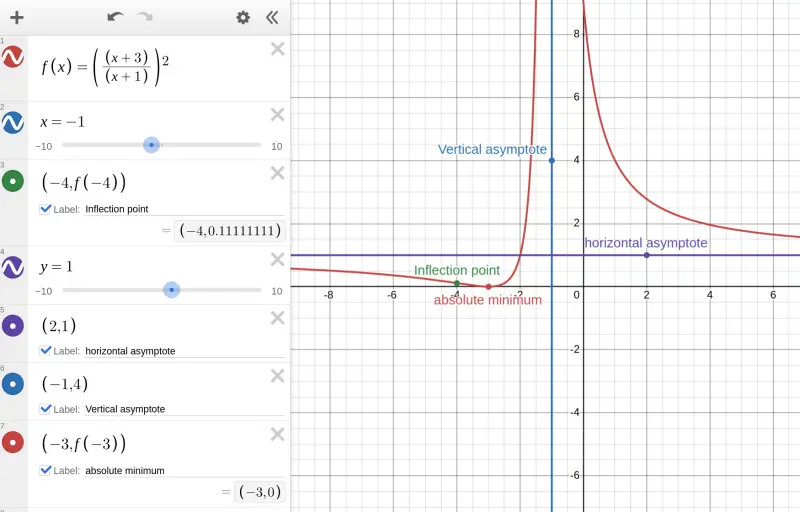
Sketch the graph of ff, labelling all asymptotes, extrema and points of inflection on your picture.

Exercise Tags

graphing

Tag:

Use the tag filtering feature on the course homepage to find all exercises with this tag.

Prerequisites for this Exercise

No prerequisite skills selected yet.

PREMIUM WALKTHROUGH

Unlock Premium Content

Get instant access to detailed walkthroughs, step-by-step explanations, and exclusive learning materials.

Unlock Now
Secure & Instant Access
Sketch the graph of ff, labelling all asymptotes, extrema and points of inflection on your picture.
PREMIUM SOLUTION

Unlock Premium Content

Get instant access to detailed solutions, step-by-step explanations, and exclusive learning materials.

Unlock Now
Secure & Instant Access

Graph of function

Figure: Graph of function