Practice Full Course (ID 17)

Full Course
McGill University, MATH 122

Exam Settings

Show Tags
Show Difficulty
Back to Course

Mcq Questions

MCQ
A1
Difficulty: 6/10
(Max Marks: 2)
Define f(x)=x0t2et6dt f(x) = \int_{-x}^{0} t^2 e^{-t^6} dt and g(x)=0xt2et6dt g(x) = \int_{0}^{x} t^2 e^{-t^6} dt , each with domain x[0,) x \in [0, \infty) . Which of the following is true? (Only one is true.)

(a) f(x)=g(x) f(x) = g(x) for all x[0,) x \in [0, \infty)
(b) f(x)=g(x) f'(x) = -g'(x) for all x[0,) x \in [0, \infty)
(c) f(x) f(x) is decreasing and g(x) g(x) is increasing on [0,) [0, \infty)
(d) f(x)=0 f(x) = 0 for all x[0,) x \in [0, \infty)
(e) f(x)<0 f(x) < 0 for all x(0,) x \in (0, \infty)

Exercise Tags

Fundamental Theorem of Calculus
Integrals: even/odd
Integrals: u-substitution

Tag:

Use the tag filtering feature on the course homepage to find all exercises with this tag.

Prerequisites for this Exercise

No prerequisite skills selected yet.

Step 1: Analyze the Integrand


Let h(t)=t2et6 h(t) = t^2 e^{-t^6} . Let's check if it's even or odd.
h(t)=(t)2e(t)6=t2et6=h(t) h(-t) = (-t)^2 e^{-(-t)^6} = t^2 e^{-t^6} = h(t)
Since h(t)=h(t) h(-t) = h(t) , the integrand h(t) h(t) is an even function.


Step 2: Relate f(x) and g(x) using Substitution


Consider f(x)=x0h(t)dt f(x) = \int_{-x}^{0} h(t) dt . Let's use the substitution u=t u = -t .
This means t=u t = -u and dt=du dt = -du .
We also change the limits of integration:
When t=x t = -x , u=(x)=x u = -(-x) = x .
When t=0 t = 0 , u=0=0 u = -0 = 0 .

Substitute into the integral for f(x) f(x) :
f(x)=u=xu=0h(u)(du) f(x) = \int_{u=x}^{u=0} h(-u) (-du)
Since h(t) h(t) is even, h(u)=h(u) h(-u) = h(u) .
f(x)=x0h(u)(du) f(x) = \int_{x}^{0} h(u) (-du)
Using the property ab=ba \int_a^b = -\int_b^a , we flip the limits and remove the negative sign from du -du :
f(x)=0xh(u)du f(x) = \int_{0}^{x} h(u) du

Now compare this to g(x)=0xh(t)dt g(x) = \int_{0}^{x} h(t) dt . Changing the variable of integration from t t to u u doesn't change the value.
Therefore, f(x)=0xh(u)du=g(x) f(x) = \int_{0}^{x} h(u) du = g(x) .

So, f(x)=g(x) f(x) = g(x) for all x x in the domain.


Step 3: Evaluate the Options


Based on the finding that f(x)=g(x) f(x) = g(x) :

(a) f(x)=g(x) f(x) = g(x) for all x[0,) x \in [0, \infty) . This is TRUE.

(b) f(x)=g(x) f'(x) = -g'(x) for all x[0,) x \in [0, \infty) . Since f(x)=g(x) f(x)=g(x) , their derivatives must be equal: f(x)=g(x) f'(x)=g'(x) . Let's find g(x) g'(x) using FTC Part 1: g(x)=ddx0xt2et6dt=x2ex6 g'(x) = \frac{d}{dx} \int_{0}^{x} t^2 e^{-t^6} dt = x^2 e^{-x^6} . So f(x)=x2ex6 f'(x) = x^2 e^{-x^6} . The statement f(x)=g(x) f'(x)=-g'(x) would imply x2ex6=x2ex6 x^2 e^{-x^6} = -x^2 e^{-x^6} , which is only true if x=0 x=0 . Thus, the statement is FALSE for x>0 x>0 .

(c) f(x) f(x) is decreasing and g(x) g(x) is increasing on [0,) [0, \infty) . We found f(x)=g(x)=x2ex6 f'(x) = g'(x) = x^2 e^{-x^6} . Since x20 x^2 \ge 0 and ex6>0 e^{-x^6} > 0 , both derivatives are non-negative (0 \ge 0 ). Therefore, both functions are increasing (or non-decreasing). FALSE.

(d) f(x)=0 f(x) = 0 for all x[0,) x \in [0, \infty) . This implies g(x)=0 g(x)=0 . But g(x)=0xt2et6dt g(x) = \int_{0}^{x} t^2 e^{-t^6} dt . The integrand t2et6 t^2 e^{-t^6} is strictly positive for t0 t \ne 0 . For x>0 x > 0 , g(x) g(x) is the integral of a positive function over an interval of positive length, so g(x)>0 g(x) > 0 . FALSE.

(e) f(x)<0 f(x) < 0 for all x(0,) x \in (0, \infty) . Since f(x)=g(x) f(x)=g(x) and we found g(x)>0 g(x) > 0 for x>0 x > 0 , this is FALSE.

The relationship between integrals of symmetric functions over symmetric limits is key. For an EVEN function h(t)h(t), x0h(t)dt=0xh(t)dt \int_{-x}^0 h(t) dt = \int_0^x h(t) dt . For an ODD function h(t)h(t), x0h(t)dt=0xh(t)dt \int_{-x}^0 h(t) dt = -\int_0^x h(t) dt .

The only true statement is (a).

Statement (a) is true: f(x)=g(x) \boxed{\text{Statement (a) is true: } f(x) = g(x)}
A2
Difficulty: 4/10
(Max Marks: 2)
Suppose that f(x) f(x) is an odd, continuous function and that 0<a<b 0 < a < b . Then abf(x)dx \int_{-a}^{b} f(x) dx is equal to:

(a) 0 0
(b) 20af(x)dx 2 \int_{0}^{a} f(x) dx
(c) abf(x)dx \int_{a}^{b} f(x) dx
(d) abf(x)dx \int_{-a}^{-b} f(x) dx
(e) abf(x)dx -\int_{a}^{b} f(x) dx

Exercise Tags

Integrals: even/odd
Splitting Integral

Tag:

Use the tag filtering feature on the course homepage to find all exercises with this tag.

Prerequisites for this Exercise

No prerequisite skills selected yet.

Step 1: Recall Properties of Odd Functions and Integrals


A function f f is odd if f(x)=f(x) f(-x) = -f(x) for all x x .
A key property for definite integrals of odd functions is:
For any odd continuous function f f , ccf(x)dx=0 \int_{-c}^{c} f(x) dx = 0 for any c c in its domain.
We are asked to evaluate abf(x)dx \int_{-a}^{b} f(x) dx where 0<a<b 0 < a < b .


Step 2: Split the Integral Strategically


We can split the interval of integration [a,b] [-a, b] into two parts in a way that lets us use the property mentioned above. Since a<a<b -a < a < b , we can split the integral at x=a x = a :
abf(x)dx=aaf(x)dx+abf(x)dx \int_{-a}^{b} f(x) dx = \int_{-a}^{a} f(x) dx + \int_{a}^{b} f(x) dx


Step 3: Apply the Odd Function Integral Property


The first part of the split integral is aaf(x)dx \int_{-a}^{a} f(x) dx .
Since f(x) f(x) is an odd function, we know that:
aaf(x)dx=0 \int_{-a}^{a} f(x) dx = 0


Step 4: Combine the Results


Substitute the result from Step 3 back into the split integral equation from Step 2:
abf(x)dx=0+abf(x)dx \int_{-a}^{b} f(x) dx = 0 + \int_{a}^{b} f(x) dx
abf(x)dx=abf(x)dx \int_{-a}^{b} f(x) dx = \int_{a}^{b} f(x) dx

This result matches option (c).


abf(x)dx=aaf(x)dx+abf(x)dx=0+abf(x)dx(since f is odd)=abf(x)dx
\begin{align*}
\int_{-a}^{b} f(x) dx &= \int_{-a}^{a} f(x) dx + \int_{a}^{b} f(x) dx \\
&= 0 + \int_{a}^{b} f(x) dx \quad (\text{since } f \text{ is odd}) \\
&= \boxed{\int_{a}^{b} f(x) dx}
\end{align*}

This result matches option (c).
A3
Difficulty: 5/10
(Max Marks: 2)
Find the area of the region enclosed by the curve y=x3 y = \sqrt[3]{x} , the y-axis, and the line y=3 y = 3 .

(a) 9 9
(b) 274 \frac{27}{4}
(c) 3 3
(d) 814 \frac{81}{4}
(e) 27 27

Exercise Tags

Area: General
Integrate wrt y

Tag:

Use the tag filtering feature on the course homepage to find all exercises with this tag.

Prerequisites for this Exercise

No prerequisite skills selected yet.

Step 1: Visualize and Define the Region


We need the area of the region bounded by the curve y=x3 y = \sqrt[3]{x} , the y-axis (which is the line x=0 x = 0 ), and the horizontal line y=3 y = 3 .
The curve y=x3 y = \sqrt[3]{x} passes through the origin (0,0) (0, 0) .
The region is bounded on the left by x=0 x = 0 , on the right by the curve, below by y=0 y = 0 (where the curve meets the y-axis), and above by y=3 y = 3 .

Since the region is defined by boundaries involving y y , it's convenient to integrate with respect to y.


Step 2: Express the Boundary Curve as x = f(y)


We need to express the right boundary curve in the form x=f(y) x = f(y) .

Given y=x3 y = \sqrt[3]{x} , we cube both sides to solve for x x :
x=y3 x = y^3

The left boundary is the y-axis, which has the equation x=0 x = 0 .


Step 3: Set Up the Integral for Area


When integrating with respect to y, the area between a right curve x=f(y) x = f(y) and a left curve x=g(y) x = g(y) from y=c y = c to y=d y = d is given by:
A=cd[f(y)g(y)]dy A = \int_c^d [f(y) - g(y)] dy


In our case:
The right curve is xright=y3 x_{right} = y^3 .
The left curve is xleft=0 x_{left} = 0 .
The limits of integration are the y-values defining the region's vertical extent, which are from y=0 y = 0 to y=3 y = 3 .

So, the integral for the area A A is:
A=03(y30)dy A = \int_0^3 (y^3 - 0) dy


Step 4: Calculate the Definite Integral


We evaluate the integral 03y3dy\int_0^3 y^3 dy.
The antiderivative of y3 y^3 is y44 \frac{y^4}{4} .
We evaluate this from y=0 y=0 to y=3 y=3 .

The result 81/4 81/4 corresponds to option (d).


A=03(y30)dy=03y3dy=[y44]03=(344)(044)=8140=814
\begin{align*}
A &= \int_0^3 (y^3 - 0) dy \\
&= \int_0^3 y^3 dy \\
&= \left[ \frac{y^4}{4} \right]_0^3 \\
&= \left( \frac{3^4}{4} \right) - \left( \frac{0^4}{4} \right) \\
&= \frac{81}{4} - 0 \\
&= \boxed{\frac{81}{4}}
\end{align*}

A=03(y30)dy=03y3dy=[y44]03=(344)(044)=8140=814
\begin{align*}
A &= \int_0^3 (y^3 - 0) dy \\
&= \int_0^3 y^3 dy \\
&= \left[ \frac{y^4}{4} \right]_0^3 \\
&= \left( \frac{3^4}{4} \right) - \left( \frac{0^4}{4} \right) \\
&= \frac{81}{4} - 0 \\
&= \boxed{\frac{81}{4}}
\end{align*}
A4
Difficulty: 3/10
(Max Marks: 2)
The integral 0r2π(r2x2)dx \int_0^r 2\pi (r^2 - x^2) dx computes:

(a) the volume of a sphere of radius r r .
(b) the area of a circle of radius r r .
(c) the surface area of a sphere of radius r r .
(d) the volume of a cylinder of height 2π 2\pi and radius r r .
(e) the circumference of a circle of radius r r .

Exercise Tags

integrals
Volume: Rotating Regions
Volume: Disks/Rings Method

Tag:

Use the tag filtering feature on the course homepage to find all exercises with this tag.

Prerequisites for this Exercise

No prerequisite skills selected yet.

Step 1: Analyze the Integrand and Context


The expression (r2x2) (r^2 - x^2) appears inside the integral. Recall the equation of a circle centered at the origin with radius r r : x2+y2=r2 x^2 + y^2 = r^2 . The upper semi-circle is given by y=r2x2 y = \sqrt{r^2 - x^2} .

The integral involves π(r2x2) \pi (r^2 - x^2) , which looks related to the disk method for finding volumes of revolution.

The volume of a solid generated by revolving the area under a curve y=f(x) y = f(x) from x=a x=a to x=b x=b around the x-axis is given by the disk method formula: V=abπ[f(x)]2dx V = \int_a^b \pi [f(x)]^2 dx .

Let's consider the function y=r2x2 y = \sqrt{r^2 - x^2} . If we revolve the area under this curve from x=0 x=0 to x=r x=r (which is a quarter-circle) around the x-axis, the volume generated is a hemisphere. Using the disk method, its volume would be:
Vhemi=0rπ(r2x2)2dx=0rπ(r2x2)dx V_{hemi} = \int_0^r \pi (\sqrt{r^2 - x^2})^2 dx = \int_0^r \pi (r^2 - x^2) dx


Step 2: Relate the Given Integral to the Geometric Formula


The integral in the question is 0r2π(r2x2)dx \int_0^r 2\pi (r^2 - x^2) dx .
We can factor out the 2: 20rπ(r2x2)dx 2 \int_0^r \pi (r^2 - x^2) dx .

Notice that 0rπ(r2x2)dx \int_0^r \pi (r^2 - x^2) dx is exactly the integral we identified as the volume of a hemisphere of radius r r .

Therefore, the given integral is 2×Vhemi 2 \times V_{hemi} .
Two hemispheres make a full sphere. So, the integral represents the volume of a sphere of radius r r .


Step 3: Confirm by Calculation (Optional but helpful)


We can directly calculate the integral to verify. The volume of a sphere is known to be 43πr3 \frac{4}{3}\pi r^3 . Let's see if the integral evaluates to this.

The calculation shows that the integral indeed equals the formula for the volume of a sphere. Therefore, the correct option is (a).


I=0r2π(r2x2)dx=2π0r(r2x2)dx=2π[r2xx33]0r=2π((r2(r)r33)(r2(0)033))=2π(r3r330)=2π(3r3r33)=2π(2r33)=43πr3
\begin{align*}
I &= \int_0^r 2\pi (r^2 - x^2) dx \\
&= 2\pi \int_0^r (r^2 - x^2) dx \\
&= 2\pi \left[ r^2x - \frac{x^3}{3} \right]_0^r \\
&= 2\pi \left( (r^2(r) - \frac{r^3}{3}) - (r^2(0) - \frac{0^3}{3}) \right) \\
&= 2\pi \left( r^3 - \frac{r^3}{3} - 0 \right) \\
&= 2\pi \left( \frac{3r^3 - r^3}{3} \right) \\
&= 2\pi \left( \frac{2r^3}{3} \right) \\
&= \boxed{\frac{4}{3}\pi r^3}
\end{align*}

(a)
A5
Difficulty: 1/10
(Max Marks: 2)
Find the average value of the function g(x)=sin(x)g(x) = \sin(x) on the interval [0,π][0, \pi].

(a) 1π \frac{1}{\pi}
(b) 2π \frac{2}{\pi}
(c) 2 2
(d) 0 0
(e) π2 \frac{\pi}{2}

Exercise Tags

Integrals: Average Value
integrals

Tag:

Use the tag filtering feature on the course homepage to find all exercises with this tag.

Prerequisites for this Exercise

No prerequisite skills selected yet.

Step 1: Recall the Formula for Average Value


The average value of a function f(x)f(x) over an interval [a,b][a, b] is given by the integral of the function over that interval, divided by the length of the interval.

The formula for the average value favgf_{avg} of a function ff on the interval [a,b][a, b] is:
favg=1baabf(x)dxf_{avg} = \frac{1}{b-a} \int_a^b f(x) dx


For our specific function g(x)=sin(x)g(x) = \sin(x) and the interval [0,π][0, \pi], we have a=0a=0 and b=πb=\pi.

So, we need to calculate:
gavg=1π00πsin(x)dxg_{avg} = \frac{1}{\pi - 0} \int_0^{\pi} \sin(x) dx


Step 2: Calculate the Definite Integral


First, we find the antiderivative of sin(x)\sin(x). The integral of sin(x)\sin(x) is cos(x)-\cos(x).

Next, we evaluate the definite integral 0πsin(x)dx\int_0^{\pi} \sin(x) dx using the Fundamental Theorem of Calculus.

We evaluate the antiderivative cos(x)-\cos(x) at the upper limit (x=πx=\pi) and subtract its value at the lower limit (x=0x=0).


Step 3: Calculate the Average Value


Now we substitute the value of the integral back into the average value formula.

Remember that the length of the interval is ba=π0=πb-a = \pi - 0 = \pi.

Divide the result of the integral (which is 2) by the length of the interval (π\pi) to get the average value.


gavg=1π00πsin(x)dx=1π0πsin(x)dx=1π[cos(x)]0π=1π((cos(π))(cos(0)))=1π(((1))((1)))=1π(1(1))=1π(1+1)=1π(2)=2π
\begin{align*}
g_{avg} &= \frac{1}{\pi - 0} \int_0^{\pi} \sin(x) dx \\
&= \frac{1}{\pi} \int_0^{\pi} \sin(x) dx \\
&= \frac{1}{\pi} \left[ -\cos(x) \right]_0^{\pi} \\
&= \frac{1}{\pi} \left( (-\cos(\pi)) - (-\cos(0)) \right) \\
&= \frac{1}{\pi} \left( (-(-1)) - (-(1)) \right) \\
&= \frac{1}{\pi} \left( 1 - (-1) \right) \\
&= \frac{1}{\pi} (1 + 1) \\
&= \frac{1}{\pi} (2) \\
&= \boxed{\frac{2}{\pi}}
\end{align*}

2π
\boxed{\frac{2}{\pi}}

True False Questions

True / False
B1
Difficulty: 1/10
Price pp and demand xx for a given product follow the rule

(1+x+x2)ep=1.(1 + x + x^2) e^p = 1.

What is the rate of change dpdx \frac{dp}{dx} when x=1x = 1?

(A) 1 -1

(B) ln(1/3) \ln(1/3)

(C) 1/3 -1/3

(D) 1/e -1/e

(E) None of the above \text{None of the above}

Exercise Tags

implicit differentiation

Tag:

Use the tag filtering feature on the course homepage to find all exercises with this tag.

Prerequisites for this Exercise

No prerequisite skills selected yet.

Step 1: Differentiate both sides implicitly with respect to xx


Using the product rule on the left side:

ddx((1+x+x2)ep)=ddx(1)
\frac{d}{dx} \left( (1 + x + x^2) e^p \right) = \frac{d}{dx}(1)


The derivative of the right side is:

ddx(1)=0
\frac{d}{dx}(1) = 0


Now apply the product rule to the left side:

ddx(1+x+x2)ep+(1+x+x2)ddx(ep)=0
\frac{d}{dx} \left( 1 + x + x^2 \right) \cdot e^p + (1 + x + x^2) \cdot \frac{d}{dx}(e^p) = 0


This simplifies to:

(1+2x)ep+(1+x+x2)epdpdx=0
(1 + 2x) e^p + (1 + x + x^2) e^p \frac{dp}{dx} = 0


Step 2: Solve for dpdx \frac{dp}{dx}


First, isolate the term with dpdx \frac{dp}{dx} :

(1+x+x2)epdpdx=(1+2x)ep
(1 + x + x^2) e^p \frac{dp}{dx} = -(1 + 2x) e^p


Now, divide both sides by (1+x+x2)ep (1 + x + x^2) e^p to get:

dpdx=1+2x1+x+x2
\frac{dp}{dx} = -\frac{1 + 2x}{1 + x + x^2}


Step 3: Evaluate at x=1x = 1


When x=1x = 1, the expression becomes:

dpdx=1+2(1)1+1+12=1+21+1+1=33=1
\frac{dp}{dx} = -\frac{1 + 2(1)}{1 + 1 + 1^2} = -\frac{1 + 2}{1 + 1 + 1} = -\frac{3}{3} = -1


Step 4: Final Answer


Thus, the rate of change dpdx \frac{dp}{dx} when x=1x = 1 is:

1
\boxed{-1}


The correct answer is:

(A)1
\boxed{(A) \, -1}
(A)1
\boxed{(A) \, -1}

Short Answer Questions

Short Answer
C1
Difficulty: 2/10
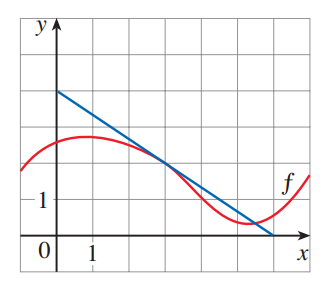
If g(x)=f(x) g(x) = \sqrt{f(x)} , where the graph of f f is shown, evaluate g(3) g'(3) .
Current Exercise Image

Exercise Tags

Review Lesson
Video Lesson
Chain Rule

Tag:

Use the tag filtering feature on the course homepage to find all exercises with this tag.

Prerequisites for this Exercise

No prerequisite skills selected yet.

Step 1: Use the Chain Rule


To evaluate g(3) g'(3) , we first need to find the derivative of g(x)=f(x) g(x) = \sqrt{f(x)} . We can rewrite this as g(x)=(f(x))1/2 g(x) = (f(x))^{1/2} . We must use the chain rule to find the derivative.
g(x)=12(f(x))1/2f(x)=f(x)2f(x)
\begin{aligned}
& \quad g'(x) \\
&= \frac{1}{2}(f(x))^{-1/2} \cdot f'(x) \\
&= \frac{f'(x)}{2\sqrt{f(x)}}
\end{aligned}


Step 2: Find Values from the Graph at x=3x=3


Next, we need to find two values from the provided graph: the value of the function f(3)f(3) and the slope of the tangent line f(3)f'(3) at x=3x=3.

From the graph, we can see that the red curve passes through the point (3,2)(3, 2).
f(3)=2
\begin{aligned}
& \quad f(3) \\
&= 2
\end{aligned}

The blue line is the tangent line to the curve at x=3x=3. We can find its slope by identifying two points on the line, for example, (0,4)(0, 4) and (3,2)(3, 2).
f(3)=2430=23
\begin{aligned}
& \quad f'(3) \\
&= \frac{2 - 4}{3 - 0} \\
&= \frac{-2}{3}
\end{aligned}


Step 3: Evaluate g(3)g'(3)


Now we substitute the values we found into the derivative formula from Step 1.
g(3)=f(3)2f(3)=2/322=2/322=132=13222=26
\begin{aligned}
& \quad g'(3) \\
&= \frac{f'(3)}{2\sqrt{f(3)}} \\
&= \frac{-2/3}{2\sqrt{2}} \\
&= \frac{-1}{3\sqrt{2}} \\
&= \frac{-1}{3\sqrt{2}} \cdot \frac{\sqrt{2}}{\sqrt{2}} \\
&= -\frac{\sqrt{2}}{6}
\end{aligned}


Final Answer


=26
\begin{aligned}
&= \boxed{-\frac{\sqrt{2}}{6}}
\end{aligned}
=26
\begin{aligned}
&= \boxed{-\frac{\sqrt{2}}{6}}
\end{aligned}
C2
Difficulty: 7/10
(Max Marks: 3)
Evaluate the following limit:
limt(t+4t1)t \lim_{t \to \infty} \left(\frac{t+4}{t-1}\right)^{t}

Exercise Tags

limits: general
Key Insight
limits: definition of exponential

Tag:

Use the tag filtering feature on the course homepage to find all exercises with this tag.

Prerequisites for this Exercise

No prerequisite skills selected yet.

Step 1: Analyze the limit and rewrite the base

First, notice that as tt \to \infty, the expression inside the parentheses approaches 1, while the exponent approaches \infty. This gives the indeterminate form 11^\infty, which often suggests that the limit involves the exponential function, ee. Our goal is to manipulate the expression to fit the standard form for the definition of ee. We can do this by rewriting the base, t+4t1\frac{t+4}{t-1}, into the form 1+something1 + \text{something}.

Step 2: Manipulate the expression to match the definition of e

By rewriting t+4t+4 as t1+5t-1+5, we can split the fraction. This isolates a '1' which is crucial for the next step.

limt(t+4t1)t=limt(t1+5t1)t=limt(t1t1+5t1)t=limt(1+5t1)t \begin{align*}
& \lim_{t \to \infty} \left(\frac{t+4}{t-1}\right)^{t} \\
&= \lim_{t \to \infty} \left(\frac{t-1+5}{t-1}\right)^{t} \\
&= \lim_{t \to \infty} \left(\frac{t-1}{t-1} + \frac{5}{t-1}\right)^{t} \\
&= \lim_{t \to \infty} \left(1 + \frac{5}{t-1}\right)^{t}
\end{align*}


The key formula to remember is the limit definition of the exponential function: limn(1+xn)n=ex \lim_{n \to \infty} \left(1 + \frac{x}{n}\right)^n = e^x . Our entire strategy is to make our limit look like this form.
Now that our limit looks very similar to the definition, we can use a substitution to make it match perfectly.

Step 3: Apply the substitution and evaluate the limit

Let n=t1n = t-1. As tt \to \infty, it's also true that nn \to \infty. From this substitution, we also have t=n+1t = n+1. After substituting, we can split the exponent using the property ab+c=abaca^{b+c} = a^b \cdot a^c. This allows us to separate the expression into two parts. The first part will match the definition of exe^x exactly, and the second part will be a simple limit to evaluate.

Let n=t1. As t,n.Also, t=n+1.limn(1+5n)n+1=limn[(1+5n)n(1+5n)1]=[limn(1+5n)n][limn(1+5n)]=(e5)(1+0)=e5 \begin{align*}
& \text{Let } n = t-1. \text{ As } t \to \infty, n \to \infty. \\
& \text{Also, } t = n+1. \\
& \lim_{n \to \infty} \left(1 + \frac{5}{n}\right)^{n+1} \\
&= \lim_{n \to \infty} \left[ \left(1 + \frac{5}{n}\right)^{n} \cdot \left(1 + \frac{5}{n}\right)^{1} \right] \\
&= \left[ \lim_{n \to \infty} \left(1 + \frac{5}{n}\right)^{n} \right] \cdot \left[ \lim_{n \to \infty} \left(1 + \frac{5}{n}\right) \right] \\
&= (e^5) \cdot (1+0) \\
&= \boxed{e^5}
\end{align*}


e5\boxed{e^5}
C3
Difficulty: 7/10
(Max Marks: 5)
For the improper integral below, either find its value or show that it diverges:
121x1dx \int_1^2 \frac{1}{x-1} dx

Exercise Tags

integrals
Integrals: Improper

Tag:

Use the tag filtering feature on the course homepage to find all exercises with this tag.

Prerequisites for this Exercise

No prerequisite skills selected yet.

Step 1: Identify the Discontinuity


The integrand is f(x)=1x1 f(x) = \frac{1}{x-1} .
This function has an infinite discontinuity (a vertical asymptote) when the denominator is zero, i.e., when x1=0 x-1 = 0 , which means x=1 x = 1 .
Since this discontinuity occurs at the lower limit of integration, this is a Type 2 improper integral.

Step 2: Write the Improper Integral as a Limit


To evaluate this improper integral, we replace the problematic lower limit with a variable (say, c c ) and take the limit as c c approaches 1 1 from the right side (since our interval is [1,2] [1, 2] , we approach 1 from within the interval):

121x1dx=limc1+c21x1dx \int_1^2 \frac{1}{x-1} dx = \lim_{c\to 1^+} \int_c^2 \frac{1}{x-1} dx

Step 3: Evaluate the Definite Integral


First, we find the antiderivative of 1x1 \frac{1}{x-1} .
Let u=x1 u = x-1 , then du=dx du = dx .
So, 1x1dx=1udu=lnu=lnx1 \int \frac{1}{x-1} dx = \int \frac{1}{u} du = \ln|u| = \ln|x-1| .

Now, evaluate the definite integral from c c to 2 2 :
c21x1dx=[lnx1]c2 \int_c^2 \frac{1}{x-1} dx = \left[ \ln|x-1| \right]_c^2
=ln21lnc1 = \ln|2-1| - \ln|c-1|
=ln(1)lnc1 = \ln(1) - \ln|c-1|
Since ln(1)=0 \ln(1) = 0 , this simplifies to:
=lnc1 = -\ln|c-1|

Since c1+ c \to 1^+ , c c is slightly greater than 1 1 , so c1 c-1 is a small positive number. Thus, c1=c1 |c-1| = c-1 .
So, the definite integral is ln(c1) -\ln(c-1) .

Step 4: Evaluate the Limit


Now we substitute this back into our limit expression:
L=limc1+(ln(c1)) L = \lim_{c\to 1^+} \left( -\ln(c-1) \right)

Let y=c1 y = c-1 . As c1+ c \to 1^+ , y0+ y \to 0^+ .
The limit becomes:
L=limy0+(ln(y)) L = \lim_{y\to 0^+} (-\ln(y))

We know that limy0+ln(y)= \lim_{y\to 0^+} \ln(y) = -\infty .
Therefore:
L=()=+ L = -(-\infty) = +\infty

When evaluating improper integrals with discontinuities, always rewrite them as a limit first. If the limit is \infty , -\infty , or does not exist, the integral diverges. If the limit is a finite number, the integral converges to that number.

Since the limit is \infty , the integral diverges.


121x1dx=limc1+c21x1dxFirst, find the antiderivative:1x1dx=lnx1Evaluate the definite integral part:c21x1dx=[lnx1]c2=ln21lnc1=ln(1)lnc1=0lnc1=lnc1Since c1+,c1>0, so c1=c1:=ln(c1)Now, evaluate the limit:limc1+(ln(c1))Let y=c1. As c1+,y0+.limy0+(ln(y))=()=+Therefore, the integral diverges.
\begin{align*}
\int_1^2 \frac{1}{x-1} dx &= \lim_{c\to 1^+} \int_c^2 \frac{1}{x-1} dx \\
\\
\text{First, find the antiderivative:} \\
\int \frac{1}{x-1} dx &= \ln|x-1| \\
\\
\text{Evaluate the definite integral part:} \\
\int_c^2 \frac{1}{x-1} dx &= \left[ \ln|x-1| \right]_c^2 \\
&= \ln|2-1| - \ln|c-1| \\
&= \ln(1) - \ln|c-1| \\
&= 0 - \ln|c-1| \\
&= -\ln|c-1| \\
\\
\text{Since } c \to 1^+, c-1 > 0, \text{ so } |c-1| = c-1: \\
&= -\ln(c-1) \\
\\
\text{Now, evaluate the limit:} \\
\lim_{c\to 1^+} \left( -\ln(c-1) \right) \\
\text{Let } y = c-1. \text{ As } c \to 1^+, y \to 0^+. \\
\lim_{y\to 0^+} (-\ln(y)) &= -(-\infty) \\
&= +\infty \\
\\
\text{Therefore, the integral } &\boxed{\text{diverges}}.
\end{align*}


121x1dx=limc1+c21x1dxFirst, find the antiderivative:1x1dx=lnx1Evaluate the definite integral part:c21x1dx=[lnx1]c2=ln21lnc1=ln(1)lnc1=0lnc1=lnc1Since c1+,c1>0, so c1=c1:=ln(c1)Now, evaluate the limit:limc1+(ln(c1))Let y=c1. As c1+,y0+.limy0+(ln(y))=()=+Therefore, the integral diverges.
\begin{align*}
\int_1^2 \frac{1}{x-1} dx &= \lim_{c\to 1^+} \int_c^2 \frac{1}{x-1} dx \\
\\
\text{First, find the antiderivative:} \\
\int \frac{1}{x-1} dx &= \ln|x-1| \\
\\
\text{Evaluate the definite integral part:} \\
\int_c^2 \frac{1}{x-1} dx &= \left[ \ln|x-1| \right]_c^2 \\
&= \ln|2-1| - \ln|c-1| \\
&= \ln(1) - \ln|c-1| \\
&= 0 - \ln|c-1| \\
&= -\ln|c-1| \\
\\
\text{Since } c \to 1^+, c-1 > 0, \text{ so } |c-1| = c-1: \\
&= -\ln(c-1) \\
\\
\text{Now, evaluate the limit:} \\
\lim_{c\to 1^+} \left( -\ln(c-1) \right) \\
\text{Let } y = c-1. \text{ As } c \to 1^+, y \to 0^+. \\
\lim_{y\to 0^+} (-\ln(y)) &= -(-\infty) \\
&= +\infty \\
\\
\text{Therefore, the integral } &\boxed{\text{diverges}}.
\end{align*}

C4
Difficulty: 7/10
(Max Marks: 5)
Evaluate the integral e2xex1dx \int \frac{e^{2x}}{\sqrt{e^x - 1}} dx .

Exercise Tags

differentiation: implicit
implicit differentiation

Tag:

Use the tag filtering feature on the course homepage to find all exercises with this tag.

Prerequisites for this Exercise

No prerequisite skills selected yet.

Step 1: Choose an Appropriate Substitution


The expression ex1 \sqrt{e^x - 1} in the denominator is a good candidate for substitution. Let's try substituting for the entire square root to simplify it.

Let u=ex1 u = \sqrt{e^x - 1} .
Squaring both sides gives u2=ex1 u^2 = e^x - 1 .
From this, we can express ex e^x in terms of u u : ex=u2+1 e^x = u^2 + 1 .

Now, we need to find dx dx in terms of du du . Differentiate ex=u2+1 e^x = u^2 + 1 implicitly with respect to x x for the left side and u u for the right side (or solve for xx first: x=ln(u2+1)x = \ln(u^2+1), then dx=2uu2+1dudx = \frac{2u}{u^2+1} du).
Using implicit differentiation on ex=u2+1 e^x = u^2 + 1 :
exdx=2udu e^x dx = 2u du .

We also need to express the numerator e2x e^{2x} in terms of u u .
e2x=(ex)2=(u2+1)2 e^{2x} = (e^x)^2 = (u^2 + 1)^2 .

Alternatively, we can write the integral as exexdxex1 \int \frac{e^x \cdot e^x dx}{\sqrt{e^x - 1}} . We already have exdx=2udu e^x dx = 2u du and ex=u2+1 e^x = u^2 + 1 . This approach seems more direct.

A common strategy for integrals involving aex+b \sqrt{a e^x + b} or similar expressions is to let u u be the entire square root, or the expression inside the square root. Letting u=ex1 u = \sqrt{e^x - 1} simplifies the denominator directly to u u .


Step 2: Substitute into the Integral


The integral is I=e2xex1dx=exexdxex1 I = \int \frac{e^{2x}}{\sqrt{e^x - 1}} dx = \int \frac{e^x \cdot e^x dx}{\sqrt{e^x - 1}} .
Substitute the expressions found in Step 1:
Numerator term ex=u2+1 e^x = u^2 + 1 .
Denominator ex1=u \sqrt{e^x - 1} = u .
Differential term exdx=2udu e^x dx = 2u du .

So, the integral becomes:
I=(u2+1)(2udu)u I = \int \frac{(u^2 + 1) (2u du)}{u}


Step 3: Simplify and Integrate with Respect to u


The u u in the numerator and denominator cancels out (assuming u0 u \ne 0 , which is true if ex1>0 e^x - 1 > 0 , i.e., x>0 x > 0 ):
I=2(u2+1)du I = \int 2(u^2 + 1) du
I=(2u2+2)du I = \int (2u^2 + 2) du

Now, find the antiderivative using the power rule for integration:
I=2u33+2u+C I = 2 \frac{u^3}{3} + 2u + C , where C C is the constant of integration.
I=23u3+2u+C I = \frac{2}{3}u^3 + 2u + C


Step 4: Substitute Back to the Original Variable x


Recall our substitution: u=ex1=(ex1)1/2 u = \sqrt{e^x - 1} = (e^x - 1)^{1/2} .
Substitute this back into the expression for I I :
I=23(ex1)3+2ex1+C I = \frac{2}{3}(\sqrt{e^x - 1})^3 + 2\sqrt{e^x - 1} + C
I=23(ex1)3/2+2(ex1)1/2+C I = \frac{2}{3}(e^x - 1)^{3/2} + 2(e^x - 1)^{1/2} + C

This is a correct answer, but it can be simplified by factoring out 2(ex1)1/2 2(e^x - 1)^{1/2} :
I=2(ex1)1/2[13(ex1)1+1]+C I = 2(e^x - 1)^{1/2} \left[ \frac{1}{3}(e^x - 1)^1 + 1 \right] + C
I=2ex1[ex13+33]+C I = 2\sqrt{e^x - 1} \left[ \frac{e^x - 1}{3} + \frac{3}{3} \right] + C
I=2ex1[ex1+33]+C I = 2\sqrt{e^x - 1} \left[ \frac{e^x - 1 + 3}{3} \right] + C
I=2ex1[ex+23]+C I = 2\sqrt{e^x - 1} \left[ \frac{e^x + 2}{3} \right] + C
I=23(ex+2)ex1+C I = \frac{2}{3}(e^x + 2)\sqrt{e^x - 1} + C

This is the simplified expression for the integral.


Let u=ex1u2=ex1ex=u2+1exdx=2udue2xex1dx=exexdxex1=(u2+1)(2udu)u=2(u2+1)du=(2u2+2)du=2u33+2u+C=23(ex1)3+2ex1+C=23(ex1)3/2+2(ex1)1/2+C=2(ex1)1/2[13(ex1)+1]+C=2ex1[ex1+33]+C=23(ex+2)ex1+C
\begin{align*}
\text{Let } u &= \sqrt{e^x - 1} \\
u^2 &= e^x - 1 \\
e^x &= u^2 + 1 \\
e^x dx &= 2u du \\
\int \frac{e^{2x}}{\sqrt{e^x - 1}} dx &= \int \frac{e^x \cdot e^x dx}{\sqrt{e^x - 1}} \\
&= \int \frac{(u^2+1)(2u du)}{u} \\
&= \int 2(u^2+1) du \\
&= \int (2u^2 + 2) du \\
&= 2\frac{u^3}{3} + 2u + C \\
&= \frac{2}{3}(\sqrt{e^x - 1})^3 + 2\sqrt{e^x - 1} + C \\
&= \frac{2}{3}(e^x - 1)^{3/2} + 2(e^x - 1)^{1/2} + C \\
&= 2(e^x - 1)^{1/2} \left[ \frac{1}{3}(e^x - 1) + 1 \right] + C \\
&= 2\sqrt{e^x - 1} \left[ \frac{e^x - 1 + 3}{3} \right] + C \\
&= \boxed{\frac{2}{3}(e^x + 2)\sqrt{e^x - 1} + C}
\end{align*}


Let u=ex1u2=ex1ex=u2+1exdx=2udue2xex1dx=exexdxex1=(u2+1)(2udu)u=2(u2+1)du=(2u2+2)du=2u33+2u+C=23(ex1)3+2ex1+C=23(ex1)3/2+2(ex1)1/2+C=2(ex1)1/2[13(ex1)+1]+C=2ex1[ex1+33]+C=23(ex+2)ex1+C
\begin{align*}
\text{Let } u &= \sqrt{e^x - 1} \\
u^2 &= e^x - 1 \\
e^x &= u^2 + 1 \\
e^x dx &= 2u du \\
\int \frac{e^{2x}}{\sqrt{e^x - 1}} dx &= \int \frac{e^x \cdot e^x dx}{\sqrt{e^x - 1}} \\
&= \int \frac{(u^2+1)(2u du)}{u} \\
&= \int 2(u^2+1) du \\
&= \int (2u^2 + 2) du \\
&= 2\frac{u^3}{3} + 2u + C \\
&= \frac{2}{3}(\sqrt{e^x - 1})^3 + 2\sqrt{e^x - 1} + C \\
&= \frac{2}{3}(e^x - 1)^{3/2} + 2(e^x - 1)^{1/2} + C \\
&= 2(e^x - 1)^{1/2} \left[ \frac{1}{3}(e^x - 1) + 1 \right] + C \\
&= 2\sqrt{e^x - 1} \left[ \frac{e^x - 1 + 3}{3} \right] + C \\
&= \boxed{\frac{2}{3}(e^x + 2)\sqrt{e^x - 1} + C}
\end{align*}

C5
Difficulty: 6/10
(Max Marks: 5)
Evaluate the integral x2sin(x)dx \int x^2 \sin(x) dx .

Exercise Tags

Integrals: logarithms
Integrals: Integration By Parts

Tag:

Use the tag filtering feature on the course homepage to find all exercises with this tag.

Prerequisites for this Exercise

No prerequisite skills selected yet.

Step 1: Apply Integration by Parts (First Time)


The formula for integration by parts is udv=uvvdu \int u dv = uv - \int v du .
We need to choose u u and dv dv . Using the LIATE (Logarithmic, Inverse trig, Algebraic, Trigonometric, Exponential) heuristic, we choose the algebraic part for u u .

Let u=x2 u = x^2 and dv=sin(x)dx dv = \sin(x) dx .
Then, we find du du and v v :
du=2xdx du = 2x dx
v=sin(x)dx=cos(x) v = \int \sin(x) dx = -\cos(x)

Now, apply the formula:
x2sin(x)dx=x2(cos(x))(cos(x))(2xdx) \int x^2 \sin(x) dx = x^2(-\cos(x)) - \int (-\cos(x))(2x dx)
=x2cos(x)+2xcos(x)dx = -x^2\cos(x) + 2 \int x\cos(x) dx

We now have a new integral, xcos(x)dx \int x\cos(x) dx , which also requires integration by parts.


Step 2: Apply Integration by Parts (Second Time)


For the integral xcos(x)dx \int x\cos(x) dx :
Let u2=x u_2 = x and dv2=cos(x)dx dv_2 = \cos(x) dx .
Then, we find du2 du_2 and v2 v_2 :
du2=dx du_2 = dx
v2=cos(x)dx=sin(x) v_2 = \int \cos(x) dx = \sin(x)

Apply the formula to this part:
xcos(x)dx=xsin(x)sin(x)dx \int x\cos(x) dx = x\sin(x) - \int \sin(x) dx
=xsin(x)(cos(x)) = x\sin(x) - (-\cos(x))
=xsin(x)+cos(x) = x\sin(x) + \cos(x)


Step 3: Substitute Back and Combine


Now substitute the result from Step 2 back into the expression from Step 1:
x2sin(x)dx=x2cos(x)+2(xsin(x)+cos(x))+C \int x^2 \sin(x) dx = -x^2\cos(x) + 2 \left( x\sin(x) + \cos(x) \right) + C
=x2cos(x)+2xsin(x)+2cos(x)+C = -x^2\cos(x) + 2x\sin(x) + 2\cos(x) + C
We can group the terms with cos(x) \cos(x) :
=(2x2)cos(x)+2xsin(x)+C = (2 - x^2)\cos(x) + 2x\sin(x) + C

When performing integration by parts multiple times, keep track of your substitutions and be careful with signs. The LIATE heuristic (Logarithmic, Inverse Trig, Algebraic, Trig, Exponential) is a good guide for choosing uu.


Let I=x2sin(x)dxFirst IBP: u=x2,dv=sin(x)dxdu=2xdx,v=cos(x)I=x2cos(x)(cos(x))(2xdx)=x2cos(x)+2xcos(x)dxSecond IBP for xcos(x)dx:u2=x,dv2=cos(x)dxdu2=dx,v2=sin(x)xcos(x)dx=xsin(x)sin(x)dx=xsin(x)(cos(x))=xsin(x)+cos(x)Substitute back: I=x2cos(x)+2(xsin(x)+cos(x))+C=x2cos(x)+2xsin(x)+2cos(x)+C=(2x2)cos(x)+2xsin(x)+C
\begin{align*}
\text{Let } I &= \int x^2 \sin(x) dx \\
\text{First IBP: } & u = x^2, \quad dv = \sin(x) dx \\
& du = 2x dx, \quad v = -\cos(x) \\
I &= -x^2\cos(x) - \int (-\cos(x))(2x dx) \\
&= -x^2\cos(x) + 2 \int x\cos(x) dx \\
\text{Second IBP for } \int x&\cos(x) dx: \quad u_2 = x, \quad dv_2 = \cos(x) dx \\
& du_2 = dx, \quad v_2 = \sin(x) \\
\int x\cos(x) dx &= x\sin(x) - \int \sin(x) dx \\
&= x\sin(x) - (-\cos(x)) \\
&= x\sin(x) + \cos(x) \\
\text{Substitute back: } \\
I &= -x^2\cos(x) + 2(x\sin(x) + \cos(x)) + C \\
&= -x^2\cos(x) + 2x\sin(x) + 2\cos(x) + C \\
&= \boxed{(2 - x^2)\cos(x) + 2x\sin(x) + C}
\end{align*}


Let I=(ln(x))2dxFirst IBP: u=(ln(x))2,dv=dxdu=2ln(x)1xdx,v=xI=x(ln(x))2x(2ln(x)1x)dx=x(ln(x))22ln(x)dxSecond IBP for ln(x)dx:u2=ln(x),dv2=dxdu2=1xdx,v2=xln(x)dx=xln(x)x1xdx=xln(x)1dx=xln(x)xSubstitute back: I=x(ln(x))22(xln(x)x)+C=x(ln(x))22xln(x)+2x+C
\begin{align*}
\text{Let } I &= \int (\ln(x))^2 dx \\
\text{First IBP: } & u = (\ln(x))^2, \quad dv = dx \\
& du = 2\ln(x) \cdot \frac{1}{x} dx, \quad v = x \\
I &= x(\ln(x))^2 - \int x \left(2\ln(x) \frac{1}{x}\right) dx \\
&= x(\ln(x))^2 - 2 \int \ln(x) dx \\
\text{Second IBP for } \int &\ln(x) dx: \quad u_2 = \ln(x), \quad dv_2 = dx \\
& du_2 = \frac{1}{x} dx, \quad v_2 = x \\
\int \ln(x) dx &= x\ln(x) - \int x \cdot \frac{1}{x} dx \\
&= x\ln(x) - \int 1 dx \\
&= x\ln(x) - x \\
\text{Substitute back: } \\
I &= x(\ln(x))^2 - 2(x\ln(x) - x) + C \\
&= \boxed{x(\ln(x))^2 - 2x\ln(x) + 2x + C}
\end{align*}

Long Answer Questions

Long Answer
D1
Difficulty: 8/10
(Max Marks: 10)
Let R be the region enclosed by the curves y=x y = x and y=x2 y = x^2 . Set up integrals for the volume obtained by rotating R about:
(a) the x-axis
(b) the y-axis
Do not evaluate the integrals.

Exercise Tags

Volume: Disks/Rings Method
Volume: Cylindrical Shells
Volume: Rotating Regions
Integrate wrt y

Tag:

Use the tag filtering feature on the course homepage to find all exercises with this tag.

Prerequisites for this Exercise

No prerequisite skills selected yet.

Step 1: Find the Intersection Points and Sketch the Region


First, we find the intersection points of y=x y = x and y=x2 y = x^2 :
Set the yy-values equal:
x=x2 x = x^2
x2x=0 x^2 - x = 0
x(x1)=0 x(x - 1) = 0
This gives x=0 x = 0 and x=1 x = 1 .

When x=0 x = 0 , y=0 y = 0 . So, one intersection point is (0,0) (0,0) .
When x=1 x = 1 , y=1 y = 1 . So, the other intersection point is (1,1) (1,1) .

These will be our limits of integration in xx.

Next, determine which function is the "upper" function and which is the "lower" function in the interval [0,1] [0, 1] .
Let's pick a test point, say x=0.5 x = 0.5 :
For y=x y = x : y=0.5 y = 0.5 .
For y=x2 y = x^2 : y=(0.5)2=0.25 y = (0.5)^2 = 0.25 .
Since 0.5>0.25 0.5 > 0.25 , the line y=x y = x is above the parabola y=x2 y = x^2 in the interval (0,1) (0, 1) .
So, yupper=x y_{upper} = x and ylower=x2 y_{lower} = x^2 .


(a) Volume of Revolution about the x-axis


For rotation about the x-axis, we can use the washer method.
The formula is V=πab(R(x)2r(x)2)dx V = \pi \int_a^b (R(x)^2 - r(x)^2) dx .
Here, the outer radius R(x) R(x) is the distance from the x-axis to the upper curve y=x y = x , so R(x)=x R(x) = x .
The inner radius r(x) r(x) is the distance from the x-axis to the lower curve y=x2 y = x^2 , so r(x)=x2 r(x) = x^2 .
The limits of integration are from x=0 x=0 to x=1 x=1 .

The setup for the integral is:
V=π01((x)2(x2)2)dx V = \pi \int_0^1 ((x)^2 - (x^2)^2) dx


(b) Volume of Revolution about the y-axis


For rotation about the y-axis, the cylindrical shells method is often more straightforward if our functions are already in the form y=f(x) y = f(x) .
The formula is V=2πab(shell radius)(shell height)dx V = 2\pi \int_a^b (\text{shell radius}) (\text{shell height}) dx .
Here, the radius of shell at a given x x is simply x x .
The height of shell at a given x x is h(x)=yupperylower=xx2 h(x) = y_{upper} - y_{lower} = x - x^2 .
The limits of integration are from x=0 x=0 to x=1 x=1 .

The setup for the integral is:
V=2π01x(xx2)dx V = 2\pi \int_0^1 x (x - x^2) dx

Alternatively, for part (b), you could use the washer method by integrating with respect to yy. This would require rewriting the functions as x=f(y) x = f(y) : x=yx = y and x=yx = \sqrt{y}. Then R(y)=yR(y) = \sqrt{y} and r(y)=yr(y) = y, with yy from 0 to 1. The integral would be V=π01((y)2(y)2)dy V = \pi \int_0^1 ((\sqrt{y})^2 - (y)^2) dy . Both methods (shells wrt x, or washers wrt y) are valid for rotation about the y-axis.


Summary of Set Up Integrals


(a) Rotation about the x-axis:

V=π01(x2x4)dx \boxed{V = \pi \int_0^1 (x^2 - x^4) dx}


(b) Rotation about the y-axis (using cylindrical shells):

V=2π01x(xx2)dxor equivalently V=2π01(x2x3)dx \boxed{V = 2\pi \int_0^1 x(x - x^2) dx} \quad \text{or equivalently } \quad \boxed{V = 2\pi \int_0^1 (x^2 - x^3) dx}

(Using washer method with respect to yy: V=π01(yy2)dy V = \pi \int_0^1 (y - y^2) dy )
(a) Rotation about the x-axis:

V=π01(x2x4)dx \boxed{V = \pi \int_0^1 (x^2 - x^4) dx}


(b) Rotation about the y-axis (using cylindrical shells):

V=2π01x(xx2)dxor equivalently V=2π01(x2x3)dx \boxed{V = 2\pi \int_0^1 x(x - x^2) dx} \quad \text{or equivalently } \quad \boxed{V = 2\pi \int_0^1 (x^2 - x^3) dx}

(Using washer method with respect to yy: V=π01(yy2)dy V = \pi \int_0^1 (y - y^2) dy )
D2
Difficulty: 6/10
(Max Marks: 10)
Find the area enclosed by the curves y=x2 y = x^2 and x=y2 x = y^2 .

Exercise Tags

integrals

Tag:

Use the tag filtering feature on the course homepage to find all exercises with this tag.

Prerequisites for this Exercise

No prerequisite skills selected yet.

Step 1: Express Both Curves as y = f(x)


The first curve is already in this form: y1=x2 y_1 = x^2 .
The second curve is x=y2 x = y^2 . To express y y in terms of x x , we take the square root: y=±x y = \pm \sqrt{x} .
Since y=x2 y = x^2 implies y0 y \ge 0 , the relevant part of y=±x y = \pm \sqrt{x} that can enclose an area with y=x2 y=x^2 is y2=x y_2 = \sqrt{x} (for x0 x \ge 0 ).
So, we are looking for the area between y=x2 y = x^2 and y=x y = \sqrt{x} .

Step 2: Find the Intersection Points


To find the intersection points, we set the expressions for y y equal to each other:
x2=x x^2 = \sqrt{x}
Square both sides (note: ensure x0 x \ge 0 for x \sqrt{x} to be real):
(x2)2=(x)2 (x^2)^2 = (\sqrt{x})^2
x4=x x^4 = x
x4x=0 x^4 - x = 0
Factor out x x :
x(x31)=0 x(x^3 - 1) = 0
This gives x=0 x = 0 or x31=0 x^3 - 1 = 0 .
x3=1    x=1 x^3 = 1 \implies x = 1 .

So, the curves intersect at x=0 x = 0 and x=1 x = 1 .
When x=0 x = 0 , y=02=0 y = 0^2 = 0 . Point: (0,0) (0,0) .
When x=1 x = 1 , y=12=1 y = 1^2 = 1 . Point: (1,1) (1,1) .
These are our limits of integration for x x .

Step 3: Determine the Upper and Lower Functions


In the interval [0,1] [0, 1] , we need to determine which function has greater y y -values (the upper function) and which has smaller y y -values (the lower function).
Let's pick a test point within the interval, for example, x=14 x = \frac{1}{4} .
For y1=x2 y_1 = x^2 : y1=(14)2=116 y_1 = \left(\frac{1}{4}\right)^2 = \frac{1}{16} .
For y2=x y_2 = \sqrt{x} : y2=14=12 y_2 = \sqrt{\frac{1}{4}} = \frac{1}{2} .
Since 12>116 \frac{1}{2} > \frac{1}{16} , the function y2=x y_2 = \sqrt{x} is the upper function, and y1=x2 y_1 = x^2 is the lower function on the interval [0,1] [0, 1] .

Step 4: Set Up the Definite Integral for the Area


The area A A between two curves yupper(x) y_{upper}(x) and ylower(x) y_{lower}(x) from x=a x = a to x=b x = b is given by:
A=ab(yupper(x)ylower(x))dx A = \int_a^b (y_{upper}(x) - y_{lower}(x)) dx
In our case, a=0 a=0 , b=1 b=1 , yupper(x)=x y_{upper}(x) = \sqrt{x} , and ylower(x)=x2 y_{lower}(x) = x^2 .
So, A=01(xx2)dx A = \int_0^1 (\sqrt{x} - x^2) dx .
We can rewrite x \sqrt{x} as x1/2 x^{1/2} .
A=01(x1/2x2)dx A = \int_0^1 (x^{1/2} - x^2) dx

Step 5: Evaluate the Integral


Now, we find the antiderivative using the power rule for integration (xndx=xn+1n+1 \int x^n dx = \frac{x^{n+1}}{n+1} ):
x1/2dx=x1/2+11/2+1=x3/23/2=23x3/2 \int x^{1/2} dx = \frac{x^{1/2 + 1}}{1/2 + 1} = \frac{x^{3/2}}{3/2} = \frac{2}{3}x^{3/2}
x2dx=x33 \int x^2 dx = \frac{x^3}{3}
So, the definite integral is:
A=[23x3/213x3]01 A = \left[ \frac{2}{3}x^{3/2} - \frac{1}{3}x^3 \right]_0^1
Evaluate at the upper limit x=1 x=1 :
23(1)3/213(1)3=23(1)13(1)=2313=13 \frac{2}{3}(1)^{3/2} - \frac{1}{3}(1)^3 = \frac{2}{3}(1) - \frac{1}{3}(1) = \frac{2}{3} - \frac{1}{3} = \frac{1}{3}
Evaluate at the lower limit x=0 x=0 :
23(0)3/213(0)3=00=0 \frac{2}{3}(0)^{3/2} - \frac{1}{3}(0)^3 = 0 - 0 = 0
Therefore, the area is:
A=130=13 A = \frac{1}{3} - 0 = \frac{1}{3}


A=01(xx2)dx=01(x1/2x2)dx=[x1/2+11/2+1x2+12+1]01=[x3/23/2x33]01=[23x3/213x3]01=(23(1)3/213(1)3)(23(0)3/213(0)3)=(2313)(00)=130=13
\begin{align*}
A &= \int_0^1 (\sqrt{x} - x^2) dx \\
&= \int_0^1 (x^{1/2} - x^2) dx \\
&= \left[ \frac{x^{1/2 + 1}}{1/2 + 1} - \frac{x^{2+1}}{2+1} \right]_0^1 \\
&= \left[ \frac{x^{3/2}}{3/2} - \frac{x^3}{3} \right]_0^1 \\
&= \left[ \frac{2}{3}x^{3/2} - \frac{1}{3}x^3 \right]_0^1 \\
&= \left( \frac{2}{3}(1)^{3/2} - \frac{1}{3}(1)^3 \right) - \left( \frac{2}{3}(0)^{3/2} - \frac{1}{3}(0)^3 \right) \\
&= \left( \frac{2}{3} - \frac{1}{3} \right) - (0 - 0) \\
&= \frac{1}{3} - 0 \\
&= \boxed{\frac{1}{3}}
\end{align*}


A=01(xx2)dx=01(x1/2x2)dx=[x1/2+11/2+1x2+12+1]01=[x3/23/2x33]01=[23x3/213x3]01=(23(1)3/213(1)3)(23(0)3/213(0)3)=(2313)(00)=130=13
\begin{align*}
A &= \int_0^1 (\sqrt{x} - x^2) dx \\
&= \int_0^1 (x^{1/2} - x^2) dx \\
&= \left[ \frac{x^{1/2 + 1}}{1/2 + 1} - \frac{x^{2+1}}{2+1} \right]_0^1 \\
&= \left[ \frac{x^{3/2}}{3/2} - \frac{x^3}{3} \right]_0^1 \\
&= \left[ \frac{2}{3}x^{3/2} - \frac{1}{3}x^3 \right]_0^1 \\
&= \left( \frac{2}{3}(1)^{3/2} - \frac{1}{3}(1)^3 \right) - \left( \frac{2}{3}(0)^{3/2} - \frac{1}{3}(0)^3 \right) \\
&= \left( \frac{2}{3} - \frac{1}{3} \right) - (0 - 0) \\
&= \frac{1}{3} - 0 \\
&= \boxed{\frac{1}{3}}
\end{align*}

D3
Difficulty: 1/10
(Max Marks: 10)
Find the volume of the solid resulting from rotating the region enclosed by the curves y=4x2 y = 4-x^2 and y=x+2 y = x+2 about the x-axis, using the method of cylindrical shells.

Exercise Tags

Volume: Cylindrical Shells
integrals
Integrals: u-substitution

Tag:

Use the tag filtering feature on the course homepage to find all exercises with this tag.

Prerequisites for this Exercise

No prerequisite skills selected yet.

Question: Find the volume of the solid resulting from rotating the region enclosed by the curves y=4x2 y = 4-x^2 and y=x+2 y = x+2 about the x-axis, using the method of cylindrical shells.

Step 1: Recall Formula for Cylindrical Shells (Rotation about x-axis)


When rotating a region about the x-axis and integrating with respect to y y , the Method of Cylindrical Shells uses the formula:
V=cd2π(radius)(height)dy V = \int_{c}^{d} 2\pi (\text{radius}) (\text{height}) \, dy

Here:
- The integration is over the y-interval [c,d] [c, d] covering the region.

- The radius of a shell at height y y is y y .

- The height (or width) of the shell is the horizontal distance across the region at height y y , i.e., xright(y)xleft(y) x_{right}(y) - x_{left}(y) .

Step 2: Express Curves as x(y) x(y) and Find y-Limits


We need to rewrite the boundary curves y=4x2 y = 4-x^2 and y=x+2 y = x+2 as functions of y y .

Line: y=x+2    xline=y2 y = x+2 \implies x_{line} = y-2 .

Parabola: y=4x2    x2=4y    x=±4y y = 4-x^2 \implies x^2 = 4-y \implies x = \pm \sqrt{4-y} .

The right branch is xparab,R=4y x_{parab, R} = \sqrt{4-y} .

The left branch is xparab,L=4y x_{parab, L} = -\sqrt{4-y} .

The intersection points found in Part A were (2,0) (-2, 0) and (1,3) (1, 3) .

The lowest y-value in the region is y=0 y=0 .

The highest y-value is y=4 y=4 , the vertex of the parabola.

We need to consider the shell height xrightxleft x_{right} - x_{left} across the range of y-values from 0 to 4.

- For y y between 0 and 3, the right boundary is the parabola (x=4y x = \sqrt{4-y} ) and the left boundary is the line (x=y2 x = y-2 ). Height h1(y)=4y(y2) h_1(y) = \sqrt{4-y} - (y-2) .

- For y y between 3 and 4, the region is bounded by the parabola branches. The right boundary is x=4y x = \sqrt{4-y} and the left boundary is x=4y x = -\sqrt{4-y} . Height h2(y)=4y(4y)=24y h_2(y) = \sqrt{4-y} - (-\sqrt{4-y}) = 2\sqrt{4-y} .

Because the function defining the left boundary changes at y=3 y=3 , we must split the integral into two parts.

The y-limits are c=0 c=0 and d=4 d=4 , but we split at y=3 y=3 .
V=032πyh1(y)dy+342πyh2(y)dy V = \int_{0}^{3} 2\pi y \cdot h_1(y) \, dy + \int_{3}^{4} 2\pi y \cdot h_2(y) \, dy

Step 3: Set Up the Integrals


Substitute the expressions for h1(y) h_1(y) and h2(y) h_2(y) :
V=032πy(4yy+2)dy+342πy(24y)dy V = \int_{0}^{3} 2\pi y (\sqrt{4-y} - y + 2) \, dy + \int_{3}^{4} 2\pi y (2\sqrt{4-y}) \, dy
V=2π03(y4yy2+2y)dy+4π34y4ydy V = 2\pi \int_{0}^{3} (y\sqrt{4-y} - y^2 + 2y) \, dy + 4\pi \int_{3}^{4} y\sqrt{4-y} \, dy

Step 4: Evaluate the Integral y4ydy \int y\sqrt{4-y} \, dy


Both parts involve the integral y4ydy \int y\sqrt{4-y} \, dy . Let's find its antiderivative using u-substitution.

Let u=4y u = 4-y . Then y=4u y = 4-u and dy=du dy = -du .
y4ydy=(4u)u(du)=(u4)u1/2du=(u3/24u1/2)du=u5/25/24u3/23/2+C=25u5/283u3/2+C \begin{align*} \int y\sqrt{4-y} \, dy &= \int (4-u)\sqrt{u} (-du) \\ &= \int (u-4)u^{1/2} \, du \\ &= \int (u^{3/2} - 4u^{1/2}) \, du \\ &= \frac{u^{5/2}}{5/2} - 4\frac{u^{3/2}}{3/2} + C \\ &= \frac{2}{5}u^{5/2} - \frac{8}{3}u^{3/2} + C \end{align*}
Substitute back u=4y u = 4-y :
y4ydy=25(4y)5/283(4y)3/2+C \int y\sqrt{4-y} \, dy = \frac{2}{5}(4-y)^{5/2} - \frac{8}{3}(4-y)^{3/2} + C
Let G(y)=25(4y)5/283(4y)3/2 G(y) = \frac{2}{5}(4-y)^{5/2} - \frac{8}{3}(4-y)^{3/2} .

Step 5: Evaluate the Definite Integrals


First part: V1=2π03(y4yy2+2y)dy V_1 = 2\pi \int_{0}^{3} (y\sqrt{4-y} - y^2 + 2y) \, dy
V1=2π[G(y)y33+y2]03=2π[(G(3)333+32)(G(0)033+02)] \begin{align*} V_1 &= 2\pi \left[ G(y) - \frac{y^3}{3} + y^2 \right]_{0}^{3} \\ &= 2\pi \left[ \left(G(3) - \frac{3^3}{3} + 3^2\right) - \left(G(0) - \frac{0^3}{3} + 0^2\right) \right] \end{align*}
We need G(3) G(3) and G(0) G(0) .
G(3)=25(43)5/283(43)3/2=25(1)5/283(1)3/2=2583=64015=3415 \begin{align*} G(3) &= \frac{2}{5}(4-3)^{5/2} - \frac{8}{3}(4-3)^{3/2} \\ &= \frac{2}{5}(1)^{5/2} - \frac{8}{3}(1)^{3/2} \\ &= \frac{2}{5} - \frac{8}{3} = \frac{6 - 40}{15} = -\frac{34}{15} \end{align*}
G(0)=25(40)5/283(40)3/2=25(45/2)83(43/2)=25(25)83(23)=25(32)83(8)=645643=64(3515)=12815 \begin{align*} G(0) &= \frac{2}{5}(4-0)^{5/2} - \frac{8}{3}(4-0)^{3/2} \\ &= \frac{2}{5}(4^{5/2}) - \frac{8}{3}(4^{3/2}) \\ &= \frac{2}{5}(2^5) - \frac{8}{3}(2^3) \\ &= \frac{2}{5}(32) - \frac{8}{3}(8) \\ &= \frac{64}{5} - \frac{64}{3} = 64\left(\frac{3-5}{15}\right) = -\frac{128}{15} \end{align*}
V1=2π[(3415273+9)(128150+0)]=2π[(34159+9)(12815)]=2π[3415+12815]=2π[9415]=188π15 \begin{align*} V_1 &= 2\pi \left[ \left(-\frac{34}{15} - \frac{27}{3} + 9\right) - \left(-\frac{128}{15} - 0 + 0\right) \right] \\ &= 2\pi \left[ \left(-\frac{34}{15} - 9 + 9\right) - \left(-\frac{128}{15}\right) \right] \\ &= 2\pi \left[ -\frac{34}{15} + \frac{128}{15} \right] \\ &= 2\pi \left[ \frac{94}{15} \right] = \frac{188\pi}{15} \end{align*}

Second part: V2=4π34y4ydy V_2 = 4\pi \int_{3}^{4} y\sqrt{4-y} \, dy
V2=4π[G(y)]34=4π[G(4)G(3)] \begin{align*} V_2 &= 4\pi [G(y)]_{3}^{4} \\ &= 4\pi [ G(4) - G(3) ] \end{align*}
We need G(4) G(4) .
G(4)=25(44)5/283(44)3/2=00=0 G(4) = \frac{2}{5}(4-4)^{5/2} - \frac{8}{3}(4-4)^{3/2} = 0 - 0 = 0
V2=4π[0(3415)]=4π(3415)=136π15 \begin{align*} V_2 &= 4\pi [ 0 - (-\frac{34}{15}) ] \\ &= 4\pi \left( \frac{34}{15} \right) = \frac{136\pi}{15} \end{align*}

Step 6: Calculate the Total Volume


The total volume is V=V1+V2 V = V_1 + V_2 .
V=188π15+136π15=(188+136)π15=324π15=108π5 \begin{align*} V &= \frac{188\pi}{15} + \frac{136\pi}{15} \\ &= \frac{(188 + 136)\pi}{15} \\ &= \frac{324\pi}{15} \\ &= \frac{108\pi}{5} \end{align*}
Note that this result, 108π5 \frac{108\pi}{5} , matches the volume calculated using the Washer Method in Part A, as expected.

Step 7: Conclusion for Part (b)


The volume of the solid obtained by rotating the region about the x-axis using the method of cylindrical shells is 108π5 \frac{108\pi}{5} .
V=108π5
\boxed{ V = \frac{108\pi}{5} }
V=108π5
\boxed{ V = \frac{108\pi}{5} }

Word Problem Questions

Word Problem
E1
Difficulty: 8/10
A spherical snowball is melting such that its radius is decreasing at a constant rate of 2 centimeters per hour. Find the rate at which its surface area and volume are decreasing when the radius is 10 centimeters.

Exercise Tags

differentiation: implicit
implicit differentiation

Tag:

Use the tag filtering feature on the course homepage to find all exercises with this tag.

Prerequisites for this Exercise

No prerequisite skills selected yet.

Step 1: Identify Knowns and Unknowns

We are given the rate at which the radius r r is changing:
drdt=2 cm/hr \frac{dr}{dt} = -2 \text{ cm/hr}
(The rate is negative because the radius is decreasing).
We need to find the rates at which the surface area A A and the volume V V are changing at the instant when the radius is r=10 r = 10 cm.
That is, we need to find dAdt \frac{dA}{dt} and dVdt \frac{dV}{dt} when r=10 r = 10 .

Step 2: Write Down Relevant Formulas

The formulas for the surface area and volume of a sphere with radius r r are:
Surface Area: A=4πr2 A = 4 \pi r^2
Volume: V=43πr3 V = \frac{4}{3} \pi r^3

Step 3: Differentiate with Respect to Time

Now, we differentiate both formulas with respect to time t t , using implicit differentiation because A A , V V , and r r are all functions of t t .

For Surface Area A=4πr2 A = 4 \pi r^2 :
ddt(A)=ddt(4πr2)dAdt=4π(2r)drdtdAdt=8πrdrdt \begin{align*}
\frac{d}{dt}(A) &= \frac{d}{dt}(4 \pi r^2) \\
\frac{dA}{dt} &= 4 \pi \cdot (2r) \cdot \frac{dr}{dt} \\
\frac{dA}{dt} &= 8 \pi r \frac{dr}{dt}
\end{align*}

For Volume V=43πr3 V = \frac{4}{3} \pi r^3 :
ddt(V)=ddt(43πr3)dVdt=43π(3r2)drdtdVdt=4πr2drdt \begin{align*}
\frac{d}{dt}(V) &= \frac{d}{dt}(\frac{4}{3} \pi r^3) \\
\frac{dV}{dt} &= \frac{4}{3} \pi \cdot (3r^2) \cdot \frac{dr}{dt} \\
\frac{dV}{dt} &= 4 \pi r^2 \frac{dr}{dt}
\end{align*}

When performing implicit differentiation with respect to time t t , remember that differentiating a term involving r r requires multiplying by drdt \frac{dr}{dt} . For example, ddt(rn)=nrn1drdt \frac{d}{dt}(r^n) = n r^{n-1} \frac{dr}{dt} . Similarly, ddt(A)=dAdt \frac{d}{dt}(A) = \frac{dA}{dt} and ddt(V)=dVdt \frac{d}{dt}(V) = \frac{dV}{dt} .

Step 4: Substitute Known Values and Solve for Surface Area Rate

Substitute r=10 r = 10 cm and drdt=2 \frac{dr}{dt} = -2 cm/hr into the equation for dAdt \frac{dA}{dt} :
dAdt=8πrdrdt=8π(10)(2)=160π \begin{align*}
\frac{dA}{dt} &= 8 \pi r \frac{dr}{dt} \\
&= 8 \pi (10) (-2) \\
&= -160 \pi
\end{align*}

The surface area is decreasing at a rate of 160π 160 \pi square centimeters per hour.

Step 5: Substitute Known Values and Solve for Volume Rate

Substitute r=10 r = 10 cm and drdt=2 \frac{dr}{dt} = -2 cm/hr into the equation for dVdt \frac{dV}{dt} :
dVdt=4πr2drdt=4π(10)2(2)=4π(100)(2)=800π \begin{align*}
\frac{dV}{dt} &= 4 \pi r^2 \frac{dr}{dt} \\
&= 4 \pi (10)^2 (-2) \\
&= 4 \pi (100) (-2) \\
&= -800 \pi
\end{align*}

The volume is decreasing at a rate of 800π 800 \pi cubic centimeters per hour.
Notice that the formula for dVdt \frac{dV}{dt} is 4πr2drdt 4 \pi r^2 \frac{dr}{dt} . Since the surface area A=4πr2 A = 4 \pi r^2 , we can also write dVdt=Adrdt \frac{dV}{dt} = A \frac{dr}{dt} . This sometimes provides a shortcut if the surface area is already known or easily calculated.

Final Answer

When the radius is 10 cm, the surface area is decreasing at a rate of 160π 160 \pi cm²/hr and the volume is decreasing at a rate of 800π 800 \pi cm³/hr.
dAdt=160π cm2/hr \boxed{ \frac{dA}{dt} = -160 \pi \text{ cm}^2/\text{hr} }
dVdt=800π cm3/hr \boxed{ \frac{dV}{dt} = -800 \pi \text{ cm}^3/\text{hr} }
dAdt=160π cm2/hr \boxed{ \frac{dA}{dt} = -160 \pi \text{ cm}^2/\text{hr} }
dVdt=800π cm3/hr \boxed{ \frac{dV}{dt} = -800 \pi \text{ cm}^3/\text{hr} }
E2
Difficulty: 1/10
An object moves on the curve defined by the implicit relation

4x3+y2+5x2y=0
4x^3 + y^2 + 5x^2 y = 0


When reaching x=1 x = 1 and y=4 y = -4 , the rate of change in the x x -direction is given by dxdt=3 \frac{dx}{dt} = 3 . What is dydt \frac{dy}{dt} at this point?

Exercise Tags

relates rates
differentiation: implicit

Tag:

Use the tag filtering feature on the course homepage to find all exercises with this tag.

Prerequisites for this Exercise

No prerequisite skills selected yet.

Step 1: Differentiate both sides with respect to t t


To find dydt \frac{dy}{dt} , we need to implicitly differentiate the equation with respect to t t , applying the chain rule to each term.

Starting with:

4x3+y2+5x2y=0
4x^3 + y^2 + 5x^2 y = 0


Differentiate each term with respect to t t :

ddt(4x3)+ddt(y2)+ddt(5x2y)=0
\frac{d}{dt}(4x^3) + \frac{d}{dt}(y^2) + \frac{d}{dt}(5x^2 y) = 0


Step 2: Differentiate each term


**First term**: ddt(4x3) \frac{d}{dt}(4x^3)

=43x2dxdt=12x2dxdt= 4 \cdot 3x^2 \cdot \frac{dx}{dt} = 12x^2 \frac{dx}{dt}

**Second term**: ddt(y2) \frac{d}{dt}(y^2)

=2ydydt= 2y \frac{dy}{dt}

**Third term**: ddt(5x2y) \frac{d}{dt}(5x^2 y)

Using the product rule:

=5(2xdxdty+x2dydt)=10xydxdt+5x2dydt
\begin{align}
&= 5 \left( 2x \frac{dx}{dt} \cdot y + x^2 \frac{dy}{dt} \right) \\
&= 10x y \frac{dx}{dt} + 5x^2 \frac{dy}{dt}
\end{align}


Step 3: Substitute into the differentiated equation


Now, combine all terms:


12x2dxdt+2ydydt+10xydxdt+5x2dydt=0
12x^2 \frac{dx}{dt} + 2y \frac{dy}{dt} + 10x y \frac{dx}{dt} + 5x^2 \frac{dy}{dt} = 0


Group the dydt \frac{dy}{dt} terms:

(2y+5x2)dydt=(12x2+10xy)dxdt
(2y + 5x^2) \frac{dy}{dt} = - (12x^2 + 10x y) \frac{dx}{dt}


Step 4: Substitute values for x=1 x = 1 , y=4 y = -4 , and dxdt=3 \frac{dx}{dt} = 3


Substitute x=1 x = 1 , y=4 y = -4 , and dxdt=3 \frac{dx}{dt} = 3 :
(2(4)+5(1)2)dydt=(12(1)2+10(1)(4))3
\begin{align}
&(2(-4) + 5(1)^2) \frac{dy}{dt} = \\
&- \left( 12(1)^2 + 10(1)(-4) \right) \cdot 3
\end{align}


Simplify each term:

(8+5)dydt=(1240)3
(-8 + 5) \frac{dy}{dt} = - (12 - 40) \cdot 3


3dydt=(28)3-3 \frac{dy}{dt} = -(-28) \cdot 3

3dydt=84-3 \frac{dy}{dt} = 84

Solve for dydt \frac{dy}{dt} :

dydt=843=28
\frac{dy}{dt} = \frac{84}{-3} = -28


dydt=28\boxed{\frac{dy}{dt} = -28}

Multi Part Questions

Multi-Part
F1
Difficulty: 1/10
(Max Marks: 6)
This question is presented in two parts. In Part (a), you will perform an algebraic manipulation involving polynomials. The result you obtain in Part (a) will then be directly used to help you evaluate the integral in Part (b).

Exercise Tags

Polynomial Long Division
Integrals: u-substitution
integrals: inverse trig
inverse trig functions

Tag:

Use the tag filtering feature on the course homepage to find all exercises with this tag.

Prerequisites for this Exercise

No prerequisite skills selected yet.

Sub-questions:

F1 Part a)
Difficulty: 1/10
(Max Marks: 3)
Use polynomial long division to write x3+5x22x+1=s(x)(x2+2)+r(x) x^3 + 5x^2 - 2x + 1 = s(x)(x^2 + 2) + r(x) for polynomials s(x) s(x) and r(x) r(x) with deg(r(x))<2 \text{deg}(r(x)) < 2 .

Exercise Tags

Polynomial Long Division

Tag:

Use the tag filtering feature on the course homepage to find all exercises with this tag.

Prerequisites for this Exercise

No prerequisite skills selected yet.

Step 1: Set up the Polynomial Long Division

We want to divide P(x)=x3+5x22x+1 P(x) = x^3 + 5x^2 - 2x + 1 by D(x)=x2+0x+2 D(x) = x^2 + 0x + 2 .
The initial setup is:
      ___________
x^2+2 | x^3 + 5x^2 - 2x + 1


Step 2: Perform the Long Division Algorithm Iteratively


1. First term of quotient: Divide the leading term of the dividend (x3 x^3 ) by the leading term of the divisor (x2 x^2 ): x3x2=x \frac{x^3}{x^2} = x . Write x x in the quotient area.
        x             
___________
x^2+2 | x^3 + 5x^2 - 2x + 1


2. First multiplication: Multiply the term x x by the entire divisor (x2+2 x^2 + 2 ): x(x2+2)=x3+2x x(x^2 + 2) = x^3 + 2x . Write this result below the dividend, aligning terms by power.
        x             
___________
x^2+2 | x^3 + 5x^2 - 2x + 1
x^3 + 2x


3. First subtraction: Subtract the result (x3+2x) (x^3 + 2x) from the dividend. Draw a line and write the result below. Remember to subtract corresponding terms: (x3x3=0) (x^3 - x^3 = 0) , (5x20x2=5x2) (5x^2 - 0x^2 = 5x^2) , (2x2x=4x) (-2x - 2x = -4x) . Bring down the next term (+1 +1 ) from the dividend.
        x             
___________
x^2+2 | x^3 + 5x^2 - 2x + 1
-(x^3 + 2x)
________________
5x^2 - 4x + 1


4. Second term of quotient: Divide the leading term of the new remainder (5x2 5x^2 ) by the leading term of the divisor (x2 x^2 ): 5x2x2=5 \frac{5x^2}{x^2} = 5 . Write +5 +5 in the quotient area.
        x   + 5       
___________
x^2+2 | x^3 + 5x^2 - 2x + 1
-(x^3 + 2x)
________________
5x^2 - 4x + 1


5. Second multiplication: Multiply the term +5 +5 by the divisor (x2+2 x^2 + 2 ): 5(x2+2)=5x2+10 5(x^2 + 2) = 5x^2 + 10 . Write this result below the current remainder, aligning terms.
        x   + 5       
___________
x^2+2 | x^3 + 5x^2 - 2x + 1
-(x^3 + 2x)
________________
5x^2 - 4x + 1
5x^2 + 10


6. Second subtraction: Subtract the result (5x2+10) (5x^2 + 10) from (5x24x+1) (5x^2 - 4x + 1) . Draw a line and write the final result. (5x25x2=0) (5x^2 - 5x^2 = 0) , (4x0x=4x) (-4x - 0x = -4x) , (110=9) (1 - 10 = -9) . The result is 4x9 -4x - 9 .
        x   + 5       <-- Quotient s(x)
___________
x^2+2 | x^3 + 5x^2 - 2x + 1
-(x^3 + 2x)
________________
5x^2 - 4x + 1
-(5x^2 + 10)
____________
-4x - 9 <-- Remainder r(x)

The degree of this result (4x9 -4x - 9 , degree 1) is less than the degree of the divisor (x2+2 x^2 + 2 , degree 2), so the algorithm stops.
Double-check each subtraction step carefully, especially handling signs and aligning terms correctly (like the +2x+2x under 2x-2x and +10+10 under +1+1).

Step 3: Identify Quotient and Remainder

From the final division layout:
The quotient is s(x)=x+5 s(x) = x + 5 .
The remainder is r(x)=4x9 r(x) = -4x - 9 .

The degree of r(x) r(x) is 1, which is less than the degree of the divisor (2 2 ). The condition is satisfied.

The result is: x3+5x22x+1=(x+5)(x2+2)+(4x9) x^3 + 5x^2 - 2x + 1 = (x + 5)(x^2 + 2) + (-4x - 9) .

Step 4: Conclusion


Using polynomial long division, we found the quotient s(x)=x+5 s(x) = x + 5 and the remainder r(x)=4x9 r(x) = -4x - 9 . The degree of r(x) r(x) is 1, which is less than 2.
So, x3+5x22x+1=(x+5)(x2+2)4x9 x^3 + 5x^2 - 2x + 1 = (x + 5)(x^2 + 2) - 4x - 9 .

Using polynomial long division, we found the quotient s(x)=x+5 s(x) = x + 5 and the remainder r(x)=4x9 r(x) = -4x - 9 . The degree of r(x) r(x) is 1, which is less than 2.
So, x3+5x22x+1=(x+5)(x2+2)4x9 x^3 + 5x^2 - 2x + 1 = (x + 5)(x^2 + 2) - 4x - 9 .
F1 Part b)
Difficulty: 1/10
(Max Marks: 3)
Use the result from Part A (x3+5x22x+1x2+2=(x+5)+4x9x2+2 \frac{x^3 + 5x^2 - 2x + 1}{x^2 + 2} = (x + 5) + \frac{-4x - 9}{x^2 + 2} ) to find x3+5x22x+1x2+2dx \int \frac{x^3 + 5x^2 - 2x + 1}{x^2 + 2} \, dx .

Exercise Tags

integrals
Integrals: Improper
Integrals: u-substitution

Tag:

Use the tag filtering feature on the course homepage to find all exercises with this tag.

Prerequisites for this Exercise

No prerequisite skills selected yet.

Step 1: Rewrite the Integral using the Result from Part A

Using the quotient s(x)=x+5 s(x) = x+5 and remainder r(x)=4x9 r(x) = -4x-9 found previously, we rewrite the integrand:
x3+5x22x+1x2+2dx=((x+5)+4x9x2+2)dx \begin{align*}
& \int \frac{x^3 + 5x^2 - 2x + 1}{x^2 + 2} \, dx \\
&= \int \left( (x + 5) + \frac{-4x - 9}{x^2 + 2} \right) \, dx
\end{align*}

We can split this into the sum of two integrals:
=(x+5)dx+4x9x2+2dx
= \int (x + 5) \, dx + \int \frac{-4x - 9}{x^2 + 2} \, dx


Step 2: Integrate the Polynomial Part

The first integral is a simple polynomial integration:
(x+5)dx=x22+5x+C1 \begin{align}
& \int (x + 5) \, dx \\
&= \frac{x^2}{2} + 5x + C_1
\end{align}


Step 3: Integrate the Rational Part

The second integral involves the proper rational function 4x9x2+2 \frac{-4x - 9}{x^2 + 2} . Since the denominator x2+2 x^2+2 is an irreducible quadratic, we split the fraction based on the derivative of the denominator and a constant term. The derivative of x2+2 x^2+2 is 2x 2x .
4x9x2+2dx=(4xx2+2+9x2+2)dx=4xx2+2dx91x2+2dx \begin{align*}
& \int \frac{-4x - 9}{x^2 + 2} \, dx \\
&= \int \left( \frac{-4x}{x^2 + 2} + \frac{-9}{x^2 + 2} \right) \, dx \\
&= -4 \int \frac{x}{x^2 + 2} \, dx - 9 \int \frac{1}{x^2 + 2} \, dx
\end{align*}

This split is strategic: the first part (xx2+2 \propto \frac{x}{x^2+2} ) can be solved with a u-substitution for the denominator, leading to a logarithm. The second part (1x2+2 \propto \frac{1}{x^2+2} ) matches the arctangent integration form.

Step 3a: Evaluate xx2+2dx \int \frac{x}{x^2 + 2} \, dx

Use u-substitution. Let u=x2+2 u = x^2 + 2 . Then du=2xdx du = 2x \, dx , which means xdx=12du x \, dx = \frac{1}{2} du .
xx2+2dx=1u(12du)=121udu=12lnu+C2=12ln(x2+2)+C2 \begin{align*}
& \int \frac{x}{x^2 + 2} \, dx \\
&= \int \frac{1}{u} \left( \frac{1}{2} du \right) \\
&= \frac{1}{2} \int \frac{1}{u} \, du \\
&= \frac{1}{2} \ln|u| + C_2 \\
&= \frac{1}{2} \ln(x^2 + 2) + C_2
\end{align*}

(Absolute value is dropped since x2+2 x^2+2 is always positive).
Therefore, the first part of the rational integral evaluates to 4xx2+2dx=2ln(x2+2) -4 \int \frac{x}{x^2 + 2} \, dx = -2 \ln(x^2 + 2) .

Step 3b: Evaluate 1x2+2dx \int \frac{1}{x^2 + 2} \, dx

This matches the arctangent integration formula 1v2+a2dv=1aarctan(va)+C \int \frac{1}{v^2 + a^2} \, dv = \frac{1}{a} \arctan(\frac{v}{a}) + C .
Here, v=x v = x and a2=2 a^2 = 2 , so a=2 a = \sqrt{2} .
1x2+2dx=1x2+(2)2dx=12arctan(x2)+C3 \begin{align*}
& \int \frac{1}{x^2 + 2} \, dx \\
&= \int \frac{1}{x^2 + (\sqrt{2})^2} \, dx \\
&= \frac{1}{\sqrt{2}} \arctan\left(\frac{x}{\sqrt{2}}\right) + C_3
\end{align*}

Therefore, the second part of the rational integral evaluates to 91x2+2dx=92arctan(x2) -9 \int \frac{1}{x^2 + 2} \, dx = -\frac{9}{\sqrt{2}} \arctan\left(\frac{x}{\sqrt{2}}\right) .

Step 4: Combine All Parts

Combine the results from Step 2, Step 3a, and Step 3b. Don't forget a single constant of integration C C at the end. The integral is:
x3+5x22x+1x2+2dx=(x22+5x)+(2ln(x2+2))+(92arctan(x2))+C \begin{align*}
& \int \frac{x^3 + 5x^2 - 2x + 1}{x^2 + 2} \, dx \\
&= \left( \frac{x^2}{2} + 5x \right) \\
&\quad + \left( -2 \ln(x^2 + 2) \right) \\
&\quad + \left( -\frac{9}{\sqrt{2}} \arctan\left(\frac{x}{\sqrt{2}}\right) \right) + C
\end{align*}


Step 5: Conclusion


The integral evaluates to:
x22+5x2ln(x2+2)92arctan(x2)+C \begin{align*}
&\frac{x^2}{2} + 5x - 2 \ln(x^2 + 2) \\
&\quad - \frac{9}{\sqrt{2}} \arctan\left(\frac{x}{\sqrt{2}}\right) + C
\end{align*}


The integral evaluates to:
x22+5x2ln(x2+2)92arctan(x2)+C \begin{align*}
&\frac{x^2}{2} + 5x - 2 \ln(x^2 + 2) \\
&\quad - \frac{9}{\sqrt{2}} \arctan\left(\frac{x}{\sqrt{2}}\right) + C
\end{align*}

F2
Difficulty: 10/10
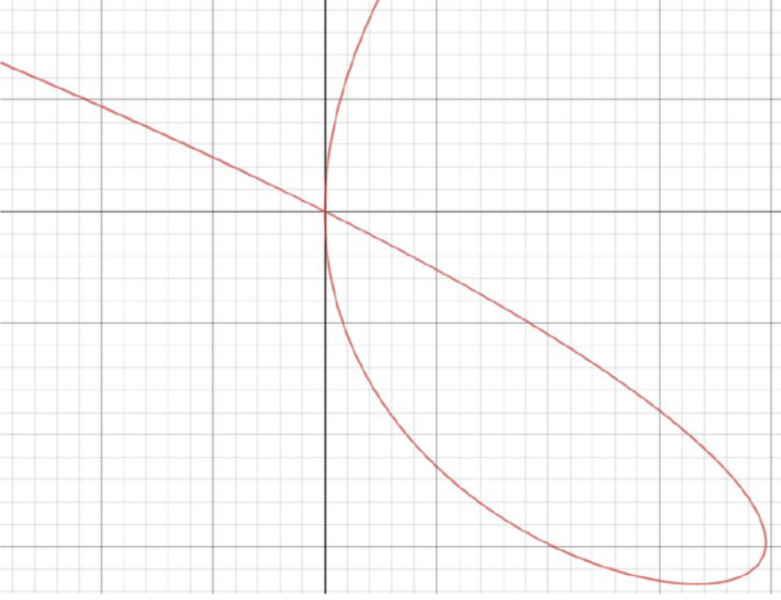
The graph of the curve defined by the implicit equation

3y32xy=x23y^3 - 2xy = x^2

is given.
Current Exercise Image

Exercise Tags

Curve Sketching

Tag:

Use the tag filtering feature on the course homepage to find all exercises with this tag.

Prerequisites for this Exercise

No prerequisite skills selected yet.

Sub-questions:

F2 Part a)
Difficulty: 1/10
Find dydx \frac{dy}{dx} .

Exercise Tags

differentiation: implicit

Tag:

Use the tag filtering feature on the course homepage to find all exercises with this tag.

Prerequisites for this Exercise

No prerequisite skills selected yet.

Step 1: Implicitly differentiate both sides with respect to x x


We start with the implicit equation:

3y32xy=x2
3y^3 - 2xy = x^2


Differentiate both sides with respect to x x . For terms involving y y , we will use the chain rule because y y is a function of x x .

ddx(3y3)ddx(2xy)=ddx(x2)
\frac{d}{dx}(3y^3) - \frac{d}{dx}(2xy) = \frac{d}{dx}(x^2)


**First term**: ddx(3y3) \frac{d}{dx}(3y^3)

Using the chain rule:

ddx(3y3)=9y2dydx
\frac{d}{dx}(3y^3) = 9y^2 \cdot \frac{dy}{dx}


**Second term**: ddx(2xy) \frac{d}{dx}(2xy)

Using the product rule:

ddx(2xy)=2(xddx(y)+yddx(x))=2(xdydx+y)
\frac{d}{dx}(2xy) = 2 \left( x \frac{d}{dx}(y) + y \frac{d}{dx}(x) \right) = 2 \left( x \frac{dy}{dx} + y \right)


**Third term**: ddx(x2) \frac{d}{dx}(x^2)

ddx(x2)=2x\frac{d}{dx}(x^2) = 2x

Now, putting everything together:

9y2dydx2(xdydx+y)=2x
9y^2 \cdot \frac{dy}{dx} - 2 \left( x \frac{dy}{dx} + y \right) = 2x


Step 2: Solve for dydx \frac{dy}{dx}


Distribute the 2 -2 :

9y2dydx2xdydx2y=2x
9y^2 \cdot \frac{dy}{dx} - 2x \cdot \frac{dy}{dx} - 2y = 2x


Now group terms involving dydx \frac{dy}{dx} :

(9y22x)dydx=2x+2y
(9y^2 - 2x) \frac{dy}{dx} = 2x + 2y


Solve for dydx \frac{dy}{dx} :

dydx=2x+2y9y22x
\boxed{\frac{dy}{dx} = \frac{2x + 2y}{9y^2 - 2x}}
dydx=2x+2y9y22x
\boxed{\frac{dy}{dx} = \frac{2x + 2y}{9y^2 - 2x}}
F2 Part b)
Difficulty: 1/10
Find the equation in the form y=mx+c y = mx + c of the tangent line at (3,1) (-3, 1) .

Exercise Tags

point slope form

Tag:

Use the tag filtering feature on the course homepage to find all exercises with this tag.

Prerequisites for this Exercise

No prerequisite skills selected yet.

Step 1: Use the derivative from part (a)


From part (a), we found the derivative of the curve to be:

dydx=2x+2y9y22x
\frac{dy}{dx} = \frac{2x + 2y}{9y^2 - 2x}


We need to find the slope of the tangent line at (3,1) (-3, 1) .

Substitute x=3 x = -3 and y=1 y = 1 into the derivative:

dydx=2(3)+2(1)9(1)22(3)
\frac{dy}{dx} = \frac{2(-3) + 2(1)}{9(1)^2 - 2(-3)}


Simplify:

dydx=6+29+6=415
\frac{dy}{dx} = \frac{-6 + 2}{9 + 6} = \frac{-4}{15}


Thus, the slope of the tangent line at (3,1) (-3, 1) is m=415 m = \frac{-4}{15} .

Step 2: Use the point-slope form to find the equation of the tangent line


The point-slope form of the equation of a line is:

yy1=m(xx1)
y - y_1 = m(x - x_1)


Substitute the point (3,1) (-3, 1) and the slope m=415 m = \frac{-4}{15} :

y1=415(x(3))
y - 1 = \frac{-4}{15}(x - (-3))


Simplify:

y1=415(x+3)
y - 1 = \frac{-4}{15}(x + 3)


Step 3: Convert to slope-intercept form


Now, expand the equation:

y1=415x45
y - 1 = \frac{-4}{15}x - \frac{4}{5}


Add 1 to both sides to solve for y y :

y=415x45+1
y = \frac{-4}{15}x - \frac{4}{5} + 1


Simplify:

y=415x+15
y = \frac{-4}{15}x + \frac{1}{5}


Thus, the equation of the tangent line is:

y=415x+15
\boxed{y = \frac{-4}{15}x + \frac{1}{5}}
y=415x+15
\boxed{y = \frac{-4}{15}x + \frac{1}{5}}